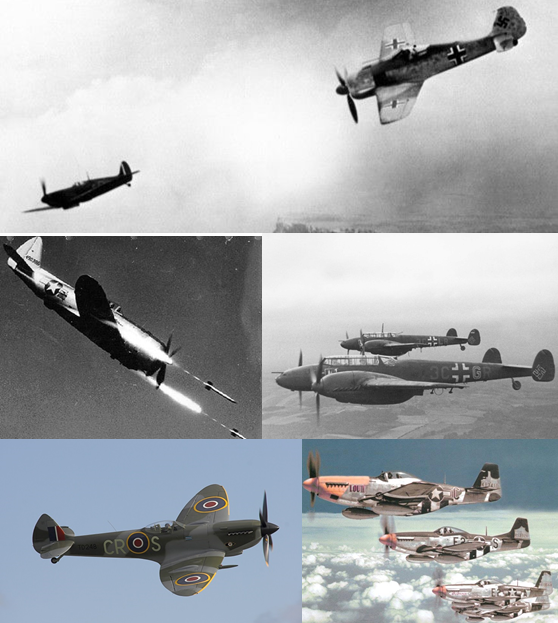
World War II was a crucible that forever transformed fighter aviation. From the rugged Hurricane and elegant Spitfire, to the pioneering Me 262 and superb P-51, various fighters reflected their nation’s technology, doctrine, and industrial capacity. They showcased the full range of human ingenuity, from the nimble A6M Zero to the indestructible P-47, from the jet-age Me 262 to the rugged La-5. Their legacy shaped postwar aviation, and led directly to the Cold War’s jet fighters. Those machines, and the men who flew them, defined air combat in the twentieth century. Below, in chronological order, are some fascinating facts about WWII’s twenty greatest fighters.
20. Messerschmitt Bf 109

The Messerschmitt Bf 109 was Germany’s most iconic fighter of World War II. It was also the backbone of the Luftwaffe’s fighter arm, the Jagdwaffe. Designed by Willy Messerschmitt, it was introduced in the mid-1930s. The Bf 109 combined a lightweight airframe, a powerful Daimler-Benz engine, and excellent aerodynamic efficiency. During the Spanish Civil War, the Bf 109 demonstrated the effectiveness of the monoplane fighter design. That set the stage for its dominance in early WWII. By 1940, the 109E “Emil” was Germany’s primary fighter.
The Bf 109 was the Luftwaffe’s main fighter during the Battle of Britain, where it faced the Spitfire and Hurricane. However, its limited range was a handicap when operating over England. Later variants like the Bf 109F “Friedrich” and 109G “Gustav” improved performance with more powerful engines and armament. However, that came at the cost of handling. Although it was gradually outclassed by Allied fighters, the Bf 109 remained in service until the war’s end. More than 33,000 were built, making it one of history’s most produced fighters.
19. Hawker Hurricane

The Hawker Hurricane is an often overlooked and unsung hero of WWII. It was the Royal Air Force’s workhorse fighter during the Battle of Britain. Though often overshadowed by the sleeker Spitfire, the Hurricane actually scored more kills during the battle. Designed by Sydney Camm, it featured a fabric-covered fuselage and a metal wing structure. It was an evolutionary step between biplanes and modern monoplanes. Armed with eight .303 Browning machine guns, the Hurricane was rugged and easy to repair. Those were vital qualities during the desperate summer of 1940.
The Hurricane excelled at intercepting bombers, while Spitfires tackled their fighter escorts. Beyond the Battle of Britain, Hurricanes served in North Africa, the Soviet Union, and Burma, where their durability proved invaluable. Variants included the Hurricane Mk IIC, equipped with 20 mm cannons, and the Hurricane IID, an effective tank-buster armed with 40 mm anti-tank guns. While gradually replaced by newer designs, over 14,000 Hurricanes were built. The aircraft embodied Britain’s resilience – a dependable, unsung hero that bore the brunt of early air combat.
18. Messerschmitt BF 110

The Messerschmitt Bf 110 was conceived as a twin engine heavy fighter, or Zerstorer. It was to complement the Bf 109 and serve in the role of long-range bomber escort and bomber destroyer. Fast and heavily armed, it excelled early in WWII during the invasions of Poland and France, against limited enemy opposition. However, during the Battle of Britain, the Bf 110’s weaknesses were unmasked. It became clear that it lacked the maneuverability to compete with nimble British single-engine fighters like the Spitfire and Hurricane.
Nonetheless, the Bf 110 found renewed purpose later in the war. As night bombing over the Third Reich intensified, it became a highly effective night fighter. Especially when equipped with radar and flown by skilled pilots such as Major Heinz-Wolfgang Schnaufer, WWII’s top-scoring night-fighter ace. The Bf 110’s long range and heavy armament made it well suited for intercepting RAF bombers at night. Although the original “destroyer” concept failed, the Bf 110’s adaptability ensured it remained valuable until 1945. Over 6,000 were built, demonstrating its persistence as a multi-role platform despite early setbacks.
17. Supermarine Spitfire

The Supermarine Spitfire was not just Britain’s most iconic airplane of WWII. It was one of the most iconic fighters in all of aviation history. Designed by R. J. Mitchell, it combined graceful lines with outstanding aerodynamics. That was largely due to its elliptical wing, which provided both speed and maneuverability. It entered service in 1938, and became Britain’s primary fighter throughout WWII. During the Battle of Britain, Spitfires engaged Luftwaffe fighters while Hurricanes targeted bombers. The Spitfire’s agility and speed allowed it to match or surpass the Messerschmitt Bf 109.
Continuous improvements kept Spitfires competitive throughout the war. Successive variants from the Mk I to the Mk XIV saw more powerful Rolls-Royce Merlin and Griffon engines, increased armament, and enhanced high-altitude performance. The Spitfire also served across multiple theaters, including North Africa, the Mediterranean, and the Pacific. It evolved into reconnaissance and naval variants, demonstrating remarkable versatility. Over 20,000 Spitfires were built. It was a symbol of British engineering, as well as the spirit of defiance that carried the Allies through the war.
16. Grumman F4F Wildcat

The Grumman F4F Wildcat was the US Navy’s primary carrier fighter during the early Pacific War. Introduced in 1940, it faced daunting odds against the Japanese Mitsubishi A6M Zero, which outperformed it in speed and maneuverability. However, the Wildcat was able to partially compensate for its shortcomings with remarkable durability, rugged construction, and superior tactics. US pilots trained to use maneuvers such as the “Thach Weave” to counter the Zero’s agility. Working together, Wildcat aviators were able to keep the nimbler Japanese Zeros off of each others’ backs.
The Wildcat’s had armor and self-sealing fuel tanks. That, combined with a heavy armament of six .50-caliber machine guns gave it staying power that the fragile Zero lacked. Wildcats defended Midway, Guadalcanal, and the Solomon Islands, helping turn the tide of the Pacific air war. Although later replaced by the Hellcat and Corsair, the Wildcat continued service on escort carriers throughout the war. It became a symbol of resilience – an underdog that fought and won through toughness, teamwork, and pilot ingenuity. Over 7,800 Wildcats were built, marking Grumman’s rise as America’s foremost naval aircraft producer.
15. Bell P-39 Airacobra

The Bell P-39 Airacobra was one of the most unusual fighters of WWII. It featured a mid-engine layout with its Allison engine mounted behind the pilot, and a 37 mm cannon that fired through the propeller hub. It was initially designed with a turbo-supercharger, but that feature was removed for cost and simplicity reasons. That had a negative impact on its performance, and limited its high-altitude capability. The Aircobra was not well liked in the US and among Western pilots in general. However, it was supplied in great numbers to the USSR under Lend-Lease, and it found great success in Soviet hands on the Eastern Front.
The Red Air Force used P-39s at low and medium altitudes, where they excelled in ground attack and dogfighting roles. Soviet aces such as Aleksander Pokryshkin achieved numerous victories flying P-39s. In the Pacific and Mediterranean, the Airacobra’s performance was mixed, but it was rugged and easy to maintain. Its heavy nose-mounted cannon proved devastating in strafing runs. Though never glamorous, the P-39 played an important role in multiple theaters. It demonstrated that unconventional designs could still achieve battlefield success.
14. Curtiss P-40 Warhawk

The Curtiss P-40 Warhawk, also known as the Tomahawk or Kittyhawk in Commonwealth service, was America’s principal fighter airplane in the early years of the Second World War. Based on the earlier P-36 Hawk, it featured an inline Allison engine and a strong airframe. While not the fastest or most agile, it was tough, easy to produce, and reliable in harsh conditions. Warhawks gained fame when they were operated by the Flying Tigers, the American Volunteer Group defending China in 1941–42.
The Flying Tigers’ shark-mouthed P-40s became iconic symbols of resistance. The aircraft performed well at low and medium altitudes, and could absorb significant damage. Used across North Africa, the Pacific, and the Soviet front, the P-40 served as a stopgap until newer fighters like the P-47 and P-51 arrived. Pilots appreciated its handling and dive speed. More than 13,000 were built, making it one of America’s most produced fighters. The P-40 was a rugged workhorse that held the line in the war’s darkest early years.
13. Mitsubishi A6M Zero

The Mitsubishi A6M Zero was Japan’s iconic WWII fighter, and symbol of its early-war dominance. Designed by Jiro Horikoshi, it achieved remarkable range and agility, allowing Japanese pilots to outfight opponents across the Pacific from 1940 to 1942. At the war’s outset, the Zero was unmatched in dogfighting. It could outturn any Allied fighter, and operate at long distances from carriers. However, its lightweight design came at a cost: no armor or self-sealing tanks, making it highly vulnerable when hit.
As the Allies introduced better tactics and aircraft, notably the F6F Hellcat and F4U Corsair, the Zero’s weaknesses became fatal. Heavier and more rugged American fighters could absorb significant punishment, but a single machinegun burst could destroy a Zero. Despite upgrades, it could not match newer Allied fighters in speed or firepower. Nonetheless, it remained in service throughout the war, flown by skilled and desperate pilots alike, including kamikazes. The Zero remains a potent reminder of Japan’s early prowess and later decline in air superiority.
12. Lockheed P-38 Lightning

The Lockheed P-38 Lightning was one of the most distinctive Allied fighters of the Second World War. It featured a twin-boom design and a central nacelle that housed the cockpit and armament, which made it readily recognizable. Designed by Clarence “Kelly” Johnson, it combined high speed, long range, and heavy firepower. Its turbo-supercharged Allison engines allowed exceptional performance at high altitudes. Used extensively in the Pacific Theater, the P-38 excelled as both a long-range escort and as a formidable interceptor.
P-38s shot down Admiral Isoroku Yamamoto’s plane in 1943, delivering a critical blow to Japan’s leadership. In Europe, it performed reconnaissance, ground attack, and bomber escort duties. However, it was less suited to the cold, damp European climate. Pilots appreciated its durability and concentrated firepower from four .50-caliber machine guns and a 20 mm cannon. America’s top two aces, Richard Bong and Thomas McGuire, both flew P-38s. The Lightning was a true multi-role aircraft: a blend of speed, endurance, and innovation unmatched in its time.
11. Vought F4U Corsair

The Vought F4U Corsair, with its distinctive inverted gull wings, was one of WWII’s fastest and most powerful naval fighters. It was initially rejected for carrier service due to landing difficulties. Among other things its main landing gear, although strong, was narrow, which contributed to looping accidents. Those drawbacks did not prevent it from being welcomed by Marine Corps squadrons operating from land bases. Powered by the Pratt & Whitney R-2800, the Corsair reached speeds over 400 mph. It was also rugged, which allowed it to excel in ground attack as well as air combat.
It became a feared opponent in the Pacific, and was nicknamed the “Whistling Death” by the Japanese. Its durability, heavy armament, and speed allowed it to dominate the air war over the Solomons, Okinawa, and beyond. As pilots mastered its tricky handling, it was eventually approved for carrier duty. It also served in the Korean War as a fighter-bomber, making it one of the longest-serving propeller-driven fighters. Over 12,500 were built. The Corsair’s blend of beauty and ferocity cemented its legend in aviation history.
10. Mikoyan-Gurevich Mig-3

The MiG-3, developed by the Soviet design bureau of Artem Mikoyan and Mikhail Gurevich, was a high-altitude interceptor that entered service in 1941. Its sleek design and powerful engine made it fast at high altitudes, where it exceeded 400 mph. However, it was ill-suited for the low altitude combat typical of the Eastern Front. Soviet pilots often struggled with its tricky handling and limited visibility, and its high-altitude strengths went largely unused against the Luftwaffe. However, in skilled hands, the MiG-3 could be a formidable fighter, particularly in diving attacks. It was rugged, well-armed with machine guns, and could intercept reconnaissance aircraft and bombers. Production ended in 1942 as Soviet focus shifted to more versatile designs like the Yak-9 and La-5. Though short-lived, the MiG-3 laid the groundwork for the MiG legacy that would dominate Cold War skies. It remains an important transitional aircraft in Soviet aviation history.
9. North American P-51 Mustang

The North American P-51 Mustang was the United States’ most iconic fighter of WWII. It is widely regarded as the finest Allied fighter of the conflict. Originally designed for the British in 1940, it was initially deemed underpowered, suitable only for low and medium altitudes. Its full potential was realized only after it was fitted with the Rolls-Royce Merlin engine. That transformed it into a long-range escort of unparalleled performance. The P-51 combined speed, agility, and range. It could escort bombers deep into Germany, and engage Luftwaffe fighters on equal or superior terms.
Mustangs with drop tanks could make it to Berlin and back. That capability turned the air war in the Allies’ favor. The P-51’s laminar-flow wing provided aerodynamic efficiency, while six .50-caliber machine guns offered potent firepower. Used in Europe, the Pacific, and numerous postwar conflicts, the Mustang became the mount of many top aces, including Geoge Predy and Chuck Yeager. More than 15,000 Mustangs were built, and it remained in service well into the jet age. The P-51 wasn’t just a fighter: it was the instrument of Allied aerial supremacy.
8. Focke-Wulf Fw 190

Introduced in 1941, the Focke-Wulf Fw 190 was arguably WWII’s best German piston-engine fighter. Designed by Kurt Tank, it featured a robust radial engine, wide landing gear, and superb firepower. Its debut shocked the RAF: it outperformed the Spitfire Mk V in speed, climb, and roll rate. The Fw 190 quickly became a lethal opponent, especially in low- and mid-altitude engagements. Later variants such as the Fw 190A-8 mounted formidable armament, including 20 mm and 30 mm cannons. That made it devastating against Allied bombers.
The Fw 190’s rugged design and versatility led to its use as a fighter bomber and ground attack aircraft on the Eastern Front. Its radial engine offered greater survivability compared to the liquid-cooled Bf 109. When Allied high-altitude bombers appeared, the Fw 190D-9 “Dora”, with a powerful inline Jumo 213 engine, was sent against. It showed itself a worthy rival of the Mustang and Spitfire XIV. Agile, durable, and deadly, the Fw 190 was one of the Luftwaffe’s most respected fighters. Enemies both feared it, and admired its engineering excellence.
7. Republic P-47 Thunderbolt

The Republic P-47 Thunderbolt, affectionately nicknamed the “Jug” by its pilots, was one of the Second World War’s largest and most powerful single-engine fighters. Powered by a Pratt & Whitney R-2800 radial engine and equipped with a turbo-supercharger, the P-47 excelled at both high altitude combat and ground attack. Initially serving as a high-altitude escort, it evolved into one of the Allies’ most effective fighter-bombers. Standard armament was eight .50-caliber machine guns in the wings, and it was capable of carrying bombs and rockets.
With such heavy armament, P-47s devastated German armor and infrastructure during and after D-Day. Their sheer size and ruggedness allowed them to absorb extraordinary damage, and still return home. In Europe, the P-47 earned the respect of pilots and ground troops alike. In the Pacific, it was less common, but still formidable. Aces like Francis “Gabby” Gabreski and Robert Johnson scored dozens of kills flying Thunderbolts. Over 15,000 were built, symbolizing American industrial might, and the transition from air superiority to air dominance.
6. Lavochkin La-5

The Lavochkin La-5 represented a major leap in Soviet fighter design. Developed from the earlier LaGG-3, it replaced the underpowered inline engine with a powerful Shvetsov radial. That transformed it into a superb front-line fighter. Introduced in 1942, the La-5 combined toughness with excellent low-altitude performance – crucial for the Eastern Front. It could finally match the Luftwaffe’s Bf 109 and Fw 190, earning the respect of both allies and enemies. The improved La-5FN variant offered greater speed, maneuverability, and climb rate. It became a favorite among Soviet aces such as Ivan Kozhedub, WWII’s highest-scoring Allied ace. Though not as elegant as Western designs, the La-5 was rugged, fast, and deadly in the close, chaotic dogfights over the Eastern Front. It evolved into the La-7, which continued the Lavochkin lineage. The La-5 symbolized Soviet resilience, turning adversity into aerial dominance.
5. Grumman F6F Hellcat

The Grumman F6F Hellcat was designed as a direct successor to the Wildcat, and the answer to the Japanese Zero. Introduced in 1943, it featured a powerful R-2800 engine, folding wings for better storage aboard aircraft carriers, heavy armament, and excellent visibility. The Hellcat was easy to fly, forgiving to carrier pilots, and ruggedly built – hallmarks of Grumman design. In combat, it achieved a staggering 19:1 kill ratio over Japanese aircraft. It was so great at destroying enemy planes that it earned the nickname the “Ace Maker”.
The F6F’s arrival coincided with a turning point of the Pacific War: the Battle of the Philippine Sea, where Hellcats destroyed hundreds of enemy planes. The slaughter was so great that the aerial portion of the battle became known as “The Great Marianas Turkey Shoot”. The F6F combined speed, firepower, and survivability better than any contemporary naval fighter. It carried six .50-caliber guns, rockets, and bombs. That allowed it to perform escort, interception, and ground-attack missions. Over 12,000 were produced, dominating the skies from 1943 to 1945. The Hellcat was the workhorse that secured US air superiority in the Pacific. It was reliable, deadly, and battle-proven.
4. Yakovlev Yak-9

The Yakovlev Yak-9 was the most produced Soviet fighter of WWII, with over 16,000 built. Light, agile, and easy to manufacture, it became the backbone of the Red Air Force from 1942 onward. Derived from the Yak-7, the Yak-9 introduced an all-metal wing and improved performance. It was fast, maneuverable, and versatile, with multiple variants tailored for different roles – long-range escort, ground attack, and bomber interception. The Yak-9T, for instance, mounted a massive 37 mm cannon, ideal for destroying tanks and bombers. Used extensively in the Battle of Kursk, the Yak-9 proved a match for German fighters like the Bf 109G. Soviet pilots appreciated its forgiving handling and reliability under harsh front-line conditions. It remained in service after the war, and served in several foreign air forces. The Yak-9 embodied Soviet practicality: it was simple, robust, and deadly effective.
3. Lavochkin La-7

The Lavochkin La-7 was the definitive late-war Soviet single-seat fighter. It was introduced in 1944 as an evolutionary, but significant improvement, of the La-5 series. Lavochkin’s team refined the airframe with cleaner fuselage lines, improved cowling and wing profiles, and weight reductions. They paired those changes with the reliable Shvetsov ASh-82 radial engine. The result was a fast, nimble plane with excellent acceleration, climb and energy retention for its class, and a crisp roll rate that made it a dangerous opponent in dogfights. Operational on the Eastern Front from late-1944 onward, the La-7 proved especially effective at low to medium altitudes. There, it often outperformed contemporary German fighters in turning combat.
Typical La-7 armament consisted of one or more cannons mounted in the nose and engine area. That gave it strong firepower for bomber interception and air superiority work. Pilots praised its handling and ruggedness, while ground crews valued its relative simplicity and maintainability compared with some inline-engine types. Though production numbers were limited compared with earlier Soviet fighters, and it arrived late in the war, the La-7 left a solid legacy as one of the USSR’s best piston fighters. It was a clean and well-balanced design that closed WWII on a high note for Soviet aviation.
2. Messerschmitt Me 262

The Messerschmitt Me 262 Schwalbe, or Swallow, was the world’s first operation jet fighter – a revolutionary leap in aviation technology. Powered by twin Jumo 004 turbojet engines, the Me 262 could reach speeds of 540 mph – far faster than any Allied piston aircraft. It entered service in 1944, too late to alter the war’s course. However, it terrified Allied bomber crews with its unmatched speed and heavy armament of four 30 mm MK 108 cannons. Despite its technical superiority, the Me 262 faced enormous challenges.
Jet engines were unreliable and prone to flameouts, while fuel shortages, poor airfields, and Allied air superiority limited operations. Hitler’s insistence on using the jet as a fighter-bomber further delayed its impact. Flown by aces like Adolf Galland and Walter Nowotny, the Me 262 achieved impressive kill ratios. However, it was overwhelmed by the Allies’ numerical superiority. Its introduction marked the dawn of the jet age, and influenced postwar designs such as the F-86 Sabre and MiG-15. As a technological marvel hampered by wartime realities, the Me 262 symbolized both Germany’s innovation and desperation.
1. The Greatest WWII Piston-Engine Fighter to Miss Combat: The Grumman F8F Bearcat

The Grumman F8F Bearcat was the final evolution of US piston-engine fighters. It entered active service during WWII, but too late to see combat during that conflict. Designed to outperform anything in the air, it was smaller, lighter, and even more powerful than the Hellcat, powered by the same R-2800 engine in a more compact airframe. The Bearcat’s climb rate and acceleration were unmatched by any piston fighter of its era. It could out-climb a Mustang and out-turn most contemporaries. Intended to defend carriers against kamikazes, it combined blistering speed with ease of maintenance and carrier handling. Although it entered service in mid-1945, the war ended before it saw action. However, it went on to serve in the US Navy and French forces, and influenced postwar designs. The Bearcat represents the pinnacle of propeller-driven performance – the last hurrah of piston fighter engineering before the jet age.
_________________
Some Sources & Further Reading
Bader, Douglas – Fight for the Skies: The Story of the Spitfire and the Hurricane (1973)
Donald, David – American Warplanes of World War II (2000)
Forsgren, Jan – Messerschmitt Bf 109: The Design and Operational History (2017)
History Halls – The Spitfire: Britain’s Most Iconic WWII Airplane
Vajda, Ferenc A., and Dancey, Peter – German Aircraft Industry and Production, 1933-1945 (1998)

