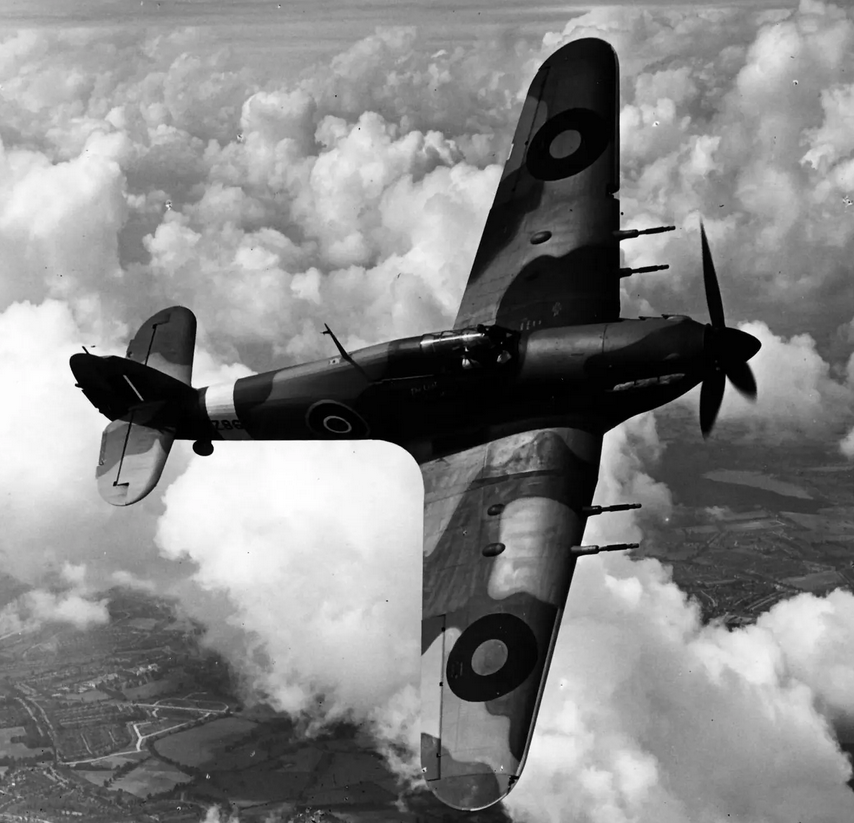
The Hawker Hurricane is often overshadowed in popular memory by the sleek Supermarine Spitfire, Britain’s most iconic fighter of World War II. However, it was the Hurricane that bore the brunt of the fighting in Britain’s darkest hour. Rugged, reliable, and adaptable, the Hurricane became the unsung hero of the Royal Air Force (RAF). It proved itself indispensable in both defensive and offensive roles throughout its service in multiple theaters during the war.
The Hawker Hurricane Was Revolutionary

The Hawker Hurricane emerged from a period of rapid technological change in aviation. In the early 1930s, RAF still flew biplanes such as the Hawker Fury. Sidney Camm, Hawker’s chief designer, foresaw that monoplane fighters would dominate the future. His design philosophy balanced innovation with pragmatism. The result was a fighter that could be built quickly, maintained easily, and flown with minimal pilot transition training from biplanes. The prototype Hurricane, then known as the “Interceptor Monoplane”, first flew on November 6th, 1935. It featured a fabric-covered fuselage and wings, coupled with the Rolls-Royce Merlin engine.
At its introduction, the Hurricane was revolutionary for the RAF: it was their first monoplane fighter that could fly at more than 300 miles per hour. It was not as advanced as the all-metal Spitfire that would follow. However, it was more readily manufactured, because of Hawker’s reliance on traditional construction methods already familiar to British factories and workers. By late 1937, the Hurricane Mk I had entered RAF service. By the outbreak of WWII in September, 1939, nearly 500 had been delivered, and they became the backbone of Fighter Command.
A Reliable and Steady Airplane

The Hawker Hurricane was a single-seat, low-wing monoplane powered by a Merlin engine that initially produced around 1,030 horsepower. It had a maximum speed of about 340 mph (547 km/h) at altitude, a service ceiling of 36,000 feet, and a range of roughly 600 miles. Armed with eight .303 Browning machine guns in the wings, the Hurricane packed considerable firepower for its time. Later versions increased armament, and replaced some machine guns with 20mm Hispano cannon, or even equipped the aircraft with bombs and rockets.
Structurally, the Hurricane combined old and new techniques. Its fuselage was built around a robust steel tube framework covered with fabric, while the wings evolved from fabric to stressed-skin metal. That hybrid construction meant the aircraft was less sleek than the Spitfire, but easier to repair. Battle-damaged Hurricanes could often be patched up quickly, which was a crucial factor in the Battle of Britain. Another asset was stability. The Hurricane was not as nimble as either the Spitfire or Germany’s Messerschmitt Bf 109. However, it was steady, forgiving, and provided an excellent gun platform. Pilots praised its ruggedness, and ground crews liked how easy it was to maintain.
An Unsung Hero

The Hawker Hurricane first saw action in the early months of the war, when the RAF was deployed to France as part of the aerial component of the British Expeditionary Force (BEF). Hurricane squadrons engaged German aircraft during the Battle of France in 1940. They proved instrumental during the Miracle at Dunkirk, patrolling the skies above the beaches as the BEF’s remnants were evacuated back to Britain. Throughout the Battle of France, Hurricanes claimed many victories, but also suffered heavy losses. Despite the setbacks, the Hurricane’s reputation as a dependable fighter grew.
It was during the Battle of Britain, fought from July to October, 1940, that the Hurricane truly earned its place in history. Of the RAF’s 620 frontline fighters, around two thirds were Hurricanes. While the Spitfires often tangled with German fighters, the Hurricanes bore the brunt of the fight against enemy bombers. By the time the battle ended, Hurricanes had destroyed more than half of the Luftwaffe aircraft lost. Their ability to absorb damage and remain operational was vital in maintaining Britain’s defensive shield.
An Ever-Evolving Platform

The Hurricane evolved significantly throughout the war, with more than 14,500 produced in various marks. Some key variants include the Hurricane Mk 1, the original version, with eight .303 machine guns. It formed the core of Fighter Command in 1939–40. The Hurricane Mk II was an improved version, with a more powerful Merlin XX engine, greater speed, and upgraded armament. Versions carried twelve machine guns, four 20mm cannons, or bombs. The Mk IIB “Hurribomber” was modified to carry bombs for ground attack missions.
The Mk IID was fitted with two 40mm Vickers S cannons, designed for anti-tank roles in North Africa. The Sea Hurricane was adapted for the Royal Navy, with arrestor hooks for carrier operations. There were also Tropical Hurricanes, equipped with Vokes air filters and desert camouflage for service in North Africa and the Middle East. This adaptability kept the Hurricane relevant long after the arrival of faster, more modern fighters. It shifted from frontline air superiority duties to ground attack, close air support, and convoy protection. Its sturdiness proved invaluable in such roles.
A Global Airplane

The Hawker Hurricane was a truly global aircraft, and flew in every major theater of the war. In the Mediterranean, it defended Malta. It fought in the North African desert, where the Mk IID, armed with 40mm cannons, earned the nickname “tank buster”. In the Far East, Hurricanes provided much-needed reinforcements against Japanese forces, although they were outclassed by agile fighters like the Mitsubishi A6M Zero. The Soviet Union received large numbers of Hurricanes through the Lend-Lease program, and used them extensively on the Eastern Front. Soviet pilots often criticized its lack of speed compared to German fighters, but they appreciated its robustness and stability as a ground-attack aircraft.
In naval service, Sea Hurricanes protected Atlantic convoys from German U-boats and long-range aircraft. They operated from small escort carriers and catapult-equipped merchant ships, and provided desperately needed air cover during the critical Battle of the Atlantic. The Hurricane’s key strengths were its rugged construction, its easy handling which pilots found quite forgiving, and versatility. It could be rapidly produced and repaired, and it proved adaptable to many roles beyond air superiority. During the Battle of Britain, such attributes meant the difference between victory and defeat. However, the Hurricane had limitations. It was slower and less maneuverable than both the Spitfire and the German Bf 109. Its fabric-covered structure, while easy to repair, made it vulnerable to fire.
From Front Line Combat to Secondary Roles

As the war progressed and enemy aircraft improved, the Hawker Hurricane became increasingly obsolete in air combat. By 1942, Spitfires, Mustangs, and other newer fighters had supplanted it in front line roles. Despite this, the Hurricane remained in valuable secondary roles until the war’s end, and ably served in ground attack and reconnaissance missions. The Hurricane is sometimes unfairly overshadowed by the glamour of the Spitfire, but its contribution cannot be overstated. During Britain’s hour of need in 1940, it formed the backbone of the RAF, and accounted for most of the Luftwaffe’s losses.
The ruggedness of the Hawker Hurricane, its adaptability, and its widespread use across the globe made it one of the most important Allied aircraft of the Second World War. Beyond combat, the Hurricane symbolized a crucial transitional moment in aviation history. It bridged the gap between the fabric-covered biplanes of the interwar years, and the sleek, all-metal fighters that dominated later conflicts. For many pilots, especially those from Commonwealth nations, the Hurricane was their first introduction to a modern combat airplane.
The Legacy of the Hawker Hurricane

Today, several Hurricanes survive and can be seen in museums and private collections. Some airworthy versions even take to the skies, and thrill audiences at airshows. They serve as reminders of the aircraft’s vital role in securing freedom, and its place in aviation heritage. The Hawker Hurricane may not have been the fastest or the most glamorous fighter of WWII, but it was one of the most important. Strong, reliable, and versatile, it won the affection of pilots and ground crews alike.
In the RAF’s finest hour at the Battle of Britain, it was the Hurricane, not the Spitfire, that destroyed the majority of German aircraft lost, and thus tipped the balance in favor of the island’s defenders. Its later adaptations ensured it remained useful in a variety of roles worldwide. In the story of the Second World War, the Hurricane stands as a true workhorse of the skies. It did not always capture headlines, but without the Hawker Hurricane, Allied victory would have been far more uncertain.

_________________
Some Sources & Further Reading
Bader, Douglas – Fight for the Skies: The Story of the Spitfire and the Hurricane (1973)
Bishop, Edward – Hurricane (1986)
Bowyer, Chaz – Hurricane at War (1974)
History Halls – The Supermarine Spitfire: Britain’s Most Iconic Fighter of World War II

