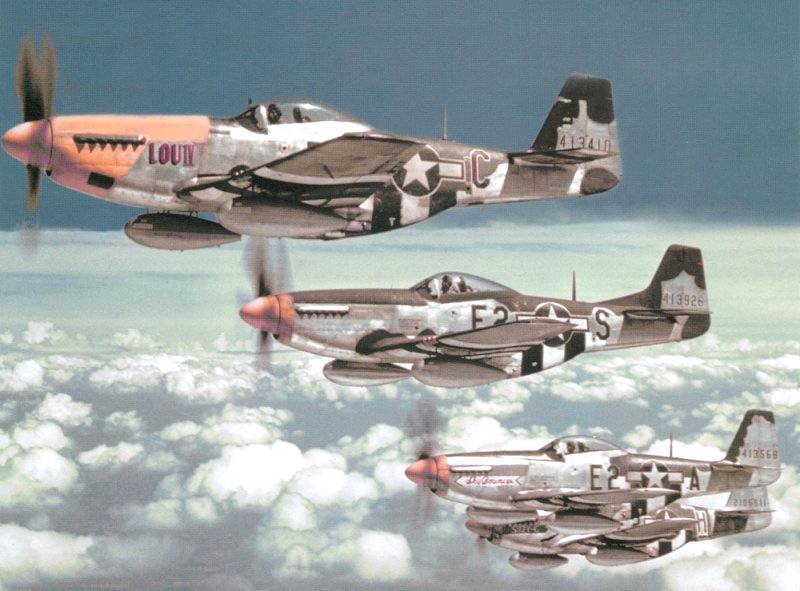
Early in World War II, American fighter airplanes were not exactly top notch compared to those of their foes in both the Pacific and European theaters. By war’s end, they dominated both the European and Pacific skies. Below are some fascinating facts about the most successful of those fighters, the North American P-51 Mustang.
The Superb Mustang Started Off as a Mediocre Airplane

The North American P-51 Mustang was perhaps the only airplane to seriously rival Britain’s Spitfire for the title of most beautiful and aesthetically pleasing fighter of WWII. When it came to performance, however, the Mustang had no serious rival for the title of war’s best fighter. It embodied the pinnacle of propeller driven fighter technology, and proved a credible match against even the revolutionary Messerschmitt Me 262 jet fighter.
The Mustang was initially designed for Britain’s Royal Air Force. The airplane that was manufactured in accordance with the British buyers’ specifications, and delivered in October, 1941, was mediocre. Equipped with an underpowered engine, the early Mustangs could not compete on an equal footing with German fighters at high altitude. So the RAF’s Fighter Command saw no use for the planes, and relegated them to tactical reconnaissance and ground attack duties.

It was not until 1943, after the US Eighth Air Force joined the bombing campaign against Germany and suffered horrendous losses during raids deep into Reich territory beyond the range of fighter escorts, that the P-51 Mustang got a second look. American front line fighters at the time, the P-38 Lightnings and P-47 Thunderbolts, had shortcomings as bomber escorts.
Most significantly, those fighters lacked sufficient range to accompany the bombers and escort them all the way to targets deep inside Germany. After a series of tests and evaluations, it was determined that the P-51 Mustang, if modified to carry additional fuel internally and fitted with external fuel tanks, would have the necessary range to escort the bombers anywhere in the European Theater of Operations.
From Mediocre to Superb

The extra fuel capacity fixed half of the problem: it transformed the P-51 Mustang into a fighter that could adequately escort American bombers and accompany them all the way to targets deep inside Germany. Fixing the other half of the problem – improving the Mustang’s performance so it could beat back German fighters and actually protect the bombers it would now escort – transformed the Mustang into a legend.
What had kept the Mustang mediocre was a mediocre engine that performed poorly at high altitudes. Equipped with that stock engine, the initial Mustangs had a top speed of 390 miles per hour, and an effective ceiling of 15,000 feet – any higher, and their performance suffered. Then a British test pilot had the bright idea of replacing the Mustang’s stock engine with the Rolls Royce engine used in the Spitfire IX. The results were immediate and dramatic.

The engine switch allowed the Mustang to realize its potential, and transformed it from a mediocrity to the war’s best fighter. From a 390 miles per hour top speed, P-51 Mustangs equipped with the the Rolls Royce engine zoomed to 440 mph (later models reached 490 mph). The fighter’s maximum altitude improved as well: from an effective ceiling of 15,000 feet, the improved Mustang soared to 42,000 feet.
The test results were passed on to the Americans, and converted Mustangs, equipped with the Rolls Royce engine and now designated the P-51B, began to roll out of factories in June, 1943, and by late 1943, P-51s were in place and ready for action in Europe. When they entered action in 1944, the P-51s broke the Luftwaffe’s back.

The German Dilemma in Dealing With the P-51 Mustang

German Messerschmitt Bf 109 fighters had good engines, capable of performing well at the high altitudes in which the bombers flew. But to actually down the rugged B-17 and B-24 heavy bombers, the 109s needed to be fitted with heavy armaments. The problem was that putting heavy armaments on the Bf 109s’ light airframe negatively impacted their performance. That made them that much more vulnerable to the bombers’ escorting P-51s, which were unencumbered by heavy armaments, and armed and optimized instead for the task of killing fighters.
German Focke-Wulf Fw 190s had it even worse than the Messerschmitt Bf 109s when they tried to penetrate the protective screen of P-51s in order to get at the bombers. The 109s at least had engines that were suited for high altitude dog fighting. Fw 190s did not have even that. Their radial engines were no match for the Mustangs’ Rolls Royce engines at high altitudes. Between that, and the dilemma of needing heavy armaments in order to shoot down heavy bombers, even as those heavy armaments reduced their ability to take on enemy fighters not similarly encumbered, the Fw 190s found themselves at a severe disadvantage against the P-51s.
The P-51 Seized the Skies From the Luftwaffe

After months of heavy losses to the Mustangs, and unsustainable attrition that bled the German fighter arm white, the Luftwaffe effectively ceded the skies over Germany to the P-51 escorted bombers. German fighters began to shadow American bomber formations protected by Mustangs, but mostly shied away from contact. They pounced instead on stragglers suffering mechanical malfunctions or damaged by flak.
The P-51 pilots begrudged the Germans even that, and would not allow the once proud Luftwaffe to skulk and scavenge in peace. As seen below, a new US Eighth Air Force commander authorized his Mustang pilots to aggressively seek the enemy’s warplanes. If German fighters would not come up to fight them, the P-51s would go down to fight the German fighters.

Destroying the Luftwaffe

Appointed to command the Eighth Air Force, Jimmy Doolittle, of Tokyo raid fame, was not content with mere bomber protection. Instead, he sought to achieve aerial supremacy over German skies. To do that, he changed the orders that had required escorting fighters to stick with the bombers at all times. Doolittle freed them to sweep far ahead of the formations, and engage any Germans they could find.
Once the bombers hit their targets, P-51s were free to leave them and “hit the deck” on their way home. Mustangs descended from their high altitudes and engaged any planes they came across. They strafed German airfields, attacked trains or road traffic, and engaged any targets of opportunity they spotted. In so doing, they provoked and dared the Luftwaffe to come out and do something about it.
Hermann Goering, Head of the Luftwaffe, Knew ‘The Jig Was Up’ When He Saw P-51s Over Berlin

In the runup to D-Day, some P-51 groups were released from bomber escort duties and unleashed on German airfields instead. Such aggressive tactics finally crippled the Luftwaffe. The P-51s proved a huge success, and were a marked improvement over the P-38s and P-47s. By late 1944, fourteen out of the Eighth Air Force’s fifteen fighter groups had switched to Mustangs.
Perhaps the greatest compliment to the Mustangs came from the Luftwaffe’s chief, Hermann Goering. He reportedly said “I knew the jig was up” when he saw P-51s over Berlin. Even the arrival of futuristic German airplanes late in the war failed to wrest aerial supremacy from the P-51s. The formidable Messerschmitt Me 262 fighter jet was kept in check by a shortage of both fuel and experienced pilots. They were also attacked at their airfields and strafed on the ground. Allied fighters patrolled near their airfields, and caught them at their most vulnerable when they were taking off or landing.

Some Sources and Further Reading
Bowman, Martin – P-51 Mustang vs Fw 190: Europe 1943-45 (2007)
Donald, David – American Warplanes of World War II (2000)
History Halls – World War II Fighters: America’s Lockheed P-38 Lightning

