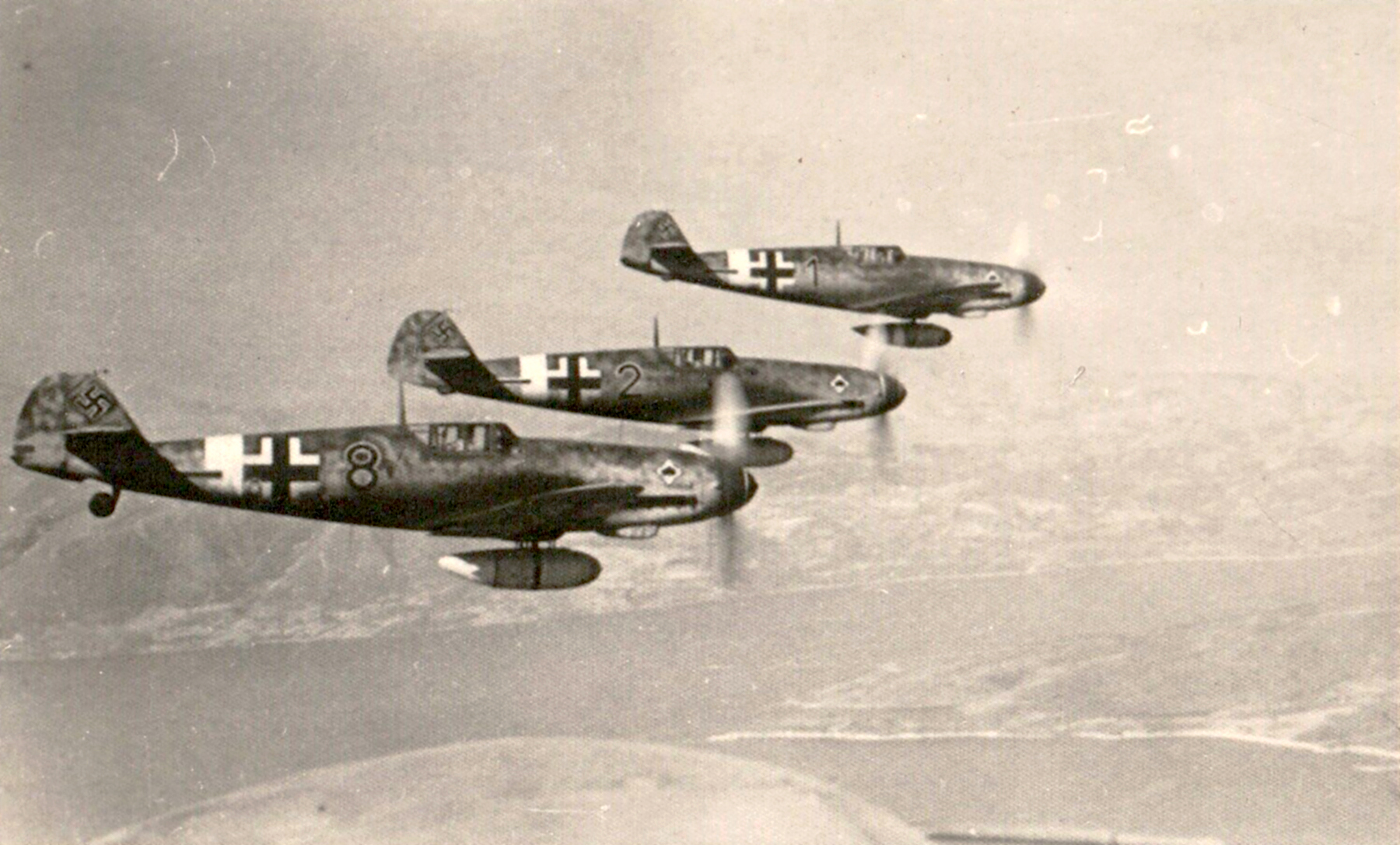
During World War II, the Germans fielded some of the world’s most successful – and innovative – fighter planes to date. Below are some fascinating facts about one of the most successful Luftwaffe fighter aircraft of the Second World War, the Messerschmitt Bf 109.
The Messerschmitt Bf 109

The Messerschmitt Bf 109, officially shortened to Bf 109 and more colloquially referred to as the Me 109, was the iconic German fighter of the Second World War. An argument could be made that the Bf 109 was the most successful fighter platform of the entire conflict. Which is not to say that the 109 was the best fighter of the war, but that its design was the most solid and serviceable of WWII.
Initial plans for the Messerschmitt Bf 109 dated back to 1934. The plane’s first prototype was flown in 1935, and the first production model entered operational service in 1937. The Bf 109 saw combat for the first time in the Spanish Civil War. It fought there as part of the Condor Legion sent by Germany to aid General Francisco Franco’s side. The Bf 109 was the only fighter, aside from the Spitfire, that was deployed in front line service at the start of WWII in 1939, and that with incremental improvements remained in front line service until war’s end, still effective and competitive against newer fighters.
A Nimble Fighter

The prototype that flew in 1935 was the world’s first low wing, retractable wheels, all metal monoplane fighter. That basic design was subsequently used by all sides during WWII. At its most basic, the essence of the Bf 109 was to take the smallest feasible airframe, and attach to it the most powerful engine possible. The Bf 109’s design had flaws, such as a cramped cockpit, a poor rear view, and a narrow undercarriage that rendered ground handling hazardous to inexperienced pilots.
There was also the drawback of the Bf 109’s relatively diminutive size. Being small and relatively light made the Messerschmitt fighter faster and more nimble. However, small size came with the downside of limited fuel capacity, which reduced the Bf 109’s range. That proved problematic during the Battle of Britain, when Bf 109s were typically limited to fifteen minutes’ worth of fighting over Britain, before dwindling fuel forced them to disengage and fly back home.
The Most Produced Fighter in History

Nonetheless, the basic concept of small airframe married to big engine proved successful. It allowed for progressive upgrades as more powerful engines became available. That in turn allowed the Bf 109 to remain competitive throughout the war. The adaptable design allowed the plane to progress from the 109D model in 1939, with a top speed of 320 miles per hour, to the 109K model at war’s end, capable of 452 miles per hour. Eric Hartman, the war’s top ace with 352 kills, flew the Bf 109.
Indeed, WWII’s top three aces, with over 900 kills between them, flew Messerschmitt Bf 109s, as did the top scoring ace against the Western Allies. In addition to the interceptor and escort role for which it had been originally designed, the Bf 109 was sufficiently adaptable to serve in a variety of other roles, including ground attack, and reconnaissance. With nearly 34,000 manufactured between 1936 and 1945, the Bf 109 was the most produced fighter aircraft in history.

_________________
Some Sources & Further Reading
Forsgren, Jan – Messerschmitt Bf 109: The Design and Operational History (2017)
History Halls – World War II Fighters: The Spitfire, Britain’s Most Iconic WWII Airplane
Vajda, Ferenc A., and Dancey, Peter – German Aircraft Industry and Production, 1933-1945 (1998)

