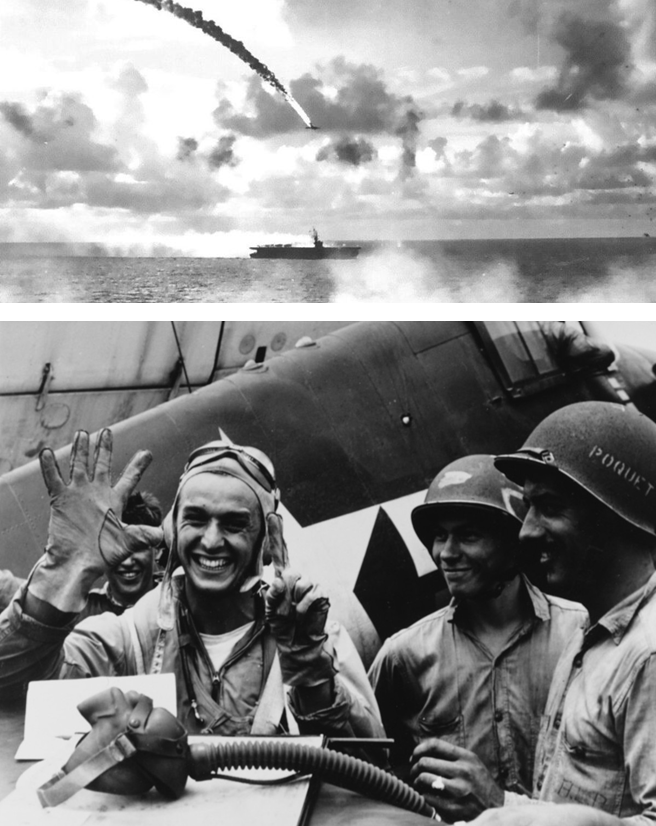
On June 19th, 1944, first day of World War II’s Battle of the Philippine Sea, American aviators downed so many Japanese airplanes that the event came to be known as “The Great Marianas Turkey Shoot”. One of the war’s most decisive battles, it marked the destruction of Japanese naval aviation as an effective fighting force. The outcome not only secured US landings in the Marianas, but also permanently shifted the balance of power in America’s favor.
A Rising US Navy, and Declining Japanese Naval Power

By mid-1944, the United States was steadily steaming across the, with the Marianas Islands – Saipan, Tinian, and Guam – as key targets. They were vital because their capture would place American B-29 bombers within range of the Japanese home islands. The Imperial Japanese Navy, fully aware of this threat, planned to contest the American invasion fleet in a decisive engagement. The Japanese strategy, known as Operation A-Go, was to lure the US Fifth Fleet under Admiral Raymond Spruance into battle. Vice Admiral Jisaburo Ozawa commanded the Japanese Mobile Fleet, composed of nine carriers, five battleships, eleven cruisers, and numerous destroyers. On paper, that was a formidable force. In practice, though, the Japanese were at a severe disadvantage.
Although the Japanese carriers had a large complement of aircraft, their pilot corps had been decimated by years of attritional combat. The Battle of Midway, the Guadalcanal campaign, and the battles of the Solomons, had cost Japan many of its most skilled aviators. Worse, the Japanese training pipeline was unable to provide a sufficient number of adequately trained replacements. By contrast, the United States had trained thousands of fresh pilots through a rigorous flight school program, and equipped them with advanced aircraft. They included the Grumman F6F Hellcat fighter, Curtiss SB2C Helldiver dive bomber, and Grumman TBF Avenger torpedo bomber. The US Navy’s carriers also operated with superior radar technology, and better coordination between ships and planes. The Americans thus steamed into battle with a quantitative advantage, plus a qualitative one in both equipment and personnel.
The Runup to the Battle of the Philippine Sea

On the morning of June 19th, 1944, US naval forces were covering amphibious landings on Saipan. Admiral Spruance was in overall command of the Fifth Fleet, and Vice Admiral Marc A. Mitscher was in charge of the aircraft carriers, Task Force 58. The previous night, Mitscher had sought permission to steam westwards, to place his carriers in better launch positions and closer to the enemy. Spruance, however, was wary of Japanese diversionary attempts to trick him into leaving the landing force undefended. He feared that if his best fighting ships steamed too far west from the Marianas to meet the Japanese, another Japanese force might slip in behind them to fall upon and devastate the landing fleet and force.
So Spruance denied Mitscher’s request, and directed him to maintain a defensive posture near the Marianas. Mitscher and his subordinates were unhappy with that decision. It meant that their carrier airplanes would have that much further to fly the following day to come to grips with the Japanese. However, Spruance’s decision meant that the Japanese would also have to sail and fly that much farther to get at the Americans, and thus stretch their already tenuous supply lines. The Battle of the Philippine Sea began in the early hours of June 19th, when American radar detected the first wave of incoming Japanese aircraft. What followed was one of the most lopsided aerial battles in history.
“The Great Marianas Turkey Shoot”

US Navy combat air patrols, comprised mostly of Grumman F6F Hellcat fighter airplanes, intercepted wave after wave of Japanese bombers and fighters long before they could reach the fleet. The Hellcat, heavily armed with six .50-caliber machine guns and possessing both ruggedness and speed, quickly earned a reputation as a “Zero killer” and an “Ace Maker” because of the ease with which its pilots shot down Japanese airplanes. Nicknaming the day’s fighting the “Great Marianas Turkey Shoot” was apt, because the Japanese attacks seemed suicidal and hopelessly uncoordinated.
For the Americans, it felt like shooting defenseless targets, much like hunters at a turkey shoot. In the first wave, about 68 Japanese aircraft approached the US fleet. More than half were shot down before they could release their bombs or torpedoes. Those that did reach the American carriers achieved little: a few near misses, and no serious damage. The second and third waves fared no better. The Hellcats, guided by radar and directed from carriers by skilled controllers, tore into the Japanese formations with deadly efficiency.
A Lopsided Victory

In one engagement, 41 out of 47 Japanese aircraft were destroyed. By day’s end, US naval aviators had shot down well over three hundred Japanese planes, at the cost of only about thirty of their own. The sheer scale of the destruction astonished participants. Veteran American pilots, many of whom had faced stiff competition earlier in the war, were shocked at the inexperience of their opponents. Early in the war, Japanese naval aviators had been a highly-skilled and frighteningly deadly elite. Now, American pilots faced foes who had only been trained for a few months before they were thrown into combat. The Japanese pilots’ lack of skill, combined with inferior aircraft, made them easy prey for seasoned Hellcat pilots.
The aerial battle got its nickname when a pilot from the USS Lexington exclaimed: “Why, hell, it was just like an old-time turkey shoot back home!” However, the fighting in the air was only one part of the day’s events. American submarines also played a crucial role in the overall. The USS Albacore and USS Cavalla each managed to torpedo and sink a Japanese carrier on June 19th. The Albacore torpedoed Taiho, Japan’s newest and most advanced carrier, which later sank after internal explosions caused by poor damage control. The Cavalla torpedoed and sank the carrier Shokaku, a veteran of the Pearl Harbor attack.
A Harrowing Return Trip Home

On June 20th, one day after the massive air engagements, Admiral Mitscher launched a late-afternoon strike against the retreating Japanese. It was a risky move, because taking off when they did meant that it would be night by the time the American planes made it back. Nighttime carrier landings were always difficult feat, and even more so in 1944. However, Mitscher believed that the risk was worth the potential payoff. The American strike destroyed two Japanese tankers, and damaged a battleship. It also damaged three aircraft carriers, and sank a fourth, the Hiyo. Although the attack did not annihilate the Japanese fleet, as had been hoped, it did inflict additional losses on top of the catastrophic air defeats of the previous day.
By the time the American planes turned around towards their carriers, most were dangerously low on fuel. Worse, night had fallen, and those pilots whose fuel lasted long enough to make it back now faced the daunting prospect of landing aboard carriers in near pitch-black conditions. Strict light discipline was maintained aboard US Navy ships to reduce the risks from enemy submarines and night bombers. The first US planes reached Task Force 58 at 8:45 PM, and it was clear that they would have great difficulty to even spot the carriers, let alone land in the darkness. The admiral aboard the USS Hornet decided to ignore the risks posed by the enemy, and illuminated his carrier.
Lights in the Dark

Admiral Joseph J. Clark aboard the Hornet ordered his searchlights to shoot their beams directly up into the sky so his position could be readily seen from miles away. Mitscher backed him, and soon, all of Task Force 58’s ships were lit up like Christmas trees. Simultaneously, destroyers fired star shells to help the returning airplanes find the their way home. Despite that, four times as many American airplanes were lost on the return leg that night because they ran out of fuel or crashed in landing attempts, than were lost due to enemy action. 240 American airplanes had been launched against the Japanese afternoon, of which 14 aborted due to mechanical defects and returned to their carriers.
226 US aircraft reached the enemy. Of those, 20 were shot down by Japanese fighters or antiaircraft guns. On the nighttime return trip, 80 American airplanes ran out of fuel and had to ditch into the water, or crashed in landing attempts. The battle was nonetheless a decisive US victory. Japanese losses included three carriers sunk, around 600 aircraft destroyed, and hundreds of irreplaceable pilots killed. By comparison, American losses were relatively light: about 130 aircraft in total, and fewer than 100 pilots and aircrew. The most significant result was the annihilation of Japanese naval aviation. Although Japan still had carriers afloat, they had almost no aircraft or skilled pilots left to operate them effectively. In future battles, such as Leyte Gulf, Japanese carriers were used as decoys rather than as true offensive weapons.
The Great Marianas Turkey Shoot Destroyed Japanese Naval Aviation

For the United States, the victory secured the Marianas, where air bases for Boeing B-29 Super Fortress heavy bombers were constructed. Within months, B-29s began to conduct raids of ever increasing intensity against Japan, culminating in the firebombing of Tokyo and, eventually, the atomic bombings of Hiroshima and Nagasaki. The Marianas campaign, and the lopsided victory in the air that ensured its success, thus directly contributed to the eventual Allied victory in the Pacific. The Great Marianas Turkey Shoot remains one of the most significant aerial battles in history.
It demonstrated the effectiveness of American training, technology, and doctrine. Simultaneously, it underscored the devastating consequences of Japan’s inability to replace its skilled aviators. The battle also highlighted the importance of radar in modern warfare. US radar allowed early detection, vectoring of fighters, and efficient use of resources. That gave American aviators an advantage, and allowed them to slaughter the massed Japanese raiders. For the American pilots, many of whom recorded multiple kills in a single day, the battle was both exhilarating and sobering. They realized that they had witnessed the destruction of an enemy force that had once dominated the Pacific skies.
Legacy of the Great Marianas Turkey Shoot

The Battle of the Philippine Sea was the last of five major carrier versus carrier engagements between the American and Japanese navies in WWII. It was also the biggest of the five, with 24 aircraft carriers deploying about 1350 carrier-based airplanes. Historians view the battle’s outcome as the death knell of Japanese carrier aviation. The war would drag on for another year. However, the Imperial Japanese Navy’s ability to mount large-scale offensive operations effectively ended in June, 1944. The Great Marianas Turkey Shoot was not just a one-sided aerial massacre; it was the culmination of years of attrition, training, and technological development.
The US Navy, with its disciplined aviators, superior aircraft, radar guidance, and coordinated fleet operations, achieved overwhelming dominance. The Japanese, suffering from inadequate training and dwindling resources, could no longer compete. In one day of combat, the balance of air power in the Pacific shifted irrevocably. What began as Japan’s attempt to halt the US advance instead ended with the destruction of its last major carrier air force. The skies over the Pacific would never again belong to the Rising Sun.

_________________
Some Sources & Further Reading
Crowl, Philip A. – Campaign in the Marianas (2016)
History Halls – World War II Fighters: America’s F6F Hellcat, ‘The Ace Maker’
History Halls – World War II Bombers: Japan’s Mitsubishi G4M Betty
Taylor, Theodore – The Magnificent Mitscher (1991)
Wilmott, H. P. – June, 1944 (1984)

