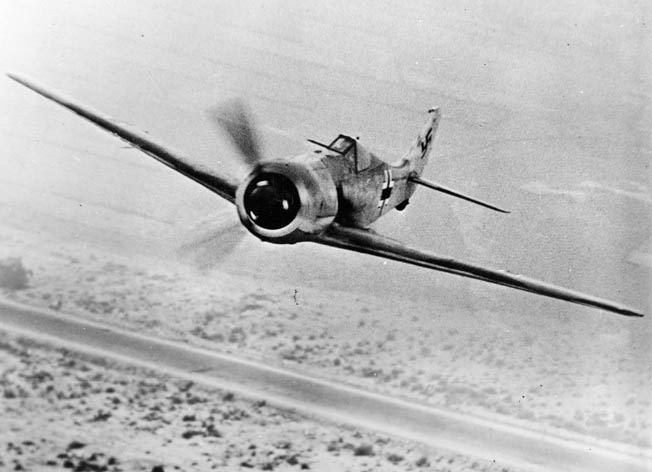
A low wing fighter powered by a BWW air cooled radial engine, the Focke-Wulf Fw 190 was first ordered in 1937, intended as insurance against possible shortages in the liquid cooled Daimler engines that powered the Luftwaffe’s mainstay fighter, the Bf 109. As things turned out, once it was introduced in late 1941, the backup quickly stole the show. The Fw 190 proved more rugged than the 109, as its huge radial engine, mounted up front, acted as extra shielding for the pilot, and could absorb far more damage than the Bf 109’s liquid cooled engine and still function. It also proved superior to the 109 in most tasks, except high altitude dog fighting. Thus, the Focke-Wulf ended up replacing the Messerschmitt as Germany’s main fighter, with over 20,000 produced by war’s end.
The Highly Capable Focke-Wulf Fw 190

The Fw 190 proved to be an excellent fighter, as it was maneuverable, and heavily armed with a standard configuration of four 20mm cannon plus two machine guns. During the middle war years, it was the world’s best air to air fighter, and asserted an ascendancy over enemy fighters that lasted until the Spitfire IX restored parity in July, 1942. However, the Spitfire lacked the range to penetrate deep into Reich territory.
Thus, when American bombers joined the fight and began to carry out daylight raids into Germany, the Fw 190s’ heavy armaments rendered it well suited for the role of bomber destroyer. When they waded into the enemy bomber formations, Fw 190s inflicted heavy losses and established an ascendancy over German skies that lasted until long range fighter escorts finally became available to shepherd US bombers in 1944.
A Versatile Airplane

The Fw 190 was also versatile. In addition to fighter duties, its platform was well-suited to other roles. Fw 190s served in reconnaissance, ground attack, and as fast light bomber that could carry a respectable 4000-bomb load. When equipped with 37mm cannons, Fw 190s also turned out to be exceptional tank busters. The Fw 190’s supremacy over Germany’s skies was first challenged by the appearance of P-38 Lightnings and P-47 Thunderbolts.
The use of drop tanks enabled those enemy fighters to escort American bombers to those targets in Germany that fell within their enhanced range, and at least part of the way to those targets deeper inside Germany that lay beyond. The Fw 190’s radial engine could not match the turbo supercharged engines of those American fighters at high altitudes. Fw 190s were forced to retreat deeper into Germany, effectively abandoning those parts within Allied escort fighter range.
The Decline of the Fw 190

Alternatively, Fw 190s would shadow the bomber formations, and wait until the escorting Thunderbolts or Lightnings reached their maximum range and had to turn back. That was when the German fighters pounced on the now undefended bombers. The appearance of the P-51 Mustang, which had the range to escort US bombers to targets anywhere inside German held territory, put the Fw 190 at a permanent disadvantage and ended its ascendancy as a bomber destroyer.
The introduction of the liquid cooled Focke-Wulf Fw 190D variant in September of 1944 restored some degree of parity. However, by then it was too late to make a difference. German factories were unable to produce enough Fw 190Ds to go around. By the time the improved model came out, the Luftwaffe had already suffered severe pilot attrition, so there was a shortage of experienced flyers capable of taking full advantage of the Fw 190D’s capabilities.

_________________
Some Sources & Further Reading
History Halls – World War II Fighters: Germany’s Messerschmitt Bf 109
History of War – Focke-Wulf Fw 190 Design and Prototypes
Vajda, Ferenc A., and Dancey, Peter – German Aircraft Industry and Production, 1933-1945 (1998)

