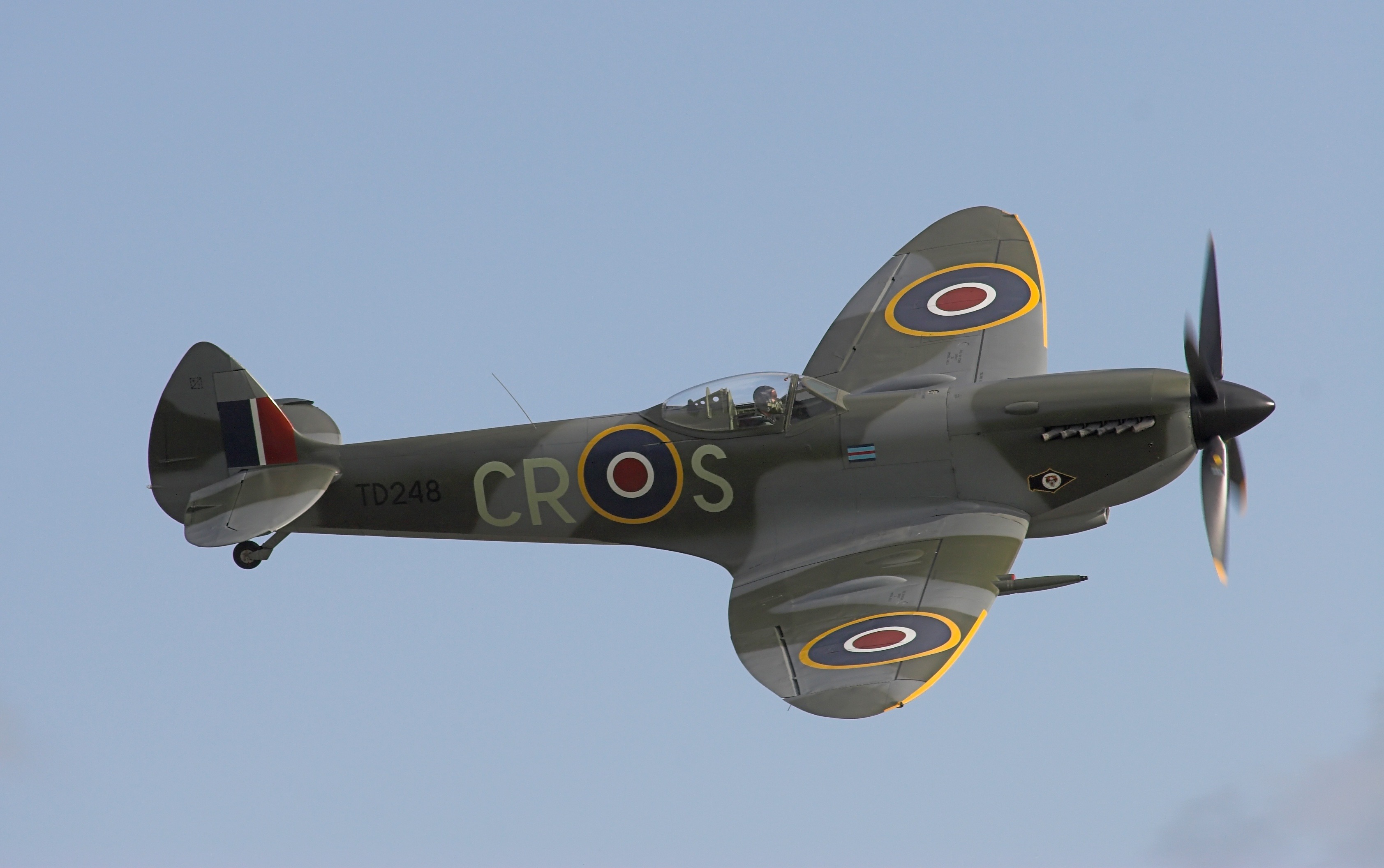
Britain’s most successful fighter airplane of World War II was the Supermarine Spitfire. It earned its laurels in the Battle of Britain, and by war’s end had secured its place as the most widely produced and strategically important Royal Air Force fighter. Below are some fascinating facts about Britain’s most iconic WWII airplane.
The Beautiful – and Deadly – Spitfire

The Supermarine Spitfire was a masterpiece of aerodynamic engineering, and perhaps the most aesthetically pleasing airplane of the WWII. It was a graceful aircraft whose wide elliptical wings, curves, and rounded components flowed smoothly into each other in an elegant whole. Pilots deemed the Spitfire quite easy to handle, and that, combined with its physical appeal and superb performance, turned it into a legend.
The Spitfire was not just beautiful: it was also tough. For such a pretty airplane, the Spitfire was also remarkably durable. As pilot John Vader wrote: “Spitfires have hit the ground, touched the sea, bashed through trees, cut telegraph and high tension wires, collided in the air, been shot to pieces, had rudders and parts of wings fall off, and have yet made safe landings, with or without wheels.”

Spitfires were designed as a high performance short range interceptors to supplement the RAF’s Fighter Command’s mainstay, the Hawker Hurricane. The Spitfire combined lethality with beauty and toughness, and proved a superb defensive fighter in the Battle of Britain, July to October, 1940. Throughout that dark summer, the Spitfire emerged as the iconic symbol of British defiance as that country stood alone against the German juggernaut.
The RAF had more Hawker Hurricanes than Supermarine Spitfires during the Battle of Britain. However, the Spitfire’s superior performance resulted in a lower attrition rate and a higher kill to loss ratio. As a result, during German raids on Britain, Spitfire squadrons usually engaged Luftwaffe fighters that escorted the German bombers and kept them occupied, while flights of Hurricanes dove in to savage the now-undefended enemy bombers.

“Give Me a Squadron of Spitfires!“

The greatest compliment to the Spitfire was inadvertently elicited by Luftwaffe chief Hermann Goering. As the Battle of Britain progressed, he grew frustrated by the inability to crush British resistance. Goering berated a gathering of his exhausted and weary fighter commanders, and took them to task for their failure to defeat the enemy despite a numerical superiority over the RAF. When he reportedly asked just what more he could do to speed up victory, one of them replied bitterly: “Give me a squadron of Spitfires!“
After the Battle of Britain, the Spitfire began to replace the Hurricane as the backbone of the RAF’s Fighter Command for the remainder of the war. The plane’s design proved sufficiently rugged and adaptable to permit the use of increasingly powerful engines as the war progressed. That led to a steady increase in the Spitfire’s performance and capabilities throughout the conflict.

Aside from machine guns, different Spitfire versions were equipped with cannons, rockets, or bombs. In addition to its primary role as interceptor, the Spitfire successfully served in other roles, such as fighter-bomber, reconnaissance, and trainer. The Supermarine Spitfire was the most produced British aircraft of the war, and more than 20,000 rolled off the assembly lines before production finally came to a halt.
Some Sources and Further Reading
Delve, Ken – The Story of the Spitfire: An Operational and Combat History (2007)
Flack, Jeremy – Spitfire: The World’s Most Famous Fighter (2015)
History Halls – World War II Fighters: The Soviet Yakovlev Yak-9

