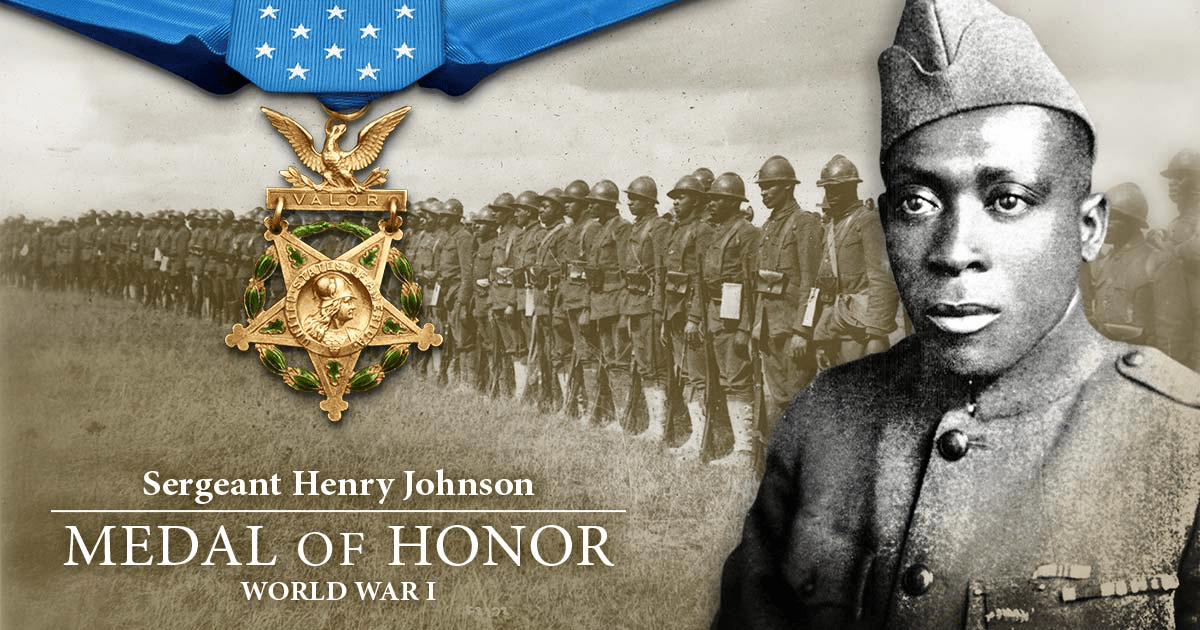
William Henry Johnson was one of World War I’s most extraordinary soldiers. An African American private in the US Army, Johnson earned international acclaim for his heroism on the Western Front. For decades, however, his achievements were ignored or minimized at home. Johnson thus became a powerful symbol of heroism in the face of racial injustice. His story reflects both Black soldiers’ valor in WWI, and the barriers they faced before, during, and after the war.
William Henry Johnson and the Harlem Hellfighters

William Henry Johnson was born on July 15th, 1892, in Winston-Salem, North Carolina, and grew up in poverty. Like many African Americans of his generation, he moved north in search of opportunity. He eventually settled in Albany, New York, where he worked as a porter at Union Station. When the United States entered WWI in April, 1917, Johnson enlisted in the New York National Guard. He became part of the 369th Infantry Regiment, a unit that would later earn fame as the “Harlem Hellfighters”.
The US Army was rigidly segregated, and Black soldiers were often assigned to labor battalions rather than combat roles. The 369th, however, was eventually sent to France and placed under French command, as American commanders were reluctant to deploy African American troops alongside white American units. The French Army, already suffering enormous casualties, welcomed the additional manpower. It treated the Harlem Hellfighters with a degree of respect rarely afforded them by their own countrymen. Equipped with French weapons and helmets, the 369th spent more time in continuous frontline combat than any other American regiment.
The “Black Death”

Johnson’s defining moment came on the night of May 14–15, 1918, in the Argonne Forest. Assigned to sentry duty alongside fellow soldier Needham Roberts, Johnson was positioned on an isolated outpost when a German raiding party attacked under cover of darkness. The enemy threw grenades and attempted to capture the two men alive for intelligence. Roberts was badly wounded early in the fight. That left it up to Johnson to defend both himself and his injured comrade against overwhelming odds.
Despite being wounded multiple times, Johnson refused to surrender. His rifle jammed and he eventually ran out of grenades. So he fought on with the only weapon left to him: a bolo knife. In close-quarters combat, Johnson received twenty one wounds, but he kept on fighting. He killed and wounded several German soldiers, prevented the capture of Roberts, and forced the attackers to retreat. His ferocity and determination under fire were so remarkable that German troops reportedly nicknamed him the “Black Death”. It was a testament to the fear he inspired in his foes.
Unrecognized Heroism

The French military quickly recognized Johnson’s bravery. He became the first American soldier in WWI to receive the Croix de Guerre with Gold Palm, one of France’s highest awards for valor. French newspapers celebrated his actions, and he was paraded through Paris as a hero. In stark contrast, the US Army offered no comparable recognition at the time. Johnson returned home to a segregated nation that was uneasy with the idea of a Black war hero who had fought – and beaten – white soldiers in hand-to-hand combat.
Initially, Johnson was celebrated in African American communities. He participated in the famous 1919 victory parade in New York City alongside the Harlem Hellfighters. However, his postwar life quickly deteriorated. His wartime injuries left him physically unable to resume his work as a porter. He also suffered from what would now be recognized as post-traumatic stress disorder (PTSD), and struggled to hold steady employment. Johnson attempted to speak publicly about his wartime experiences and the discrimination faced by Black veterans. His outspokenness brought him into conflict with military authorities. Denied adequate medical care and veterans’ benefits, he fell into poverty.
The Legacy of William Henry Johnson

William Henry Johnson died on July 1st, 1929, at just 36 years old. He was buried in an unmarked grave at Arlington National Cemetery. For decades, his heroism faded from mainstream historical memory. It was emblematic of the broader neglect of African American contributions to the war effort. Many Black servicemen had performed heroic deeds worthy of a Medal of Honor, but not a single one received America’s highest honor in WWI – or WWII, for that matter. It took almost a century for Johnson’s heroism to be recognized by his own country.
Historians, veterans’ advocates, and lawmakers finally began pushing for long-overdue recognition in the late twentieth and early twenty first centuries. In 1996, Johnson was posthumously awarded the Purple Heart – normally an automatic reward for any US serviceman wounded in combat. In 2003, he received the Distinguished Service Cross, the US Army’s second-highest award for valor. Finally, in 2015, nearly a century after his actions in the Argonne Forest, President Barack Obama awarded William Henry Johnson the Medal of Honor, the nation’s highest military decoration.
The citation praised Johnson’s “conspicuous gallantry and intrepidity at the risk of his life above and beyond the call of duty”. Today, William Henry Johnson stands as more than a war hero. He represents the courage of African American soldiers who fought for a country that denied them full equality, and the long struggle to have their service acknowledged. His story is a reminder that heroism does not always receive immediate recognition. However, perseverance by individuals and communities can eventually remedy injustice, even if only partially and belatedly.

_________________
Some Sources & Further Reading
Sweeney, William Allison – History of the American Negro in the Great World War (1919)
Latest Articles
- The Brink’s-Mat Robbery: Britain’s Biggest Gold Heist
- Fighting Women: Artemisia I of Caria Led Her Ships at the Battle of Salamis
- Alexander the Great and Sisygambis, Mother of Persia’s King Darius III
- Unholy Holy Fathers: Pope Leo X’s Corruption Was So Brazen, it Triggered the Protestant Reformation
- Edward England, the Humane Pirate Captain Deposed by His Men for Being Too Nice

