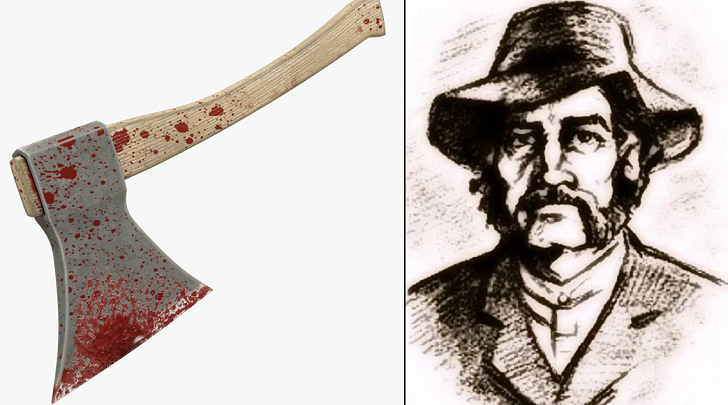
John Lynch occupies a grim and often overlooked place in early colonial Australian criminal history. An ax murderer active primarily in the 1840s, he became one of the country’s earliest identifiable serial killers. His predation focused on settlers and travelers in the rugged frontier environment of New South Wales’ southern highlands. Lynch’s crimes are less well known today than later Australian murder cases. However, they reveal much about the dangers, social fragmentation, and limited policing in the colony’s expanding rural districts.
A Transported Convict

John Lynch was born in Ireland around 1813, and transported to New South Wales as a convict. Like many transported convicts, he eventually secured his ticket of leave and moved into the frontier farming districts. He settled near the settlement of Berrima, a region of isolated farms, scattered travellers, and limited law enforcement. That environment created opportunities for a predator to operate unnoticed. Lynch’s crimes began to attract attention only after his arrest, by which time had probably murdered at least ten people. His earliest known victims were fellow settlers or itinerant workers whom he encountered along remote tracks.
Lynch was unusual among serial killers, in that his preferred murder weapon was an ax. He often lured unsuspecting men with promises of employment or partnership, then killed them for their possessions. Such behavior was facilitated by the fluid, transient nature of bush life, where individuals might vanish without immediate alarm. Central to his exposed crimes was the murder of a man named James Kelly, a traveller whose disappearance initially drew the attention of authorities. Lynch murdered Kelly near the Wingecarribee River, an area patrolled by mounted police stationed out of settlements like Goulburn. Evidence later showed that Lynch had strangled Kelly and stolen his possessions, then buried his body in a shallow grave.
A Serial Killer in the Outback

John Lynch’s murder of James Kelly was just one of his many killings. Another victim was a young man named McEvoy. Lynch murdered him, stripped him of his belongings, then tried to disguise the crime as an accident. His coldest killing was of John Mulligan, who owed him £30 for stolen goods he had sold him, along with his family. Lynch visited the Mulligan farm, chopped up the family with an ax, and disposed of the bodies. He then coolly made himself at home in their farm. Lynch told neighbors that the Mulligans had moved, and that he had bought their farm. He even placed a notice in a newspaper in John Mulligan’s name, to make it seem as if he was still alive.
The territory roamed by Lynch was mostly isolated farmlands. Strangers were common in such settings, and identification systems rudimentary. Lynch’s eventual downfall came when he tried to shift blame for Kelly’s murder onto another man. The authorities were not convinced, and investigations finally connected Lynch to a number of crimes. The era’s colonial justice system relied heavily on magistrates such as those operating from the court at Berrima. It was here that Lynch faced trial for murder in 1842. The proceedings were presided over by Alfred Stephen, a respected judge whose career spanned decades, and who played a major role in shaping colonial law.
Legacy of John Lynch

Under Alfred Stephen’s guidance, the court heard a series of testimonies, including incriminating statements by Lynch himself. During the trial, Lynch shockingly confessed to multiple killings, which he described with chilling nonchalance. He viewed murder as a practical means of eliminating obstacles or acquiring property, and felt little remorse for his actions. The jury found Lynch guilty, and he was sentenced to death by hanging. His execution took place at Berrima Gaol, where public hangings were still part of the colony’s penal culture. Before his execution, Lynch made additional confessions that expanded the tally of his victims, and claimed responsibility for ten murders. Whether these were exaggerated or understated remains a matter of historical debate. Many potential victims were itinerants whose disappearances were never systematically recorded.
Lynch’s story today offers insight into the realities of early colonial Australia. Many lived in isolation in a vast and thinly policed landscape, where settlers on the frontier were quite vulnerable. Lynch’s case helped spur improvements in policing and record-keeping in rural districts, as the colonial government recognized the challenges posed by criminals who could exploit the bush’s remoteness. Though overshadowed by later Australian criminal cases, John Lynch stands as one of the country’s first identifiable serial killers. His violence flourished in the young colony’s unsettled margins, and his crimes remain a haunting chapter in early Australian history.

_________________
Some Sources & Further Reading
History Halls – The Crutchy Push: The One-Legged Australian Gangsters Who Terrorized Melbourne
Kerr, Gordon – Evil Psychopaths: Dangerous and Deranged (2009)
Kidd, Paul B. – Australia’s Serial Killers (2011)

