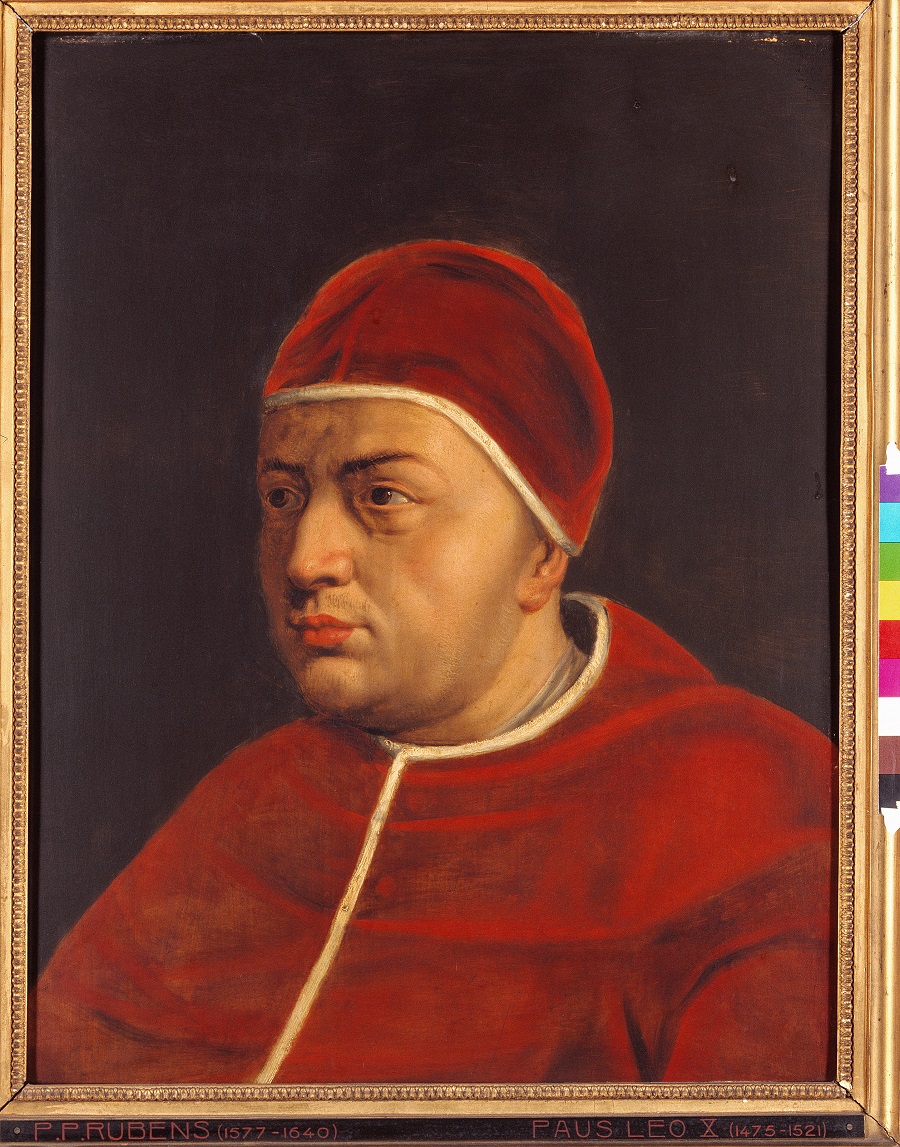
Leo X (1475 – 1521) was Holy Father from 1513 until his death. A true Renaissance pope and prince, he helped transform Rome into a center of culture and the arts. However, his lavish spending on those pursuits bankrupted the Church, so he turned to the wholesale selling of indulgences to raise funds for his projects – a controversial practice that lowered his and the Church’s prestige. He was also brazen in his homosexual relationships, openly fawning upon and advancing the careers of his handsome male lovers. Between those trespasses and ignoring the backlash building against his and the Church’s corruption, Leo X contributed to the outbreak of the Protestant Reformation and the resulting dissolution of the western Church. Below are some fascinating facts about the life and career of this notoriously unholy Holy Father.
The Splurging Medici Pope

Born Giovanni di Lorenzo de Medici, this pope was the second son of Lorenzo the Magnificent, the greatest of Florence’s Medici rulers, and one of Renaissance Italy’s most powerful figures. His influential Medici connections paved the way for his rise in the Church hierarchy. He was made a lay cardinal in 1488, at age thirteen, and joined the College of Cardinals at age seventeen.
Although he devoted most of his time and energies to the affairs of the Medici family, whose head he became after the deaths of his father and elder brother, Giovani di Lorenzo de Medici retained his influence in the Catholic Church. When the papal throne became vacant in 1513, he competed to fill it, won the election for the next Holy Father, and became Pope Leo X.

Lorenzo the Magnificent had been a huge patron of culture and the arts, and having grown up in his father’s court, the new pontiff was also passionate about the arts and culture. Leo X spent lavishly as he went on a buying spree for the papal library, patronized the arts, kicked off a huge building project to beautify the Vatican, and accelerated the construction of Saint Peter’s Basilica. However, the splurging caused him to run out of money while he was in the middle of his greatest project, Saint Peter’s Basilica. To raise money, he turned to the controversial expedient of selling of indulgences.
Corruption So Brazen, it Permanently Split the Catholic Church

Indulgences were basically documents asserting that the pope would use his holy powers to get a dead person out of purgatory, or at least shorten his or her stay in that waiting room between heaven and hell. Previous popes had sold indulgences, but they had been more discreet about it, and sold them only to a select (and wealthy) few. Leo X went the Walmart route, relied on volume to more than make up for lowered prices, and sold indulgences at bargain basement rates that put them within the reach of the masses.
Soon, indulgence sellers were crisscrossing Christendom, hawking indulgences to all. One of the most notorious indulgence sellers was Johann Tetzel, a Dominican friar who gained infamy for an oft-repeated phrase from his sales pitch: “As soon as the coin in the coffer rings, the soul from Purgatory springs”. One of those upset by such cynicism was a professor of theology named Martin Luther, who wrote the Ninety Five Theses to address indulgences and other corrupt Church practices. Leo X however failed to take such criticisms seriously, and that failure contributed to the rise of Protestantism and the fracture of the western church.

_________________
Some Sources & Further Reading
Chamberlain, E. R. – The Bad Popes (1969)
History Halls – Unholy Holy Fathers: Alexander VI, the Corrupt Borgia Pope
Pastor, Ludwig – The History of the Popes From the Close of the Middle Ages (1899)
Vaughn, Herbert M. – The Medici Popes (1908)

