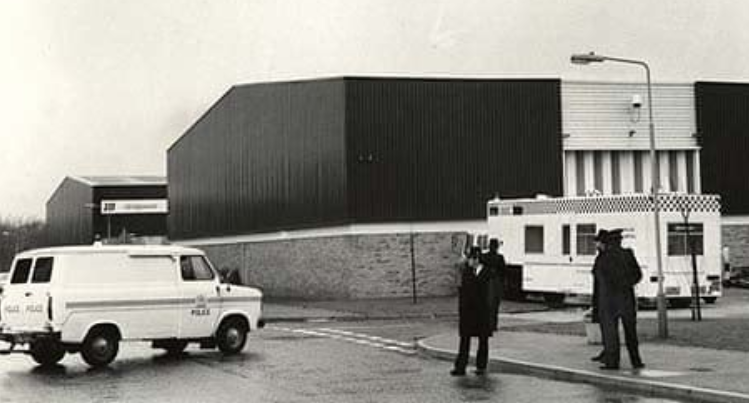
In the Brink’s-Mat robbery, November 26th, 1983, criminals got their hands on £26 million worth of gold bullion. It was an extremely lucky break – they had targeted something else, and had not even known that gold was present. Their haul was equivalent to £290 million or about $400 million based on the gold exchange rate in 2026. That made it one of the biggest robberies in British history. What began as a carefully planned warehouse burglary at Heathrow Airport ended with the theft of nearly three tons of gold bullion, the laundering of astonishing sums of money, a trail of murders, and lasting consequences for policing and organized crime in Britain. It was more than a spectacular heist. It was a saga of misplaced trust, ingenuity, and the difficulties of handling the proceeds of such a huge crime.
The Insider and the Robber

The Brink’s-Mat robbery took place inside Unit 7 of the Heathrow International Trading Estate, a warehouse jointly operated by Brink’s, the American secure transport company, and MAT Transport. The facility stored high-value cargo awaiting shipment, including cash, platinum, and gold. Although the building was designed for security, practices within the warehouse had grown increasingly lax. Guard rotations were predictable, and security codes were known to several staff members. The guards included Anthony “Tony” Black, a man with criminal connections. He betrayed his employer and colleagues by providing crucial inside information to criminals.
Black’s sister was in a relationship with Brian Robinson, a known armed robber. He told Robinson of the warehouse’s layout, the number of guards on duty, and how to bypass internal alarms. Believing the warehouse contained a large amount of foreign currency, Robinson and fellow criminal Michael “Micky” McAvoy assembled a gang of six armed men to execute a swift, intimidating robbery. In the early hours of November 26th, 1983, they drove to the facility wearing police uniforms and impersonating officers. Their plan was simple: get in, restrain the guards, force access to the vault, collect the cash, and escape.
The Brink’s-Mat Robbery

The thieves’ entry was swift. Tony Black had arranged to be on duty, and opened the doors for them. The gang handcuffed and subdued the remaining guards, doused them in gasoline, and demanded their cooperation with threats of incineration. The intimidation worked. Black and another guard accompanied them to the vault. Inside, the gang expected to find between £1 and £3 million in cash. Instead, they stumbled onto something they had neither anticipated nor prepared for: 6,800 gold bars packed into wooden crates. The gold, destined for shipping to Hong Kong, weighed nearly three tons. It was worth £26 million at the time, and £290 million in late 2025.
The unexpected discovery transformed the scale of the Brink’s-Mat robbery. The robbers loaded the gold into their vehicle with the help of the intimidated warehouse staff. By the time the gang left, they had committed what was then Britain’s largest ever robbery. The Metropolitan Police quickly realized that the heist was an inside job, and Tony Black’s behavior aroused suspicion almost immediately. Under interrogation, he confessed his role and implicated Robinson and McAvoy. Both men were arrested within weeks. In 1984 they were convicted and sentenced to 25 years each for armed robbery. By then, however, the gold had already vanished.
Disposing of the Gold

From the moment the gang escaped the warehouse, their central problem became how to convert the gold into clean money. The gold bars were stamped with their refinery marks, which made them easily identifiable. Trying to sell them in Britain would quickly expose the criminals. So they had to melt the gold down, and recast it into untraceable ingots. For that, they needed specialists. Enter Kenneth Noye, a well-connected and experienced criminal with knowledge of metallurgy. Noye agreed to help melt down and sell the gold, in the belief that he would keep a substantial share. He established a smelting operation at his Kent farmhouse, where he worked with another criminal, John “Archie” Palmer.
With makeshift furnaces, they gradually melted the Brink’s-Mat robbery gold bars into new ingots. To disguise their purity and origin, they mixed in other metals. The recast bars were then sold through jewelers, brokers, and international intermediaries. The laundering process was complex and international in scope. Much of the gold was sold back into legitimate markets, and by 1985, large portions of the stolen bullion had already entered the global supply chain. The scale of the operation revealed a new sophistication in British organized crime. Rather than a quick disposal of stolen goods, the Brink’s-Mat robbery thieves methodically laundered massive wealth across borders. They used offshore banking networks, shell companies, and corrupt financial professionals.
Tragedy as the Net Closed In on the Robbers

Kenneth Noye was suspected of involvement, and it was during police surveillance of his property that tragedy struck. In January, 1985, a young undercover officer, Detective Constable John Fordham, was discovered hiding in Noye’s garden. A confrontation ensued, in which Noye stabbed Fordham to death. That revived and intensified public scrutiny of case. Noye was tried for murder, but claimed self-defense and was acquitted by a jury. He was later tried and convicted of handling stolen gold, and got a fourteen-year sentence. The laundering continued even as some conspirators were caught. One of the robbery’s most visible outcomes was the sudden emergence of luxury property developments funded by illicit money.
John Palmer established timeshare resorts and lavish properties in the Canary Islands, and became known in the press as “Goldfinger”. Millions funneled through offshore accounts were reinvested in real estate, restaurants, cars, and businesses. A key challenge for investigators was the sheer complexity of the financial networks. Money passed through dozens of accounts, both domestic and international, which made the paper trail nearly impossible to follow. Detectives later remarked that the laundering operations were far more intricate than the robbery itself. Many who became involved in laundering the money were not part of the original heist. Over time, dozens became entangled – some willingly, others unknowingly – in one of the most notorious criminal enterprises in British history. Several of those who touched the money met violent ends.
The Brink’s-Mat Curse

The Brink’s-Mat robbery became associated with a grim pattern of killings that journalists later dubbed “the Brink’s-Mat curse”. As disputes erupted over shares, debts, blackmail, and police cooperation, many connected to the bullion or its profits were murdered. Charles Wilson, a veteran criminal involved in laundering some of the proceeds, was shot dead in Spain in 1990. Solly Nahome, a financial adviser linked to the handling of the money, was murdered outside his London home in 1998. John Palmer, long suspected of betraying associates, was shot dead at his home in Essex in 2015. Several other lesser-known intermediaries or enforcers also died in suspicious circumstances throughout the 1990s.
Those deaths contributed to the legend of the robbery, and underscored the dangerous dynamics of organized crime in the wake of such an enormous heist. Police persisted in their pursuit of the missing gold and the individuals involved. In the early 1990s, more suspects were arrested and prosecuted for money laundering related to the robbery. Though only a portion of the bullion was ever recovered – by most estimates less than half – the investigative efforts resulted in over £10 million worth of assets being seized or frozen.
A Consequential Crime

The unresolved question of who orchestrated what, and how much money various participants actually earned, continues to generate speculation. What is clear is that the Brink’s-Mat robbery fundamentally changed how British authorities understood and approached organized crime. It highlighted the need for stronger financial regulations, better international cooperation, and more robust mechanisms for tracking illicit money flows. The bullion robbery was only the first chapter in Kenneth Noye’s criminal career. After his release from prison for handling the stolen gold, Noye became involved in further criminal activities. In 1996, he stabbed and killed Stephen Cameron in a road rage incident on the M25. He fled to Spain, where he attempted to use the criminal networks developed during the Brink’s-Mat years to avoid capture.
Noye was eventually extradited, convicted of murder in 2000, and received a life sentence. His notoriety kept public attention on the older robbery for decades. Today, the Brink’s-Mat robbery remains a defining moment in the history of British crime. It is often compared to the Great Train Robbery of 1963, but in many ways, Brink’s-Mat was more consequential. The Great Train Robbery involved a larger group of criminals and gained enormous media attention. Brink’s-Mat, however, had a much deeper influence on organized crime. It demonstrated how criminals could exploit global financial systems, manipulate offshore accounts, and integrate stolen assets into legitimate markets.
Legacy of the Brink’s-Mat Robbery

The Brink’s-Mat robbery also left a cultural imprint. It inspired books, documentaries, dramatizations, and recurring media fascination. For many Britons, Brink’s-Mat symbolizes both criminal audacity, and the security and oversight failures that made the theft possible. Perhaps most importantly, Brink’s-Mat forced the British government to rethink financial crime. In its wake, new legislation strengthened money laundering controls, and expanded the powers of agencies that track suspicious financial transactions. Investigators began to treat financial crime not as a secondary concern, but as central to fighting organized criminal groups.
The Brink’s-Mat robbery was far more than a daring heist. It was the catalyst for a sprawling, violent, decades-long criminal saga. What began as an inside job at a Heathrow warehouse evolved into an international gold-laundering operation that implicated scores of criminals, and left a trail of death in its wake. Its impact on British policing and on the underworld was profound. Even today, almost half a century later, the fate of a large portion of the gold remains unknown. Melted into new forms and absorbed into global markets, it is an enduring reminder of a robbery that changed everything.

_________________
Some Sources & Further Reading
Clarkson, Wensley – The Curse of Brink’s-Mat: 25 Years of Murder and Mayhem (2012)
Guardian, The, May 18th, 2003 – Curse of the Brink’s-Mat Millions
History Halls – Colonel Blood: The Audacious Rogue Who Stole the Crown Jewels of England
Hogg, Andrew – Bullion, Brink’s-Mat: The Story of Britain’s Biggest Gold Robbery (1988)

