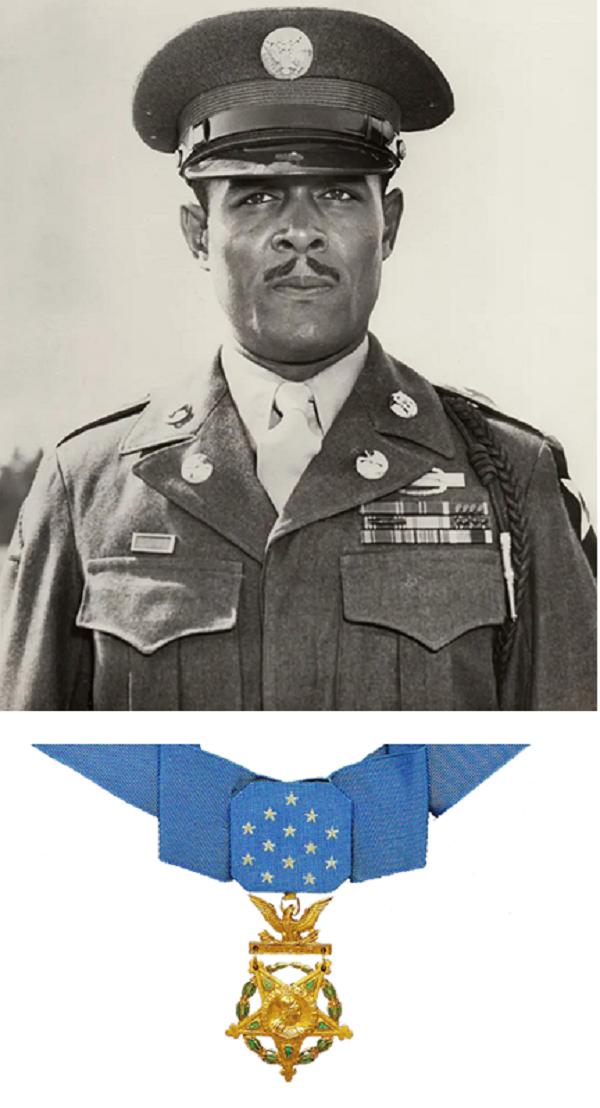
Edward Allen Carter Jr was one of the most remarkable yet long-overlooked American World War II heroes. His story is one of extraordinary battlefield courage, racial injustice, and eventual recognition decades after his deeds. Awarded the Medal of Honor posthumously in 1997, Carter’s life and service illustrate both the heroism of African American soldiers, and the systemic discrimination that long denied them full acknowledgment.
An Unusual Background and Upbringing

Edward Allen Carter Jr. was born on May 26th, 1916, in Los Angeles, California, to American missionary parents. His father was black, his mother East Indian, and his childhood was unusually global. His life can be distilled into his need to fight bad guys. There were many of them in his lifetime, and he went at them hammer and tongs. He first donned his superhero cape at age fifteen to fight Japanese militarism in China. He then took off to take a whack at fascism, to fight General Francisco Franco in the Spanish Civil War. Then, like a video game character working his way up to the Big Boss, he took the Nazis in WWII.
In his childhood, Carter’s family moved to India and later China, where he spent much of his youth. Life overseas exposed him to multiple cultures and languages. By his teenage years he was fluent in several languages, including Hindi, Mandarin, German, and Italian. That cosmopolitan upbringing shaped his worldview and also instilled in him a strong sense of discipline and independence. China was the biggest attraction for Christian missionaries back then, but they were still relatively rare. That in of itself would have set Carter apart while growing up in China. Blacks were even thinner on the ground, which would have set him apart yet even more.
Edward Allen Carter Jr. Fought the Japanese at Age Fifteen

Edward Allen Carter was not exactly a social misfit. However, his background, the restrictions imposed by his religious parents, and the environment in which he grew up, all combined to make him different. Just how different first became clear when he was still a teenager. In his teens, Carter was drawn to conflict zones and causes larger than himself. To be sure, it not unusual for teenagers to act up, rebel, and test boundaries. Carter’s teenage rebellion, though, did not just test boundaries, but shattered them. He did not start to smoke, drink, do drugs, or hang out with delinquents. That was for poseurs and pikers. Instead, he ran away when he was fifteen to go fight the Imperial Japanese Army.
The Great Depression hit Japan hard, as countries resorted to high tariffs and trade restrictions to protect their native industries. That devastated Japan’s export based economy. Nearby, though, was China, with its teeming millions. A perfect market, that would be even more perfect if captive. Literally. When diplomacy failed to convince China to adopt trade policies highly favorable to Japan, the Japanese resorted to arms. In 1932, a red flag operation was staged. Japan falsely claimed it had been victimized by Chinese aggression, and launched a military intervention known as The Shanghai Incident. That gave Carter got his first taste of combat. He ran away at age fifteen, and joined the Nationalist Chinese forces as they fought to beat off Japanese aggression.
A Lieutenant in the Chinese Army

The teenaged Edward Allen Carter fought in the ranks of the Chinese 19th Route Army. He endured aerial bombing from Japanese carrier planes, shelling from Japanese artillery, and ferocious ground attacks from Japanese infantry. Carter showed a knack for fighting, and somehow managed to get a brevet commission to lieutenant in the Chinese Army. His adventure came to abrupt end, however, when his true age was discovered. To Lieutenant Carter’s chagrin, he was yanked out of the front lines, discharged, and returned to his parents. By then, however, he had gotten his first taste of combat, and decided he liked it. He would be back at it before long.
At some point during his brief stint fighting the Japanese in 1932, Carter came to believe that he had been visited by a spirit. It told him that he would become a great warrior, but would not die in war. So he enrolled in a Chinese military school in Shanghai as soon as he was old enough. He took to it like a duck to water. Carter excelled in military studies, and learned German as a fourth language. He added it to English, Hindi, and Mandarin Chinese, all of which he already spoke fluently.
Fighting the Fascists in Spain

Edward Allen Carter became active in leftist politics while he was in China. When the Spanish Civil War erupted in 1936, it drew him like a magnet. The conflict pitted fascists led by General Francisco Franco, generously backed by Mussolini’s fascist Italy and Hitler’s Nazi Germany, against an elected leftist Republican government. Antifascist to the core, Carter decided to fight on the Republican side. He made it to Spain, and enlisted in the Abraham Lincoln Brigade – an American volunteer unit composed primarily of leftists. He served as a machine gunner and ambulance driver, and was wounded in action.
Early exposure to warfare hardened Carter and gave him combat experience far beyond his years. Unfortunately, the bad guys won. As Franco’s fascists surged to victory and the Republican government collapsed, Carter and the rest of the Abraham Lincoln Brigade were forced to flee to France in 1938. From there, he made his way to the United States. Back in his birthplace after having spent most of his life overseas, Carter took a stab at settling down. In 1940, while World War II raged in Europe, he met and married his wife Mildred in Los Angeles.
A Background that Baffled the US Army

Marriage did not keep Edward Allen Carter away from combat for long. As the clouds of conflict drew closer, Carter sensed that it would not be long before America joined the war. So he enlisted in the US Army in September, 1941, just three months before the Japanese attack on Pearl Harbor. At the time, the Army was still segregated, and often deeply discriminatory towards African Americans. Initially assigned to non-combat roles typical for black soldiers back then, Carter served as a supply truck driver and cook. With his background and experience, it took only months before he was promoted to staff sergeant. However, his background and experience also led to the opening of a counterintelligence file on him.
Globetrotting African Americans were rare in those days. Globetrotting African Americas who spoke Hindi, Chinese, and German, and who had fought in the Abraham Lincoln Brigade? Even more rare. The US Army did not know what to make of Carter. Eventually, an unknown intelligence officer deemed it advisable to put him under surveillance because his Spanish Civil War experience meant that he had “been exposed to communism”. The counterintelligence file also noted: “Subject… capable of having connections with subversive activities due to… early years (until 1938) in the Orient”. Carter was shipped to Europe in 1944. The racially segregated US Army had a few black combat units. Despite his combat experience, Carter was not assigned to one of those. Instead, with typical Army logic, he was assigned supply duties.
Edward Allen Carter Had to Fight to be Allowed to Fight

Edward Allen Carter was itching for a combat assignment, but racism kept him away from one. Eventually, his persistence paid off when racism had to make way, at least partially, to the dictates of necessity. On December 16th, 1944, the Germans launched a surprise strategic offensive that caught the Allies off guard. As the ensuing Battle of the Bulge raged and the Army desperately fought to contain the Germans, it ran short of replacement combat troops. So General Dwight D. Eisenhower instituted the volunteer Ground Force Replacement Command for rear echelon troops of all races. Staff Sergeant Carter jumped at the chance to have a go at the Nazis, and immediately volunteered for combat duty. He was reassigned to the 56th Armored Infantry Battalion of the 12th Armored Division.
Carter became one of the relatively few African American soldiers integrated into a frontline infantry unit during WWII. There was a catch, though. The ad hoc units cobbled up by the Ground Force Replacement Command were racially integrated, true. However, they were integrated on the basis that no black soldiers were to command white ones. To join, Carter had to accept a demotion from staff sergeant to private. Taking a whack at the Nazis in person was worth it, so he accepted. On March 23rd, 1945, near Speyer, Germany, he was riding on a tank when it was hit. What followed made Carter an even bigger legend than he already was.
Sublime Heroism

As Edward Allen Carter’s medal citation described it: “When the tank on which he was riding received heavy bazooka and small arms fire, Sergeant Carter voluntarily attempted to lead a three-man group across an open field. Within a short time, two of his men were killed and the third seriously wounded. Continuing on alone, he was wounded five times and finally forced to take cover. As eight enemy riflemen attempted to capture him, Sergeant Carter killed six of them and captured the remaining two. He then crossed the field using as a shield his two prisoners from which he obtained valuable information concerning the disposition of enemy troops”. Carter received the Distinguished Service Cross, the Army’s second-highest award for valor. Under normal circumstances, such heroism would have been awarded a Medal of Honor.
Unfortunately, despite numerous acts of conspicuous gallantry, no African American soldier received a Medal of Honor during WWII. That injustice was not remedied until decades later, when some black soldiers – some such as Carter, posthumously – belatedly received the nation’s highest award for gallantry. Carter spent a month recovering in a hospital from his wounds. He was then restored to his rank of staff sergeant, and spent the rest of the war training troops. He tried to reenlist in 1949, but by then the Red Scare was on and America was in the grip of anticommunist hysteria. Carter’s background in China, which had recently fallen to the communists, and in the Spanish Civil War, where he had fought with the leftists of the Abraham Lincoln Brigade, made him suspect. His bid for reenlistment was denied, and he was discharged from the Army.
The Legacy of Edward Allen Carter

As a civilian, Edward Allen Carter worked in the tire business, and became a dedicated family man. In 1962, he was diagnosed with lung cancer, which doctors attributed to wartime shrapnel still embedded in his neck. It killed him the following year. For decades after his death, his story remained largely unknown outside military circles. It was not until the 1990s, amid a reassessment of racial discrimination in military awards, that he received renewed attention. A 1993 US Army study concluded that racism had unjustly denied African American soldiers the Medal of Honor during WWII. As a result, President Bill Clinton awarded the Medal of Honor to seven African American WWII veterans in 1997.

Carter was among them, and his son accepted the medal on his behalf at a White House ceremony. Today, Edward Allen Carter Jr. is remembered for his fearless actions on the battlefield. He is also remembered as a symbol of perseverance in the face of injustice. His life reflects the paradox faced by many black soldiers: fighting for freedom abroad, while being denied equality at home. His posthumous Medal of Honor did more than honor one man. It served as a reminder of the countless contributions of African American servicemen whose valor was ignored or minimized. His legacy endures as both an inspiration and a call to remember history honestly. It is a call to acknowledge not only acts of heroism, but also the barriers that once obscured them.

________________
Some Sources & Further Reading
California Center for Military History – Staff Sergeant Edward A. Carter, Medal of Honor Recipient
US Army Online – Medal of Honor: African American Hero Recognized Decades After Brave Act
US Department of Defense – Medal of Honor Monday: Army Sgt. 1st Class Edward Carter Jr.
Latest Articles
- The Johnstown Flood – Thousands Perished When A Dam Collapsed After Gilded Age Tycoons Modified it for their Private Resort
- The Jacquerie: The Medieval Peasant Uprising That Terrified France’s Aristocrats
- Things That Weren’t Thought Through: WWII’s Sticky Bomb Stuck to Users’ Hands Once Activated
- German Tanks of World War II – The Panzer 38(t), a Czech Tank in German Service
- Nicholas Alkemade: The WWII Airman Who Survived an 18,000 Foot Fall From a Bomber Without a Parachute

