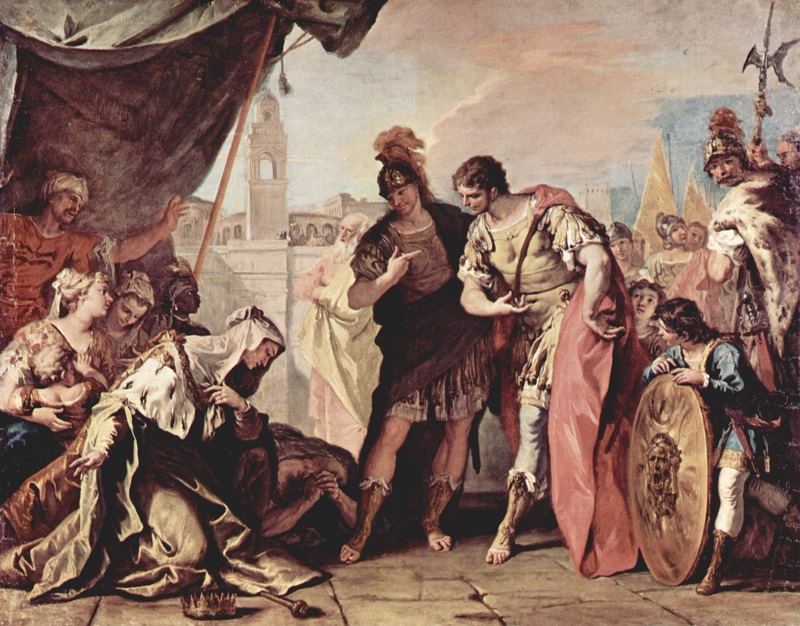
In 333 BC, Alexander the Great defeated Persia’s King Darius III at the Battle of Issus. Darius fled and left behind not only his defeated army, but also his family and harem. It was customary for Persian kings to take their womenfolk with them on campaign. Thus, when Darius fled, he left behind his wife, two daughters, and his mother, Sisygambis. She did not like that one bit. She seems to have despised Darius as a result. In an ancient kind of Stockholm Syndrome, she came to see her captor, Alexander, as her son.
Alexander the Great’s Capture of the Persian King’s Mother

Sisygambis occupies a symbolically rich place in the history of Alexander the Great’s conquest of the Achaemenid Persian Empire. Though she appears only intermittently in the ancient sources, her story illuminates the dramatic collapse of Persia’s last great dynasty. It highlights the complex interplay of dignity, loyalty, and cultural negotiation in the shadow of imperial upheaval. She was the matriarch of the royal house at the moment of its greatest crisis. As such, Sisygambis became a figure around whom themes of loss, pride, and reconciliation were powerfully expressed. Little is known of her early life, and even her exact genealogy remains uncertain. She was almost certainly a member of the wider Achaemenid noble family.
Panic and chaos engulfed the Persian side following Darius’ defeat at Issus. Amidst that confusion, Sisygambis, along with Darius’s wife Stateira, his daughters, and his young son, fell into Macedonian hands. The capture of the women represented a significant political prize, but it also created a delicate cultural situation. They were symbols of royal legitimacy and had to be treated with care. Ancient authors emphasize the humane and respectful treatment Alexander extended to Sisygambis and her family. That served both moral and strategic purposes. When brought before Alexander, Sisygambis prostrated herself before his friend Hephaestion, mistaking him for the Macedonian king. Alexander reassured her “he too is Alexander”, a gesture that conveyed courtesy and soothed her humiliation.
Ancient Stockholm Syndrome

Alexander ensured that the royal women retained their status, clothing, and attendants, and protected them from harassment by his soldiers. It was partly propaganda, partly deft politics. Alexander presented himself not as a barbarian conqueror, but as a just ruler worthy of succeeding the Achaemenids. Sisygambis’s relationship with Alexander evolved into a kind of maternal affection. Although disappointment that Darius had fled and abandoned her, she hoped that he would rally and restore Achaemenid rule. Alexander’s continued successes – Cilicia, Egypt, Gaugamela, and the capture of Babylon, Susa, and Persepolis – guaranteed that would not happen.
When Darius fled east in a final attempt to raise a new army, Alexander piled more royal honors upon Sisygambis and the rest of the royal family, partly to emphasize that he viewed himself as the rightful protector of the empire. Alexander treated Darius’ female relatives with respect. Her son’s flight, however, had filled Sisygambis with contempt for Darius who ran away and left her behind. Alexander defeated Darius once again at the Battle of Gaugamela, and once again, Darius fled the field. When the Persian king was eventually slain, Alexander sent his body to Sisygambis, to mourn for and bury him. Instead, she coldly said: “I have but one son [meaning Alexander] and he is king of all Persia”.
Sisygambis and the Politics of Royal Legitimacy

It seems that in a kind of ancient Stockholm Syndrome, Sisygambis adopted her captor as her real son. Whether that reflects genuine emotion or Greek narrative shaping, it highlights how Alexander’s careful diplomacy paid symbolic dividends. Sisygambis lived quietly during Alexander’s final years, residing in Susa and receiving honors befitting her rank. Her death came in 323 BCE, shortly after Alexander himself died in Babylon. By contrast to her reaction to her own son’s death, Sisygambis went into paroxysms of mourning when Alexander died.
Overwhelmed by grief at the loss of the king who had guaranteed her dignity, she is said to have refused food until she succumbed. That might have been an embellishment. Nonetheless, it encapsulates how later writers transformed her into a tragic emblem of Persia’s fall and Alexander’s imperial charisma. Though her story is filtered through Greek perspectives, Sisygambis was a memorable figure whose conduct exhibited resilience, pride, and adaptability. Her presence in the narrative of Alexander’s conquest underscores the human dimension of imperial collapse, and highlights how royal women could shape, however subtly, political legitimacy.

_________________
Some Sources & Further Reading
Heckel, Waldemar – Who’s Who in the Age of Alexander the Great (2006)
History Halls – George Washington’s Mother, Mary Ball, Kept Making Things Awkward for Her Son
Plutarch – Parallel Lives: Alexander

