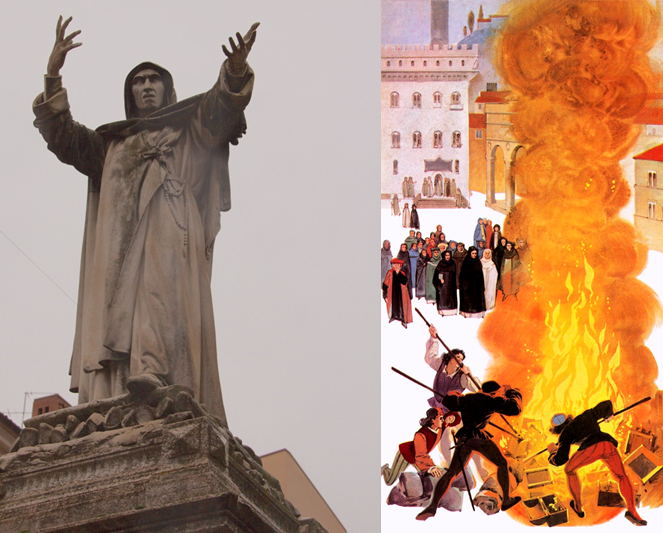
Girolamo Savonarola and the Bonfire of the Vanities stand among the most dramatic episodes of the Italian Renaissance. It was a moment when religious zeal, political upheaval, and cultural brilliance collided in spectacular fashion. Savonarola was a complex figure, and neither a simple fanatic nor a straightforward reformer. His career reveals the deep anxieties beneath Renaissance humanism and the intense moral struggles of late fifteenth-century Italy. His fight against rampant clerical corruption led early Protestants such as Martin Luther to consider him a Protestant Reformation precursor. He is best known, however, for the Bonfire of the Vanities. Often remembered as an act of cultural destruction, it was in fact the visible climax of a broader moral and political revolution that briefly transformed Florence.
A Born Reformer

Girolamo Savonarola was born in Ferrara in 1452, into a family of comfortable means. Initially destined for a secular career, he studied liberal arts and medicine. However, he grew increasingly disillusioned with what he saw as the corruption and vanity of the world. Influenced by the writings of St. Augustine and Thomas Aquinas, he entered the Dominican Order in 1475. From an early stage, Savonarola’s spirituality was marked by a deep sense of moral urgency and an apocalyptic worldview. He believed that God was actively intervening in history, and that divine punishment awaited societies that failed to reform themselves. His biggest pet peeves were clerical corruption, vanity, tyranny, and exploitation of the poor.
Savonarola arrived in Florence in the 1480s, a city then at the height of its cultural and economic power. Under the de facto rule of the Medici family, Florence was a center of art, banking, and humanist learning. Beneath the prosperity, however, lay social tensions, political resentment, and widespread criticism of moral decadence. The Church itself was deeply compromised in the eyes of many Italians. The papacy of Alexander VI, a member of the Borgia family, became synonymous with corruption, nepotism, and scandal. Savonarola’s fiery sermons, delivered in the cathedral of Santa Maria del Fiore, struck directly at those anxieties.
Girolamo Savonarola Sought to Transform Florence Into a New Jerusalem

What set Girolamo Savonarola apart from many preachers was his rhetorical power and prophetic tone. He did not merely condemn sin in abstract terms. He named it, dramatized it, and linked it to Florence’s political destiny. Savonarola attacked luxury, sexual immorality, gambling, pride, and condemned both the Medici and the papacy for their worldliness. He proclaimed that Florence had been chosen by God as a “new Jerusalem”. It was destined either for greatness through repentance, or destruction through moral failure. The sermons drew enormous crowds, and turned Savonarola into one of Florence’s most influential figures.
The turning point in Savonarola’s career came in 1494, when Charles VIII of France invaded Italy. That event shattered the balance of power that had sustained the Italian city-states, and sent shockwaves through Florence. Piero de’ Medici, Lorenzo the Magnificent’s son, proved incapable of managing the crisis and was expelled from the city. In the political vacuum that followed, Savonarola emerged as a moral authority whose prophecies appeared fulfilled. He had predicted foreign invasion as divine punishment, and many Florentines now believed he was guided by God.
A Cultural Revolution in Renaissance Florence

Although Girolamo Savonarola never formally held political office, he exercised immense influence over Florence’s new republican government. He advocated a more inclusive political system with broader participation by citizens, and promoted laws aimed at moral reform. The city became, for a brief period, a theocratic republic in spirit if not in name. Public life was infused with religious symbolism, and Florence tried to reshape itself according to Savonarola’s vision of Christian virtue. It is within that context that the Bonfire of the Vanities must be understood.
The Bonfire of the Vanities was not an isolated outburst, but part of an organized campaign to cleanse Florence of moral corruption. Savonarola encouraged the formation of groups of boys and young men, often called “fanciulli”, to enforce his moral crusade. Like a 1400s version of Chairman Mao’s Cultural Revolution, they went door to door collecting items deemed sinful or frivolous. They included cosmetics, mirrors, perfumes, cards, dice, musical instruments, fashionable clothing, secular books, and paintings with mythological or erotic themes.
The aim was to remove temptations that distracted people from spiritual devotion. On February 7th, 1497, during the Carnival season, the collected objects were piled into a massive pyramid in the Piazza della Signoria. Contemporary accounts describe it as towering several stories high. When it was set alight, the flames consumed not only luxury goods, but symbols of Renaissance culture itself. Masterpieces by artists such as Botticelli were reportedly destroyed, though modern historians debate how extensive this artistic loss truly was.
Clashing With a Corrupt Pope

Regardless of just what or how much was burned by Girolamo Savonarola, the spectacle left a profound impression on observers. The Bonfire of the Vanities was both a religious ritual and a political performance. It dramatized the rejection of worldly excess, and reinforced Savonarola’s authority as Florence’s moral guide. For his supporters, it was an act of purification – a communal sacrifice that aligned the city with God’s will. For his critics, it was an alarming display of fanaticism that threatened artistic freedom, intellectual inquiry, and personal liberty. The event crystallized opposition to Savonarola among humanists, artists, and elites who had once tolerated or even admired him.
Savonarola’s enemies were not limited to Florence. His increasingly open attacks on the papacy brought him into direct conflict with Pope Alexander VI, the Borgia Holy Father. Possibly history’s most brazenly corrupt pope, Savonarola’s anti-corruption crusade was bound to rub Borgia wrong. The pope initially attempted to silence Savonarola through diplomacy, and offered him positions and privileges in exchange for obedience. Savonarola refused, convinced that he was carrying out a divine mission. In 1497, Alexander VI excommunicated him, a sentence Savonarola publicly rejected as unjust and corrupt. That defiance placed him in a perilous position, both politically and spiritually.
The Dramatic Downfall of Girolamo Savonarola

Support for Girolamo Savonarola began to erode in Florence. Economic difficulties worsened, foreign threats loomed, and the promised transformation of Florence into a holy city seemed incomplete. Factions emerged: the “Piagnoni”, or Weepers, who supported Savonarola, and their opponents, who mocked Savonarola and resented his moral strictures. The city’s mood eventually shifted from fervor to fatigue. The Bonfire of the Vanities, once a symbol of renewal, became for many a reminder of loss and repression. The final act of Savonarola’s downfall came in 1498. Under mounting pressure from both the papacy and internal opponents, Savonarola agreed to a trial by fire to prove the divine origin of his mission.
The ordeal descended into chaos and fiasco, with delays, disputes, and sudden rainstorms that prevented the test from taking place. The failure of the trial severely damaged Savonarola’s credibility. Shortly afterward, he was arrested, tortured, and forced to confess under duress. Savonarola was tried for heresy and schism, condemned by both church and civic authorities, and executed on May 23rd, 1498. He was hanged, then burned in the same Piazza della Signoria where the Bonfire of the Vanities had taken place. In a grim irony, the reformer who had sought to purify Florence through fire met his own end in flames. His ashes were scattered in the Arno River to prevent the creation of relics.
A Fanatic, or a Sincere Reformer?

The legacy of Girolamo Savonarola and the Bonfire of the Vanities is deeply contested. For centuries, he was remembered largely as a fanatical enemy of art and culture. He became a symbol of religious extremism opposed to the Renaissance spirit. That view was reinforced by Enlightenment thinkers and later historians who saw the Renaissance as a triumph of reason and creativity over medieval superstition. From that perspective, the Bonfire of the Vanities represented a tragic assault on human achievement. However, other interpretations have emerged.
Savonarola had denounced corruption, called for moral accountability, and emphasized personal faith and repentance. He never abandoned Catholicism. He held on to the belief that Rome’s church, headed by the pope, was the mother of all churches. However, he did protest papal corruption, did not buy into papal infallibility, and used the Bible as his guide. That made him a forerunner of Protestantism. His writings spread and became especially popular in Germany and Switzerland. Some scholars saw him as a sincere reformer who anticipated later movements within Christianity such as the Protestant Reformation and the Catholic counterreformation it inspired. Martin Luther later expressed admiration for Savonarola, and saw him as a martyr who had challenged a corrupt church. In that light, the Bonfire of the Vanities appears less as an act of mindless destruction, and more as a desperate attempt to realign society with spiritual values.
The Legacy of Girolamo Savonarola and the Bonfire of the Vanities

The Bonfire of the Vanities reveals tensions within Renaissance culture. Florence was not just a city of artists and philosophers. It was also a city of intense religious devotion and fear of divine judgment. The same society that produced Botticelli and Michelangelo could also rally behind a preacher who urged the destruction of luxury and art. The Bonfire of the Vanities underscores how fragile the balance between faith and culture could be, and how quickly it could tip toward radical reform. In the end, Savonarola’s vision proved unsustainable. Florence returned to more conventional political arrangements, and the Medici eventually regained power.
Renaissance culture continued to flourish, though never entirely free from moral and religious critique. However, the memory of Savonarola lingered, a reminder that the Renaissance was not a simple march toward modernity. It was actually a period of profound conflict over the meaning of human life, virtue, and salvation. Girolamo Savonarola and the Bonfire of the Vanities thus occupy a unique place in history. They represent a moment when a single charismatic individual reshaped an entire city’s values, if only briefly, and when the promise and peril of moral absolutism were laid bare. The flames that rose in the Piazza della Signoria consumed more than objects. They illuminated the deep contradictions of an age struggling to reconcile earthly beauty with eternal truths.

_________________
Some Sources & Further Reading
History Halls – Unholy Holy Fathers: Alexander VI, the Corrupt Borgia Pope
Martines, Lauro – Fire in the City: Savonarola and the Struggle for Renaissance Florence (2006)
Weinstein, Donald – Savonarola: The Rise and Fall of a Renaissance Prophet (2011)
Newest Articles
- Henry Jennings: The Privateer-Turned-Pirate Who Set the Stage for the Caribbean’s Golden Age of Piracy
- Fighting Women: Tomoe Gozen, the Fearsome Female Samurai
- From the NFL to the Sands of Iwo Jima: Medal of Honor Recipient Jack Lummus
- The Zanj Rebellion: The African Slave Revolt That Rocked Medieval Mesopotamia
- The Dacian Falx: The Curved Ancient Sword that Shocked the Romans

