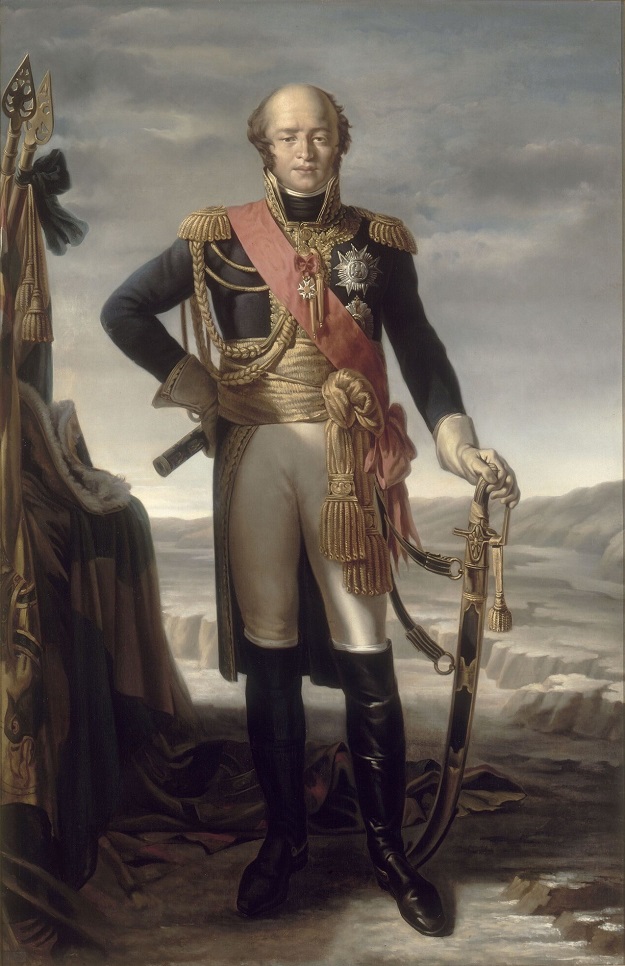
Louis-Nicolas d’Avout, better known as Marshal Davout, was one of the Napoleonic era’s most formidable and intellectually rigorous commanders. Often overshadowed in popular memory by more flamboyant figures such as Murat, Ney, or Lannes, Davout was nonetheless Napoleon Bonaparte’s most consistently effective marshal. His reputation did not rest on dramatic cavalry charges or rhetorical brilliance. It was built instead on a foundation of discipline, meticulous planning, and an unyielding commitment to duty. Nicknamed the “Iron Marshal,” Davout combined tactical brilliance with moral severity. It was a blend that made him respected and feared by soldiers and civilians alike.
An Aristocrat With Republican Sympathies

Louis-Nicolas d’Avout was born on May 10th, 1770, at Annoux in Burgundy into a family of the minor provincial nobility. His father died young and left the family relatively poor, but with a strong sense of honor and obligation. Davout was educated at the Royal Military School in Auxerre. He later transferred to the Ecole Militaire in Paris – the same institution attended by Napoleon. When the French Revolution erupted in 1789, much of the old officer corps was purged. Unlike many aristocratic officers, Davout embraced the French Revolution – a choice that would shape both his career and his character. Davout’s republican sympathies allowed him to remain in service while many of his peers fled or were dismissed.
Davout distinguished himself in the early Revolutionary Wars as an able and reliable officer. He served with the Army of the North and later the Army of the Rhine. That gave him experience in the chaotic and ideologically charged environment of revolutionary warfare. His talents lay less in improvisational daring than in organization, training, and battlefield control. Davout showed a rare ability to maintain discipline among troops who were often poorly trained and politically volatile. His insistence on order and professionalism sometimes put him at odds with more radical elements. He even resigned his commission briefly during the height of revolutionary turmoil rather than compromise his principles.
Napoleon Came to Rely on Marshal Davout for the Most Difficult Tasks

Davout’s fortunes changed dramatically after Napoleon’s rise. Though not initially close to Bonaparte, Davout came to the First Consul’s attention through his competence rather than personal charm. He served under Napoleon in Egypt, where he commanded cavalry forces. He demonstrated both loyalty and restraint in a campaign marked by hardship and moral ambiguity. Unlike some officers who enriched themselves or indulged in excess, Davout maintained strict standards of conduct. That impressed Napoleon, who valued results above all else, and began to rely on Davout for difficult and sensitive commands.
In 1804, when Napoleon crowned himself Emperor and created the first marshals of the Empire, Davout was among those elevated. At just 34 years old, he was one of the youngest marshals, and his promotion was not universally popular. Many older generals resented his severity and lack of social polish. Marshal Davout made little effort to ingratiate himself: he believed that authority flowed from competence and obedience, not popularity. His troops, however, soon learned that he was no mere martinet. Davout’s harsh discipline was paired with an unwavering concern for his men’s effectiveness and survival in battle.
Executing One of History’s Most Epic Forced Marches

Davout’s first defining moment came during the War of the Third Coalition in 1805, at the Battle of Austerlitz. Commanding the III Corps, Marshal Davout executed one of the most demanding forced marches in military history. He covered nearly seventy miles in two days, and arrived in the nick of time to secure Napoleon’s right flank. Once at Austerlitz, exhausted as Davout and his troops were, they bore the brunt of the initial Allied assault. They held firm under immense pressure. His ability to maintain cohesion and resist superior numbers allowed Napoleon to execute his decisive counterstroke against the enemy’s center. Austerlitz cemented Davout’s reputation as a commander who could be trusted in the most critical circumstances.
Even greater fame followed during the War of the Fourth Coalition, at the twin battles of Jena-Auerstadt, October 14th, 1806. At the Battle of Auerstedt, Davout achieved what many consider his greatest victory. Napoleon had split his forces in order to counter a divided Prussian army. He kept the main French army under his own command to take on the main Prussian army at Jena. He then sent Davout with a single corps of about 25,000 men on a flanking march. The marshal’s instructions were to interdict the main Prussian force’s supplies, and prevent them from getting reinforcements. Le Empereur had misjudged the situation and got it backwards, however. It was Napoleon who faced the smaller force, and Davout who found himself confronted with the main Prussian army.
The “Iron Marshal”

Marshal Davout, with a corps of 25,000 men, ran into the main Prussian army of about 64,000 men at Auerstadt. Rather than retreat, Davout decided to take on the Prussians. He deployed his corps with remarkable skill, exploited terrain, disciplined infantry formations, and aggressive counterattacks to fight an epic battle. The twin battles of Jena-Auerstadt, separated by about twenty miles, were fought on the same day. Napoleon won at Jena, but Davout won an even more impressive victory at the Battle of Auerstadt. Although outnumbered nearly three to one, Davout crushed the main Prussian army commanded by the Duke of Brunswick and King Frederick William III. That victory earned Davout the nickname “Iron Marshal”.
When he received word, Napoleon initially refused to believe that Marshal Davout had stolen his thunder. He doubted that his subordinate could have defeated the main Prussian army on his own with a single corps. He mocked Davout, who wore spectacles, for having such poor eyesight that he was seeing double. Napoleon finally accepted facts when it became clear that Davout had, indeed, pulled off an incredible deed. In acknowledgement, he granted Davout and his men the honor of entering Berlin first on October 25th. He later granted Davout the title 1st Duke of Auerstadt.
A Harsh Taskmaster

After Prussia was defeated, Marshal Davout was entrusted with governing Berlin and later large portions of occupied territory. In that capacity, his austere character became even more apparent. He enforced contributions, requisitions, and laws with relentless efficiency. That earned him deep hatred from the local population, but ensured order and steady supplies for the French army. Davout saw occupation as a military necessity rather than a political or humanitarian exercise. While less brutal than some occupation regimes, his administration was uncompromising, and he showed little tolerance for resistance or evasion.
Davout’s loyalty to Napoleon remained unshakable throughout the Empire’s rise and eventual decline. During the 1809 War of the Fifth Coalition against Austria, he again commanded effectively. At the Battle of Eckmuhl, his precise maneuvers helped defeat Archduke Charles. Napoleon rewarded him further, and made him 1st Prince of Eckmuhl, one of the most powerful figures in the Empire. Despite such honors, Davout never became a courtier. He avoided the social life of Paris, and focused instead on military administration and readiness.
The most revealing test of Davout’s character came in the later years of the Empire. Especially after the disastrous Russian campaign of 1812. Unlike many marshals whose reputations collapsed amid defeat and confusion, Marshal Davout retained cohesion and discipline among his forces. Though he suffered losses and endured immense hardship, he did not abandon his responsibilities or seek excuses. In 1813, during the German campaigns, he was tasked with holding Hamburg, a strategically vital port. As Allied forces closed in, Davout conducted one of the most stubborn and methodical defenses of the Napoleonic Wars.
Marshal Davout at Hamburg

The defense of Hamburg from 1813 to 1814 became a symbol of Davout’s iron will. Isolated, short of supplies, and facing superior enemy forces, Marshal Davout maintained strict order within the city. He refused to surrender even after Napoleon abdicated in April, 1814. Only after receiving official confirmation from the restored Bourbon government did he finally evacuate the city. His refusal to capitulate earlier was criticized by some as pointless obstinacy. Others saw it as a demonstration of unwavering loyalty, and a strict interpretation of military honor.
Davout initially fell from favor during the Bourbon Restoration. Unlike some marshals who quickly aligned themselves with the new regime, Davout remained aloof and distrustful. His association with Napoleon and his reputation for severity made him suspect. During the Hundred Days in 1815, he immediately rallied to Napoleon upon his return from Elba. Appointed Minister of War, Davout undertook the monumental task of rebuilding the French army in a matter of weeks. His organizational genius was on full display, though he did not take field command during the Waterloo campaign.
The Legacy of Marshal Davout

After Napoleon’s final defeat at Waterloo, Davout faced political marginalization and temporary exile. However, he avoided the harsher punishments inflicted on some of his peers like marshals Ney and Murat, who were executed. Over time, Davout’s reputation for integrity and professionalism led to partial rehabilitation. He served in the Chamber of Peers and remained a respected, if reserved, figure until his death on June 1st, 1823. Unlike many Napoleonic figures, Davout left no memoirs filled with self-justification or romantic exaggeration. That silence reflected his character as much as any battlefield exploit.
The legacy of Marshal Davout is that of a soldier’s soldier. He was not beloved, nor did he seek to be. His contemporaries often described him as cold, rigid, and unforgiving. However, even his critics acknowledged his honesty and courage. He demanded obedience, but did not waste lives carelessly. He punished looting and indiscipline, but ensured his men were trained, supplied, and used effectively. Napoleon himself famously remarked that if he had two marshals like Davout, he would have conquered the world.
Davout represents the ideal of professional command in an age of revolutionary chaos and imperial ambition. His victories were not accidents of luck or flashes of brilliance. They were the product of thorough preparation, discipline, and clear thinking under pressure. He is less known and celebrated in popular culture than other, more romantic and dashing marshals. However, historians increasingly recognize Davout as one of the greatest commanders of the Napoleonic Wars. His career offers a stark contrast to the romantic image of war, emphasizing instead the hard, often thankless virtues that usually win battles and sustain armies.

_________________
Some Sources & Further Reading
Chandler, David G. – Napoleon’s Marshals (2000)
Gallaher, John G. – The Iron Marshal: A Biography of Louis N. Davout (1976)
History Halls – Bernadotte: The Napoleonic French Marshal Who Became King of Sweden
Keefe, Major John M. – Marshal Louis N. Davout and the Art of Command (2015)
Newest Articles
- The Brink’s-Mat Robbery: Britain’s Biggest Gold Heist
- Fighting Women: Artemisia I of Caria Led Her Ships at the Battle of Salamis
- Alexander the Great and Sisygambis, Mother of Persia’s King Darius III
- Unholy Holy Fathers: Pope Leo X’s Corruption Was So Brazen, it Triggered the Protestant Reformation
- Edward England, the Humane Pirate Captain Deposed by His Men for Being Too Nice

