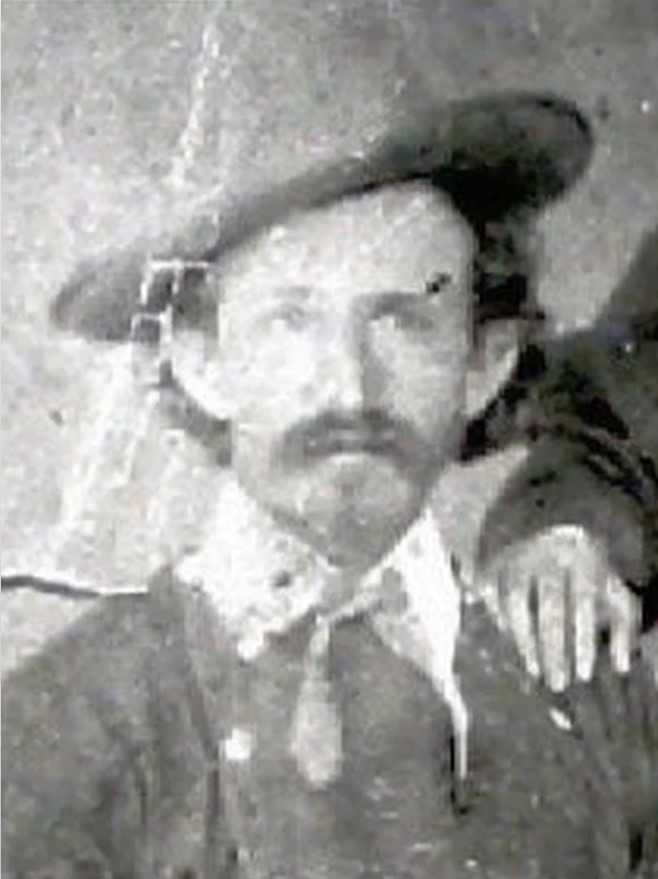
Charlie Bowdre was a little-known but significant figure of the American Old West. He is remembered chiefly for his association with Billy the Kid and the Lincoln County War in New Mexico. Though overshadowed by more famous contemporaries, Bowdre’s life reflects the volatile mix of personal loyalty, frontier violence, and lawlessness that characterized the Southwest in the late nineteenth century.
Charlie Bowdre and the Regulators in the Lincoln County War

Charles “Charlie” Bowdre was born around 1850, likely in Mississippi or Georgia. His childhood and teenage years were marked by the Civil War and its aftershocks. Like many young men of his generation, he drifted west in search of opportunity, work, and a fresh start. By the mid-1870s he had arrived in the New Mexico Territory. It was a land where cattle ranching, mercantile competition, and weak law enforcement created fertile ground for conflict. He joined posses that hunted down cattle rustlers, and lynched those they caught. In 1876, he was part of a mob that stormed the Lincoln County jail to seize an imprisoned rustler. They took him to the outskirts of town, where he was hanged. Bowdre settled in Lincoln County, an area dominated by rival business factions whose disputes would soon explode into open warfare.
Bowdre became associated with a group later known as the Regulators. It was a loosely organized band formed to avenge the murder of English rancher John Tunstall in 1878. Tunstall’s murder by men aligned with the powerful Murphy-Dolan faction triggered what became known as the Lincoln County War. It was a bloody feud that involved hired gunmen, corrupt law officers, and competing economic interests. Bowdre aligned himself with Billy the Kid, whose charisma and skill with firearms made him the most famous Regulator. At the time, though, he was just one among several young men seeking justice and survival. Deputized and armed with warrants for the apprehension of accused murderers and factional opponents, the Regulators tracked down and killed a number of men for “resisting arrest”.
From Deputized Lawman to Outlaw

Within the Regulators, Charlie Bowdre was considered loyal and dependable, rather than flamboyant. Contemporaries described him as quiet and steady – a man who followed orders and stood by his companions in dangerous situations. He participated in several key ambushes and skirmishes against rivals and their associated lawmen during the Lincoln County War. Although not always named in detailed accounts, Bowdre was present during much of the violence that cemented the Regulators’ outlaw status. As the conflict dragged on, the Regulators gradually lost legal and popular support.
Eventually, the territorial governor decreed that the justice of the peace who had commissioned the Regulators had been illegally appointed. He had thus lacked the authority to issue the warrants enforced by the Regulators. That transformed Bowdre’s group overnight from a legal posse to outlaws. Warrants were issued against the former deputized avengers who were now rebranded as criminals. They became criminals in fact. The Regulators’ remnants, now led by Billy the Kid, became a cattle thieving gang appropriately renamed the “Rustlers”. Bowdre remained with Billy the Kid as the group fractured and many members were killed, captured, or fled the territory. By 1880, Bowdre was an outlaw who moved from place to place to avoid arrest. He supported himself through cattle rustling and other crimes commonly associated with survival on the margins of frontier society.
A Tragic if Unsurprisingly Violent End

The personal life of Charlie Bowdre offers a glimpse into the contradictions of the outlaw world. He was married to Manuela Bowdre, a Hispanic woman from New Mexico. He lived for a time with her on a small ranch near Fort Sumner. That domestic existence coexisted uneasily with his life as a fugitive outlaw. The couple attempted to build a stable home even as Charlie remained entangled in violence and criminal pursuits. Their ranch became a gathering point for Billy the Kid and his remaining companions.

Unsurprisingly, Bowdre came to a violent end. In 1880, he joined the Rustlers in a failed attempt to assassinate lawman Pat Garrett. A gunfight ensued, and Bowdre and the surviving were forced to flee. On December 23rd, 1880, Garrett and a posse tracked Billy the Kid’s gang to their Fort Sumner hideout. In the early morning darkness, Bowdre stepped outside a house and was shot multiple times by Garrett or a deputy. He fell back into the house, mortally wounded. Billy the Kid reportedly urged him to “take a few of them with you when you die”.
Although too weak to unholster his pistol, Bowdre staggered to his feet to charge out the door. He was met by another hail of gunfire and instantly killed. His was one of the final fatalities of the Lincoln County War’s long aftermath. Though history remembers him largely as a secondary character, Bowdre’s story embodies the tragic trajectory of many frontier figures. Drawn into conflict by loyalty and circumstance, he lived briefly between domestic hopes and outlaw realities. He was eventually destroyed by the violence of the path he chose.

_________________
Some Sources & Further Reading
Caldwell, Clifford R. – Dead Right: The Lincoln County War (2011)
History Halls – Johnny Ringo, the Tragic Wild West Outlaw
Utley, Robert M. – Billy the Kid: A Short and Violent Life (1991)
Newest Articles
- Henry Jennings: The Privateer-Turned-Pirate Who Set the Stage for the Caribbean’s Golden Age of Piracy
- Fighting Women: Tomoe Gozen, the Fearsome Female Samurai
- From the NFL to the Sands of Iwo Jima: Medal of Honor Recipient Jack Lummus
- The Zanj Rebellion: The African Slave Revolt That Rocked Medieval Mesopotamia
- The Dacian Falx: The Curved Ancient Sword that Shocked the Romans

