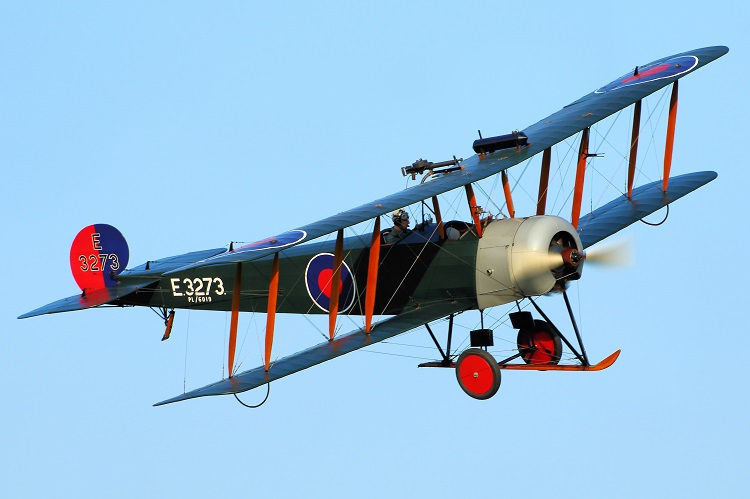
The British Avro 504 was the most produced warplane of World War I. It was one of the early twentieth century’s most significant airplanes, and an aviation cornerstone during and after WWI. Designed by A. V. Roe and Company (Avro), it blended simplicity, reliability, and adaptability. That combination made it one of its era’s most produced and influential airplanes. Although it was soon outclassed as a frontline combat aircraft, the Avro 504’s lasting legacy lies in its role as a trainer. It shaped generations of pilots, and helped professionalize military aviation.
Early WWI Successes

The Avro 504 first flew in September, 1913, when powered flight was still in its infancy. Its designer, Roy Chadwick working under A. V. Roe, produced a conventional two-seat biplane. It had a wooden frame, fabric covering, fixed landing gear, and a 36 feet or 11 meters wingspan. In its earliest form, it was powered by an 80-horsepower Gnome rotary engine. That modest power plant gave the 504 a top speed of roughly 95 miles per hour or 150 km/h. That was adequate for the period, but hardly exceptional even by early war standards. What set the 504 apart, however, was its excellent handling and forgiving flight characteristics. It was stable, predictable, and easy to fly.
When WWI began in August, 1914, the Avro 504 was quickly taken into service by the Royal Flying Corps (RFC) and the Royal Naval Air Service (RNAS). Initially, it was used for reconnaissance and light bombing. One of the 504’s most famous early actions occurred on November 21st, 1914, when RNAS pilots flew a daring raid on the Zeppelin sheds at Friedrichshafen in Germany. Although the material damage was limited, the psychological impact was considerable. The raid demonstrated that airplanes could strike targets deep behind enemy lines.
An Adaptable Airplane

Despite early exploits, the Avro 504 soon proved vulnerable in combat. It was slow, lightly armed, and lacked the structural strength to carry heavier weapons or armor. As air combat rapidly evolved, faster and more heavily armed aircraft took over frontline roles. By 1915, the 504 was increasingly relegated to training duties. In that role, it would excel far beyond its brief combat career. As a trainer, the Avro 504 became indispensable. Its docile handling made it ideal for novice pilots learning flight fundamentals. It could tolerate rough landings and pilot errors that would have destroyed more temperamental machines. That reliability was crucial during a period when pilot training was rushed and accidents were common.
Thousands of British and Commonwealth pilots took their first solo flights in an Avro 504. That made it one of the most familiar aircraft in aviation history. Numerous 504 variants were produced, reflecting its adaptability. The 504K, fitted with a universal engine mount, was the most famous version. It allowed different rotary engines to be installed depending on availability. That flexibility simplified maintenance and production, particularly during wartime shortages. Other versions were adapted for anti-aircraft gunnery training, communications, and even early experiments in night flying. Some were equipped with skis for winter operations, while others were modified for floatplane use.
Legacy of the Avro 504

The influence of the Avro 504 extended far beyond Britain. It was exported widely and built under license in several countries, including France, Italy, Japan, and Russia. In fact, the Soviet Union produced large numbers of Avro 504 derivatives well into the 1920s. Known as Avrushkas (“little Avros”), they were used as trainers and utility aircraft during the Red Air Force’s formative years. Few of that era’s aircraft designs enjoyed such an international career. Surplus Avro 504s flooded the civilian market after the war. Many were converted for private flying, barnstorming, and aerial displays, which helped popularize aviation with the public. Flying clubs and civilian training schools relied heavily on the 504, as it was cheap to operate and well understood. In such roles, the 504 helped bridge the gap between wartime aviation and the emerging peacetime aviation industry.
By the late 1920s, the Avro 504 was becoming obsolete. So it was gradually replaced by more modern trainers with metal structures and more powerful engines. Nevertheless, its impact was profound. It was the most produced warplane of WWI, with about 9,000 made during the conflict. By the time production ended in 1932, more than 10,000 had been manufactured. Above all, the Avro 504 trained an entire generation of pilots and laid the groundwork for modern flight instruction. Its significance lay not in aerial victories or cutting-edge technology. Its legacy lay in the essential role it played in making aviation practical, reliable, and accessible.

_________________
Some Sources & Further Reading
Bruce, J.M. – The Aeroplanes of the Royal Flying Corps Military Wing (1982)
History Halls – WWI Fighters: The Sopwith Pup, British Pilot’s Most Beloved Airplane
Jackson, A. J. – Avro Aircraft Since 1908 (2000)
Newest Articles
- The Johnstown Flood – Thousands Perished When A Dam Collapsed After Gilded Age Tycoons Modified it for their Private Resort
- The Jacquerie: The Medieval Peasant Uprising That Terrified France’s Aristocrats
- Things That Weren’t Thought Through: WWII’s Sticky Bomb Stuck to Users’ Hands Once Activated
- German Tanks of World War II – The Panzer 38(t), a Czech Tank in German Service
- Nicholas Alkemade: The WWII Airman Who Survived an 18,000 Foot Fall From a Bomber Without a Parachute

