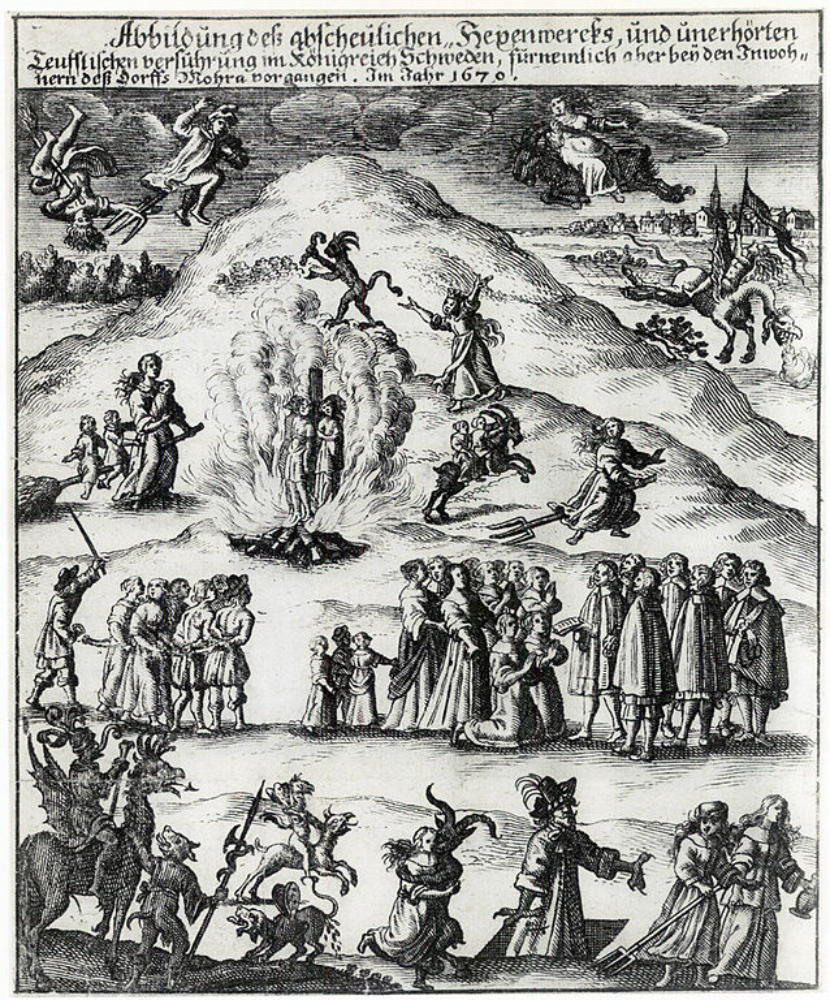
Laurentius Hornaeus was a central figure in one of the darkest and most tragic episodes of seventeenth-century Scandinavian history. In 1675, he became the driving force behind mass witch trials and executions in the parish of Torsaker. His involvement illustrates how religious authority, social panic, and unquestioned belief in supernatural evil combined to produce catastrophic consequences.
Laurentius Hornaeus

Although he was not a judge or executioner, Laurentius Hornaeus’ influence as a Lutheran pastor was immense in Torsaker. His actions helped legitimize the accusations that led to the deaths of seventy-one people in a single day. That mass execution remains the largest witchcraft execution in the history of Sweden. Hornaeus was born into a clerical family in the early seventeenth century. His father had been a minister, and Hornaeus followed the same path. He joined the Lutheran clergy, and eventually became pastor of Torsaker parish in the province of Angermanland.
The Lutheran Church in seventeenth century Sweden was not merely a religious institution. It was a central pillar of society, closely integrated with the state. Pastors were responsible not only for spiritual instruction, but also for moral discipline, education, and local governance. Their authority extended deeply into the parishioners’ daily lives, and their judgments carried enormous weight. Hornaeus was considered an educated and devout man by the standards of his time. He was trained in Lutheran theology, which emphasized the ongoing struggle between divine and demonic forces.
“The Great Noise” and the “Revealing Boys”

In seventeenth century Europe, belief in witchcraft was not seen as superstition: witches were seen as real and present dangers. In Sweden, clergy were taught that the Devil actively worked through human agents to corrupt souls and undermine Christian society. Within that worldview, witches were not merely criminals, but servants of Satan engaged in spiritual warfare. The witch panic that reached Torsaker was part of a broader phenomenon in Sweden. Known as Det stora ovasendet, or “The Great Noise”, it lasted from roughly 1668 to 1676. During this period, witchcraft accusations spread rapidly across the country, driven by fear, religious fervor, and the testimony of children.
Witchcraft accusations until then had often focused on harmful magic against individuals. Swedish witch trials during this period, however, frequently centered on claims by children known as Visgossar, or “revealing boys”. Visgossar supposedly had the ability to reveal witches who had abducted and taken them to a place called Blakulla. There, the witches allegedly met the Devil, renounced Christianity, and participated in blasphemous rituals. It was, of course, nonsense, but it was nonsense that was believed. It thus gave life and death power to children who made up whatever fantastic tales of evil and debauchery their imaginations could contrive, and accused women – especially unpopular women – of all kinds of heinous things.
Laurentius Hornaeus Fed and Fueled Sweden’s Worst Witch Panic

Witchcraft accusations began to circulate in Torsaker in the early 1670s. Children claimed they had been taken from their homes at night and transported through the air to Blakulla. Their stories included vivid descriptions of feasts, dances, and demonic ceremonies. The children of Torsaker named specific adults in their community as the perpetrators. Rather than dismiss the stories as imagination or fantasy, many adults, including Laurentius Hornaeus, believed them to be true. He played an active role in investigating these claims.
Hornaeus questioned children extensively, and treated their testimony as credible evidence. At least, so long as it was what he wanted to hear. When the children did not mouth the evidence he sought, Hornaeus whipped them, dunked them in ice cold water, put them in ovens and threatened to bake them alive, and otherwise pressured them to say what he wanted. His position as pastor gave him both authority and responsibility to address what he believed was a grave spiritual threat. He recorded testimonies, helped identify suspects, and encouraged further questioning.
Hornaeus’ involvement lent religious legitimacy to the accusations, and reinforced the belief that witches were present in the community. As accusations spread, fear gripped the parish. Neighbors began to suspect one another, and longstanding tensions and resentments surfaced. Individuals who were socially marginal, eccentric, or unpopular were particularly vulnerable to accusations. However, the panic in Torsaker became so widespread that even respected members of the community were accused. Entire families were implicated, and those accused were arrested and interrogated. Although torture was officially limited under Swedish law, intense psychological pressure was applied.
Identifying Witches

The accused were urged to confess and repent. In seventeenth century Catch-22, confession was seen as proof of guilt, but denial was also interpreted as evidence of deception and allegiance to the Devil. That created a situation in which the accused had little chance of escaping condemnation. Hornaeus believed he was performing a necessary and righteous duty. He saw himself as protecting his congregation from demonic influence, and saving souls from eternal damnation. His sermons reinforced the fear of witchcraft and the need for vigilance.
Laurentius Hornaeus encouraged the accused to confess and seek forgiveness. He believed that repentance could at least save their souls, even if their bodies were condemned. In 1675, the accused witches were brought to trial. Civil authorities, supported by clergy including Hornaeus, examined the evidence. Much of the evidence consisted of testimony from children, which was accepted with little skepticism. Two boys stood at the church’s door to identify witches as they entered by an invisible mark on their forehead.
One of the boys identified Hornaeus’ wife, who immediately slapped him. The boy promptly apologized, and said he had made a mistake because he was blinded by the Sun. Despite flimsy evidence, the court convicted seventy-one individuals of witchcraft. It was an extraordinary number, especially given the small size of the parish. The condemned included sixty-five women – a fifth of all women in Torsaker – plus two men and four boys. The inclusion of boys highlights the panic’s indiscriminate nature. Witchcraft accusations had expanded beyond the traditional stereotype of elderly women to include individuals of various ages and genders.
Sweden’s Biggest Mass Execution of Witches

On June 1st, 1675, the condemned were taken to a site known as Haxberget, or “Witch Mountain.” There, they were killed in a mass execution that has no parallel in Swedish history. The victims were beheaded, which was considered a more merciful form of execution than burning alive, and their bodies were then burned. The burning symbolized complete condemnation and destruction of the witch’s physical presence. Even by the standards of the time, the legality of the executions was questionable.
The local courts and authorities did not have the legal right to carry out executions. They could conduct trials, but their sentences were to then be reported to a higher court. Only if that court confirmed the sentences were executions to be carried out. None of that happened in Torsaker. The local court and authorities accused, tried, condemned, and executed the suspects without any higher court confirmation. Hornaeus was present at the executions. His role was to provide spiritual guidance to the condemned in their final moments. He urged them to confess and repent, believing he was helping save their souls.
Hornaeus believed he was performing an act of compassion within the framework of his religious beliefs. To modern observers, however, his role was deeply troubling. He was not merely a passive witness, but an active participant in a system that condemned innocent people. His authority helped create the conditions that made the executions possible. The executions devastated the community. Seventy-one people represented a significant portion of Torsaker’s adult population. Families were destroyed, children were left orphaned, and the social fabric of the parish was severely damaged. The psychological trauma endured by survivors was profound.
Belated Reforms

Ironically, the Torsaker executions occurred near the end of Sweden’s witch panic. Doubts had begun to emerge elsewhere in the country about the reliability of child testimony. Investigations revealed that children had sometimes been influenced by suggestion, pressure, or fear. Authorities began to question whether the accusations were credible. When the wave of witchcraft hysteria finally reached the capital, skepticism reached the highest levels of government, including the court of Charles XI. Royal authorities ordered greater caution and stricter standards of evidence.
Visgossar kids began to be questioned more rigorously, and it soon became apparent that they were just making things up. Two of the worst children, a boy and a girl, were executed by hanging. In Torsaker, the boys who had pointed out witches at the church door were found with their throats cut. That had an understandably chilling effect on other children inclined to perjure themselves by naming witches. Witchcraft accusations, hurled about so cavalierly until then, promptly dried up. By 1676, the witch trials had largely come to an end. Officials recognized that many innocent people had likely been executed.
Despite his central role in the Torsaker trials, Laurentius Hornaeus faced no punishment or formal condemnation. He remained a respected pastor and continued his career. That lack of accountability reflects the fact that his actions were considered legitimate at the time. He had acted within the accepted framework of religious and legal authority. Later accounts suggest that Hornaeus may have expressed some regret, but there was no official acknowledgment of wrongdoing. He lived out the remainder of his life as a clergyman, respected by his community.
The Legacy of Laurentius Hornaeus

Historians have debated how to judge Laurentius Hornaeus. Some view him as a fanatic who helped perpetuate injustice. Others see him as a product of his time, shaped by widely-shared beliefs and pressures. He was not uniquely cruel or malicious, but he was deeply committed to a worldview that made the executions possible. His story illustrates how ordinary individuals can participate in extraordinary acts of injustice when guided by fear and belief. He did not see himself as a villain, but as a servant of God performing his duty. That makes his story all the more disturbing, as it demonstrates how sincere conviction can lead to tragic consequences.
The Torsaker witch trials remain a powerful example of mass hysteria and institutional failure. They show how fear, authority, and social pressure can override reason and compassion. The role of Laurentius Hornaeus highlights the influence that religious leaders can wield and the responsibility that accompanies such authority. Today, the events at Torsaker serve as a reminder of the dangers of unquestioned belief, and the importance of skepticism and due process. They stand as a testament to the human cost of fear, and the need for critical thinking in the face of extraordinary claims. Laurentius Hornaeus remains a symbol of how deeply held beliefs, when combined with institutional authority and social panic, can lead to irreversible tragedy.

_________________
Some Sources & Further Reading
Hogman, Hans – The Torsaker Witch Trial of 1675 and the Clergyman Hornaeus
Klaits, Joseph – Servants of Satan: The Age of the Witch Hunts (1985)
Newest Articles
- The Johnstown Flood – Thousands Perished When A Dam Collapsed After Gilded Age Tycoons Modified it for their Private Resort
- The Jacquerie: The Medieval Peasant Uprising That Terrified France’s Aristocrats
- Things That Weren’t Thought Through: WWII’s Sticky Bomb Stuck to Users’ Hands Once Activated
- German Tanks of World War II – The Panzer 38(t), a Czech Tank in German Service
- Nicholas Alkemade: The WWII Airman Who Survived an 18,000 Foot Fall From a Bomber Without a Parachute

