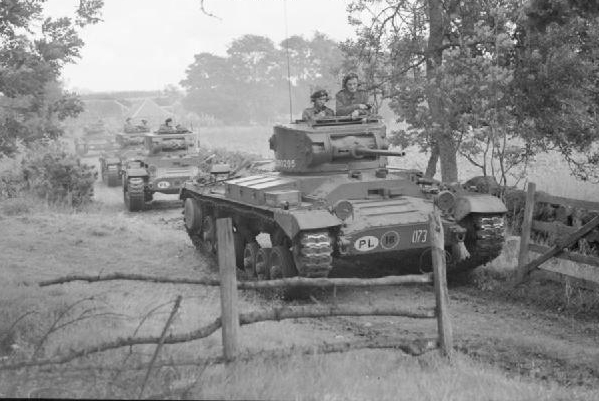
The British Valentine tank was one of the most numerous and long-serving armored vehicles of World War II. Designed in the late 1930s, it was notable not for technical brilliance, but for reliability, adaptability, and sheer availability. It was named either after tank designer Sir John Valentine Carden or, according to a popular legend, because its design proposal was submitted on Valentine’s Day. It emerged at a moment when Britain urgently needed modern armor that could be produced quickly and in large numbers. The result was a vehicle that, while conservative in design, proved invaluable across multiple theaters of war.
An Improved Infantry Tank

The Valentine originated as a private venture by Vickers-Armstrong. The idea was to improve upon earlier cruiser and infantry tank concepts by creating a compact, well-protected vehicle. The British Army was initially uninterested, but had second thoughts as war approached and deficiencies in existing tanks became clear. So it accepted it into service in 1940 with the official designation Infantry Tank Mark III, Valentine. As an infantry tank, it was intended to advance slowly with foot soldiers and provide close support. Armor protection was emphasized over speed. That philosophy shaped every aspect of its design.
One of the Valentine’s defining features was its low silhouette, as the hull and turret were relatively small. That made the tank harder to spot and hit – a significant advantage on the battlefield. Early models were powered by gasoline engines, later replaced in many variants by more efficient and safer diesels. Those later variants included Canadian-built Valentines that used General Motors power plants. The suspension system, while unspectacular, was robust and able to handle rough terrain with minimal maintenance. That contributed to the tank’s reputation for mechanical reliability.
Not a World Beater, but Appreciated for Reliability

Armament evolved over the Valentine’s long production run. Early versions mounted the 2-pounder (40 mm) gun, which was effective against most German tanks in 1940–1941. It lacked a high-explosive shell, however, which limited its usefulness against infantry and fortifications. Later variants were equipped with the more versatile 6-pounder (57 mm) gun, which improved anti-tank performance. The tradeoff was a more cramped two-man turret and an overworked commander, who now also had to serve as loader. Attempts to fit larger 75 mm guns were limited by the Valentine’s small turret ring, highlighting the design’s inherent constraints.
Despite shortcomings, Valentines saw extensive service, starting with deployments in Britain’s defense against anticipated invasion. It first saw combat in the North African campaign, where its thick armor proved resistant to many Italian and early German anti-tank weapons. While slower than cruiser tanks and increasingly outgunned as the war progressed, the Valentine’s dependability made it popular with crews. Especially in harsh desert conditions, where mechanical breakdowns could prove fatal. It was later used in the Italian campaign, though by then it was largely relegated to secondary roles.

The Valentine’s most significant service was with the USSR. Through Lend-Lease, Britain supplied thousands of Valentines to the Red Army, making it one of the most common British tanks used on the Eastern Front. Soviet crews generally appreciated its armor protection, reliability, and diesel engine, which reduced the risk of fire. However, they criticized its weak armament and cramped interior. Even so, Valentines fought from the Arctic Circle to the Caucasus, taking part in key battles from 1941 through 1944.
Significance and Legacy of the Valentine

The Valentine also served as a versatile chassis for specialized vehicles, such as bridge-layers and command tanks. A notable version was the Valentine DD (Duplex Drive) amphibious tank, used for training and in limited operational roles ahead of the Normandy landings. There was also the Archer tank destroyer, which mounted a powerful 17-pounder gun in a rear-facing configuration. Such derivatives based on a Valentine chassis extended the design’s relevance late into the war. Production of the Valentine was remarkable for its scale and geographic spread. Built in Britain and Canada, more than 8,000 units were manufactured between 1940 and 1944. That made it the most produced British tank of the war. Indeed, the Valentine represented a quarter of British WWII tank production.
The Valentine’s longevity in production was not a reflection of cutting-edge performance. Instead, it was because of a balance of simplicity, durability, and adaptability that suited Britain’s industrial and strategic needs. In retrospect, the Valentine was never the best tank on the battlefield. It was one of the most useful, though. At a time when Britain faced severe shortages and rapid technological change, the Valentine provided a dependable armored backbone that could be built in large numbers and sent wherever it was needed. Its widespread use and longevity ensured its place as a quiet but essential contributor to the Allied war effort.

_________________
Some Sources & Further Reading
Chamberlain, Peter, and Ellis, Chris – British and American Tanks of World War Two (2004)
Fletcher, David – The Great Tank Scandal: British Armour in the Second World War (1989)
History Halls – British Tanks of WWII: The Rugged Churchill
Newest Articles
- Edward England, the Humane Pirate Captain Deposed by His Men for Being Too Nice
- American Presidents: Abraham Lincoln, Hall of Fame Wrestler
- Henry Jennings: The Privateer-Turned-Pirate Who Set the Stage for the Caribbean’s Golden Age of Piracy
- Fighting Women: Tomoe Gozen, the Fearsome Female Samurai
- From the NFL to the Sands of Iwo Jima: Medal of Honor Recipient Jack Lummus

