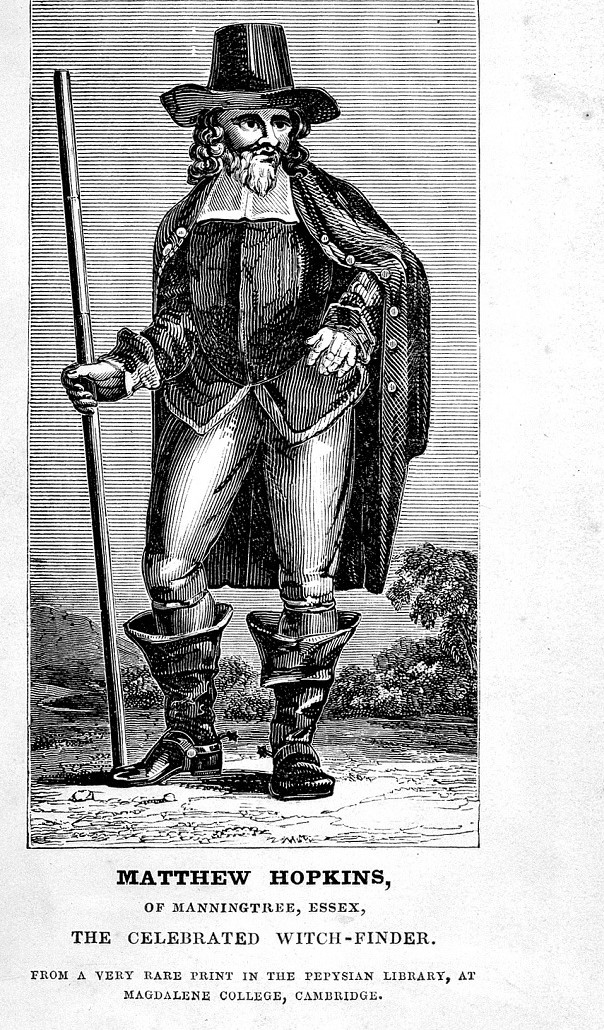
Matthew Hopkins, commonly remembered by the dramatic title “Witchfinder General”, was one of the English witch-hunting craze’s most sinister figures. His career lasted scarcely three years, but the scale of his activities and ferocity of his persecutions made him infamous. His story, entangled with civil war, religious extremism and social upheaval, reveals much about early modern England.
An Era of Witchcraft Fears and Professional Witch Finders

Matthew Hopkins was born around 1620, probably in Great Wenham, Suffolk. His father, James Hopkins, served as minister of nearby St. John’s parish. Relatively little is known about his early years, and no university records confirm a formal higher education. However, his writings reveal a high degree of literacy and familiarity with legal and theological arguments. His family background placed him within the puritan‐leaning middling classes of East Anglia. At the time, the region was steeped in zealous Protestantism, and susceptible to moral panics about witchcraft and demonic threats. In the early 1640s, amidst the English Civil War, Hopkins settled in Manningtree, an Essex village. The collapse of traditional royal authority loosened long-standing restraints on local governance. The breakdown of central oversight allowed communities to prosecute perceived threats, including witches, with unprecedented vigor and viciousness.
It was in that febrile atmosphere that Hopkins’ career began. His first known involvement in witchcraft prosecutions occurred in 1644, sparked by suspicions against several women in Manningtree. Local stories claim Hopkins overheard conversations about supernatural activities in a nearby inn. Fears of witchcraft were common back then, and communities paid witch hunters to root out witches. Hopkins wanted to be more than a run of the mill witch hunter, though. So he claimed that he had been commissioned England’s official “Witch Finder Generall” by Parliament. There was no such position or title – Hopkins simply invented and bestowed it upon himself. Amidst the civil war’s chaos, nobody bothered to check. It did not take long before Hopkins and another man, John Stearne, emerged as principal witch hunters.
Matthew Hopkins, the Witch Finder General

The accusations in Manningtree reflected typical anxieties of the time. Unexplained illness, livestock deaths, and supposed nocturnal visitations, were often blamed on witches. Matthew Hopkins and John and Stearne began to organize interrogations and “tests” to extract confessions. Women were deprived of sleep, searched for “witch’s marks,” and questioned relentlessly about supposed dealings with familiar spirits. One woman, Elizabeth Clarke, was made to confess to having imps with names like “Vinegar Tom” and “Sack and Sugar”. Under pressure, she implicated others. Subsequent trials in Chelmsford in 1645 led to several executions. Hopkins quickly discovered that he had a knack for coordinating prosecutions, extracting confessions, and rallying local officials. It secured him both influence and a lucrative income.
Fearful communities willingly paid for his services, though whether the payments were standard remuneration or inflated charges remains debated. What is certain is that word of his “expertise” spread rapidly through East Anglia. Between 1645 and 1646, Hopkins and Stearne oversaw the largest series of witch trials in English history. Amid chaos from war, plague, and economic hardship, East Anglia was engulfed in a tide of accusations, incarcerations, and executions. Hopkins and his associates toured towns and villages across Suffolk, Essex, Norfolk, and Cambridgeshire. Communities like Aldeburgh, Bury St Edmunds, Great Yarmouth, Ipswich, and Stowmarket all hosted trials connected to their work.
England’s Most Energetic Witch Finder

Matthew Hopkins and his ilk relied on a blend of legal precedent, superstition, folk beliefs, and psychological pressure. Hopkins popularized practices such as forcing accused women to stay awake for days, while observed by searchers for supernatural signs. Exhaustion often produced confessions or abnormal behavior interpreted as evidence of guilt. Teams of women searched the accused for unusual blemishes believed to be suckling points for imps. If such marks were found, Hopkins claimed they were proof of a pact with the devil. The swimming of suspects or trial by water was used in some communities. Accused were bound and lowered into water to see if they floated. Those who floated were deemed rejected by the pure element of water, and thus guilty.
Hopkins justified his procedures through pamphlets and sermons, drawing on earlier treatises such as King James I’s Daemonlogie. His own 1647 pamphlet, The Discovery of Witches, offered a framework defending his activities and insisting on legal propriety. Many contemporaries doubted the legitimacy of such methods. By some estimates, the trials associated with Hopkins and Stearne resulted in more than a hundred executions. That was an extraordinary figure: between 1500 and 1700, England as a whole executed “only” about five hundred witches. In a fourteen-month stretch, Hopkins got more people executed for witchcraft than all of England’s witch hunters of the previous century and a half.
The Use of Carnival Tricks to Prove Witchcraft

Matthew Hopkins resorted to carnival tricks to secure convictions. Conventional wisdom had it that witches and sorcerers did not feel pain, and did not bleed if pricked. So witch finders like Hopkins routinely used sleight of hand and trickery to sway juries. They often manipulated “evidence” to convince the fact finders that they had, indeed, found a witch – and thus earned their pay. One trick was to prick volunteers with sharp needles and draw blood. The witch finder would then use sleight of hand to swap a different, blunt needle, to use on the accused.
Sometimes they used needles that had a sharp end and a blunt end. The sharp end was used to prick a volunteer and draw blood, then the blunt end was used on the accused. Some witch finders used devices that had hollow handles with retractable needles. They could thus create the illusion that a needle was being plunged into an accused’s flesh without drawing blood. Some had trick needles with bends to make it look as if they were piercing an accused’s tongue without drawing blood. Another trick of the trade was trick knives with curves cut into the blade. They enabled a witch finder to create an illusion of cutting through an accused’s flesh or tongue without drawing blood.
The Tide Turns Against Matthew Hopkins

The epidemic of witchcraft accusations devastated East Anglia. It consumed the lives of families, created social rifts, and left a legacy of trauma that lasted for generations. Matthew Hopkins’ unscrupulousness produced its grisliest fruits on August 27th, 1645, in the small town of Bury St. Edmunds. That day, in England’s biggest mass execution of witches, he got eighteen men and women hanged together for witchcraft. The very scale of the witch hunts eventually provoked resistance. Some local ministers and magistrates questioned both the morality and legality of the methods Hopkins used. The Puritan minister John Gaule, vicar of Great Staughton, was one of the most vocal critics.
In his 1646 work Select Cases of Coscience Touching Witches and Witchcrafts, Gaule condemned the Witchfinder’s intrusive procedures and the credulity of those who supported such trials. He warned that fear had overtaken reason, and that false accusations were inevitable under such pressure. Gaule’s criticisms were not isolated. The legal establishment, including Assize courts judges, grew increasingly uneasy. Trials based on spectral evidence, dubious confessions, or the presence of “witch marks” lacked solid grounding in English common law. Moreover, communities financially strained by Hopkins’ fees began to resent the burden. By late 1646, the momentum of the East Anglian hunts had stalled. Hopkins, who sensed that the atmosphere had changed, withdrew from public activities.
The Chaos that Enabled the Rise of the “Witch Finder General”

By the time Matthew Hopkins ceased his witch finder activities, he had earned a handsome income upon which to retire. He did not get to enjoy it for long. In 1647, he published The Discovery of Witches, an instructional manual in which he justified his activities. He died soon thereafter that August, when he was only 27-years-old. The likeliest cause was tuberculosis. Colorful legends arose, claiming he was subjected to his own swimming test and executed as a witch. The tales were almost certainly apocryphal. His death brought an abrupt end to the period’s most intense witch-hunting wave. His partner John Stearne retired soon after, and published his own justification, A Confirmation and Discovery of Witchcraft. In it, he attempted to defend his and Hopkins’ shared legacy.
Hopkins’ rise was made possible only by the exceptional circumstances of the 1640s. East Anglia was a Puritan stronghold, deeply committed to rooting out perceived moral corruption. The English Civil War’s chaos created widespread suspicions: Royalist plots, divine judgment, and demonic influence all seemed plausible threats. Many communities lacked strong centralized authority, and fear often filled the vacuum. Economic stress also played a role. Crop failures, disease outbreaks, and troop movements strained fragile village economies. Those on society’s margins, such as poor women, widows, and healers, became convenient targets for blame. Amidst stress, confusion, and chaos, people were eager for somebody to “do something”. Hopkins stepped forward, tapped into existing anxieties, and offered what seemed like decisive action.
Exploiting Extraordinary Circumstances

Matthew Hopkins did not invent witch-hunting practices, but he did systematize and apply them at scale. His innovation lay in turning scattered local trials into a coordinated campaign. His pamphlet, The Discovery of Witches, articulated a quasi-professional identity for witch-finders, and provided rhetorical cover for his interrogations. By claiming to follow legal norms, he reassured magistrates seeking to demonstrate godly discipline. However, many of his tactics skirted or violated established legal boundaries. Torture was technically illegal in England, unlike in continental Europe. Sleep deprivation and prolonged questioning, which Hopkins routinely used, blurred into coercive practices indistinguishable from torture. The swimming test or trial by water was banned by some judges. It was revived by popular demand and given new legitimacy by Hopkins’ endorsement.
Hopkins’ notoriety has only grown since the seventeenth century. Later writers, appalled at the cruelty of witch hunts, cast him as the archetypal persecutor – zealous, opportunistic, and ruthless. Nineteenth century romantic historians and antiquarians portrayed him as a sinister fanatic. Twentieth century occult writer Montague Summers further sensationalized his image. Popular culture cemented his villainous reputation with the 1968 horror film Witchfinder General, starring Vincent Price, which dramatized him as a sadistic inquisitor roaming a terrified countryside. His legend often eclipses the period’s more complex realities.
The Legacy of Matthew Hopkins

Historians today adopt a more nuanced perspective to assess Matthew Hopkins. While they condemn his methods, they emphasize that Hopkins did not act alone or in a vacuum. Communities invited him, magistrates sanctioned his work, and juries condemned the accused. Hopkins was both a product and amplifier of a society wracked by fear and instability. His brief career as Witchfinder General remains one of the darkest episodes in English legal and religious history. In a moment of national crisis, he exploited widespread fears about witchcraft to conduct a sweeping campaign of lethal persecutions. The baseless accusations and resultant executions were unparalleled in England.
Hopkins’ methods of coercive interrogations, dubious tests, and relentless psychological pressures, devastated and wreaked havoc upon scores of innocents. However, the self-proclaimed “Witch Finder Generall” also serves as a window into the mindset of mid-seventeenth-century England. Back then, divine judgment seemed imminent, social disruption blurred reason and superstition, and communities desperately sought explanations for hardship. His legacy endures as a warning about the dangers of moral panic and unchecked authority. It is also as a reminder of how in the absence of safeguards, fear can quickly override justice.

_________________
Some Sources & Further Reading
History Halls – Moral Panic About Witchcraft Got an Arizona Teacher Fired in 1970
Klaits, Joseph – Servants of Satan: The Age of the Witch Hunts (1985)

