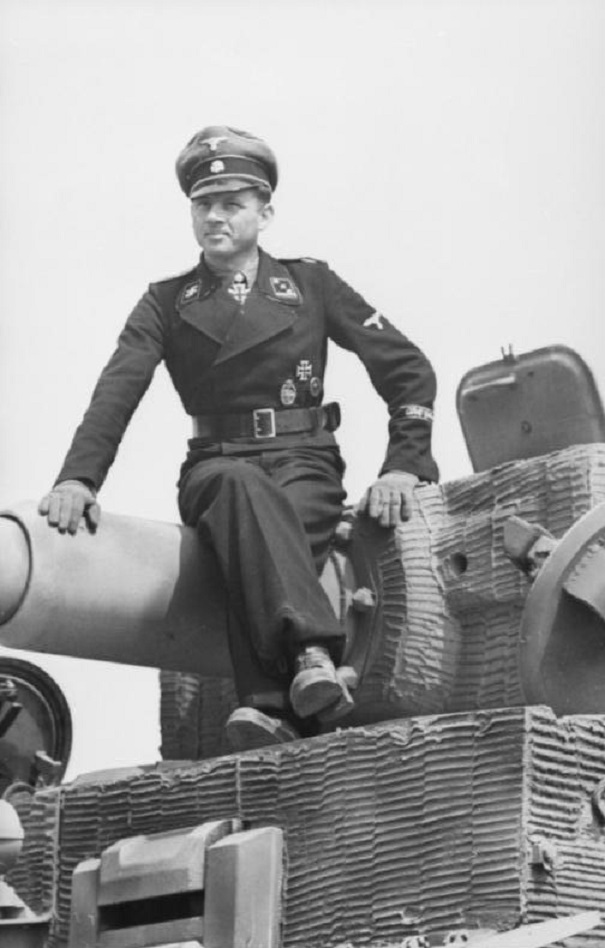
Michael Wittmann was one of World War II’s most famous and controversial tank commanders. His battlefield achievements were celebrated by Nazi propaganda, and later scrutinized by historians seeking to separate myth from reality. His story is inseparable from the Waffen-SS, and the Tiger I tank, which became both his weapon and his symbol. Wittmann’s reputation as a “panzer ace” rests on a combination of genuine tactical skill, favorable circumstances, and a propaganda machine eager to create heroic exemplars during a war that Germany was increasingly losing.
Michael Wittmann First Commanded Assault Guns

Michael Wittmann was born on April 22nd, 1914, in the rural Bavarian village of Vogelthal. He grew up in a modest farming family, an upbringing that instilled discipline and familiarity with hard physical work. Like many young Germans of his generation, he came of age in the aftermath of World War I. His formative years were shaped by the political and economic instability of the Weimar Republic. The rise of the Nazis provided opportunities for advancement and belonging that appealed to many young men seeking purpose.
In 1934, after Hitler seized power, Wittmann joined the Reichsarbeitsdienst, the compulsory labor service, before enlisting in the German Army. Two years later, he transferred to the SS-Verfugungstruppe, the armed wing that would later evolve into the Waffen-SS. Wittmann did not serve in tanks at first. His early military experience was in reconnaissance and assault gun units, particularly with the Sturmgeschütz III (StuG III), a turretless armored vehicle designed for infantry support. Assault gun units emphasized cooperation with infantry, careful positioning, and precise gunnery rather than aggressive maneuver. So that early service set the stage for Wittmann’s later rise as a tank commander.
Transferring to Tanks and Tigers

Michael Wittmann learned how to exploit terrain, use concealment, and fire accurately at weak points. Those skills would later serve him well when commanding tanks. He took part in the early campaigns of the war, including the invasion of Poland in 1939 and the campaign in the Balkans in 1941. He gained combat experience and a reputation as a capable and determined soldier. Wittmann’s rise to fame truly began on the Eastern Front after Germany launched Operation Barbarossa in June, 1941.
The Soviet Union’s vast expanses became a brutal proving ground for German armored forces. In that environment, Wittmann transitioned to tanks, first the Panzer IV, and later the Panzer VI Tiger I. The Tiger was a technological behemoth for its time. It boasted thick armor, and a powerful 88mm KwK 36 gun that could wreck most enemy tanks at long range. However, it was also mechanically complex, slow, and logistically demanding. Success in the Tiger required not only courage, but also technical understanding, disciplined crew coordination, and tactical patience.
A “Tank Ace”

Michael Wittmann served with the elite SS Heavy Panzer Battalion 101, later redesignated 501. He participated in some of the most intense armored fighting of the Eastern Front, including the 1943 Battle of Kursk. The largest tank battle in history, Kursk was a decisive turning point in the war. On the battle’s first day, Wittmann’s Tiger destroyed eight Soviet tanks, and seven antitank guns. While German forces inflicted heavy losses, they failed to achieve a breakthrough. From that point onward, the Wehrmacht was largely on the defensive.
By late 1943, Wittmann’s tally had grown into the dozens. He received several decorations, including the Iron Cross First Class and the Knight’s Cross. German propaganda seized upon figures like Wittmann as symbols of martial excellence. His claimed total of destroyed enemy tanks was widely publicized. The concept of the “ace”, borrowed from fighter pilots, was extended to tank commanders. Kill counts were emphasized, often without rigorous verification, and individual heroism was highlighted to bolster morale at home. Wittmann’s image – calm, professional, and deadly – fit perfectly. In January, 1944, he was awarded the Knight’s Cross with Oak Leaves and Swords, one of Nazi Germany’s highest military honors.
Michael Wittmann at Villers-Bocage

The most famous exploit of Michael Wittmann did not take place on the Eastern Front. It occurred in Normandy, shortly after the Allied landings on D-Day, June 6th, 1944. On June 13th, near the town of Villers-Bocage, Wittmann led a dramatic and audacious attack against British forces of the 7th Armoured Division, the famed “Desert Rats”. Acting largely on his own initiative, Wittmann drove his Tiger into the British column. It was strung out along a road, and unprepared for a sudden armored assault.

Within fifteen minutes, Wittmann destroyed fourteen British tanks, two antitank guns, and fifteen transport vehicles before his Tiger was destroyed. The action at Villers-Bocage became legendary. Already a national hero, German reports transformed Wittmann into an even bigger Nazi propaganda icon. Later historical analysis has adjusted the Villers-Bocage numbers and emphasized the role of other German units. Nonetheless, the impact of Wittmann’s attack was undeniable. It temporarily halted the British advance and demonstrated the physical mayhem and psychological shock that a well-handled Tiger could inflict.
The End of the Road

Nazi propaganda elevated Michael Wittmann and his exploits at Villers-Bocage into a near-mythical status. It presented him as the embodiment of armored warfare brilliance. However, that engagement also illustrates the limitations of individual heroics in modern war. Despite the tactical success, the broader strategic situation in Normandy continued to deteriorate for Germany. Allied air superiority, overwhelming material strength, and relentless pressure gradually wore down German defenses. Tiger units, including Wittmann’s, suffered from fuel shortages, mechanical breakdowns, and constant air attacks. The very qualities that made the Tiger formidable also made it vulnerable in a war of attrition.
Wittmann’s career came to an abrupt end on August 8th, 1944, during Operation Totalize, a major Canadian and British offensive south of Caen. Near the village of Saint-Aignan-de-Cramesnil, Wittmann led a small group of Tigers in a counterattack against advancing Allied forces. During the engagement, his tank was hit and catastrophically destroyed, killing Wittmann and his entire crew instantly. For decades, the precise circumstances of his death were debated. Competing claims credited British, Canadian, and even Polish units with the kill.
WWII’s Best Known Tank Commander

The prevailing historical consensus now attributes the destruction of Wittmann’s Tiger to a British Sherman Firefly from the Northamptonshire Yeomanry. Available evidence supports the conclusion that it fired upon Wittmann from a concealed position. Michael Wittmann was thirty-years-old at the time of his death. His remains were initially buried in an unmarked grave. They were identified in the 1980s, and reinterred at the German war cemetery at La Cambe in Normandy. His grave has since become a point of pilgrimage for some armored warfare enthusiasts. Unsurprisingly, that has generated controversy. Admiration for Wittmann can easily slide into glorification of the Waffen-SS, an organization deeply implicated in war crimes and atrocities. As such, assessing his legacy requires careful balance.
By the time of his death, Wittmann had more than cemented his status as a “tank ace”. He was credited with the destruction of 135 to 138 enemy tanks, although the exact numbers are disputed. On a purely tactical level, he was undeniably an effective tank commander. He demonstrated excellent gunnery skills, situational awareness, and the ability to exploit enemy mistakes. His crews respected him, and his superiors trusted him with difficult missions. At the same time, his achievements cannot be separated from the context in which they occurred. He fought for a regime responsible for unprecedented crimes. He served in the Waffen-SS, which was not merely a military formation but also an ideological one. Moreover, the emphasis on individual kill counts obscures the collective nature of armored warfare. Logistics, reconnaissance, infantry support, and air power are often more decisive than any single tank commander’s actions.
The Legacy of Michael Wittmann

Modern historians note that the “ace” narrative tends to exaggerate the influence of individual tank commanders. The deeds of Michael Wittmann at Villers-Bocage were tactically impressive. However, they did not alter the strategic outcome of the Normandy campaign. Similarly, his successes on the Eastern Front occurred within a broader context of massive German offensives and later desperate defensive battles. The Tiger tank itself, while formidable, was produced in relatively small numbers. It could not compensate for Germany’s overall material inferiority.
Michael Wittmann remains a compelling figure because his life encapsulates many of WWII’s contradictions. His service combines technical brilliance and moral catastrophe, individual skill and systemic failure, battlefield courage and ideological fanaticism. Wittmann’s story continues to attract attention from military historians, model builders, gamers, and the general public. Understanding Germany’s leading tank ace requires understanding more than just a talented tank commander. It requires understanding the machinery of WWII and the propaganda that transformed figures like him into symbols and icons.

_________________
Some Sources & Further Reading
Hart, Stephen – Sherman Firefly vs Tiger (2008)
History Halls – German Tanks of WWII: The Panzer VI Tiger Terrorized Allied Soldiers for Years
Reynolds, Michael – Steel Inferno: I SS Panzer Corps in Normandy (1997)
Latest Articles
- ‘Scourge of the Atlantic’: Focke-Wulf Fw 200 Condor, the Civilian Airliner Transformed Into a Lethal WWII Bomber
- The Leigh Light: A Simple Invention that Devastated Hitler’s U-Boats
- The Brink’s-Mat Robbery: Britain’s Biggest Gold Heist
- Fighting Women: Artemisia I of Caria Led Her Ships at the Battle of Salamis
- Alexander the Great and Sisygambis, Mother of Persia’s King Darius III

