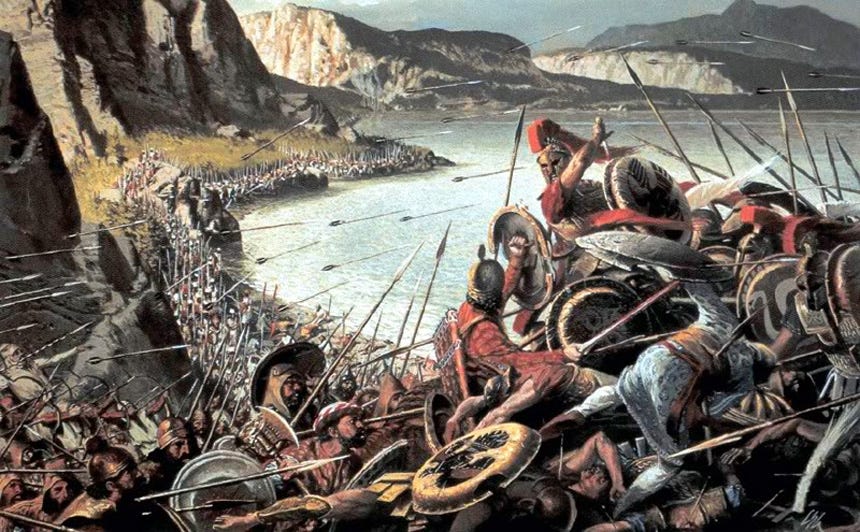
Ephialtes of Trachis, an obscure figure before 480 BC, became one of antiquity’s worst traitors that year. His treachery at the Battle of Thermopylae permanently etched his name into the annals of Greek history and infamy. His name became synonymous with betrayal in the Greek world, much like Judas Iscariot in later Christian tradition.
Betrayal at Thermopylae

Persia’s King Xerxes I launched a massive invasion of Greece in 480 BC, to avenge a defeat a decade earlier. Sparta’s King Leonidas I led 300 Spartans and a small allied force to block the Persian advance into central Greece. For his stand, he chose the narrow coastal pass of Thermopylae, a natural choke point ideal for defense. For two days, the vastly outnumbered Greeks held off the Persians, using the terrain to nullify their numerical disadvantage. It seemed possible that the Greeks might hold indefinitely. Then Ephialtes of Trachis, from a small town near Thermopylae, entered the scene.
According to Herodotus, our primary source for the battle, Ephialtes approached Xerxes with vital information. He knew of a hidden mountain trail, the Anopaia path, that bypassed the main pass. It would allow the Persians to outflank the Greeks. The trail was known to locals, but was considered difficult and thus lightly guarded. Ephialtes offered to guide the Persian army through it in exchange for a reward, and Xerxes eagerly accepted the offer. Guided by Ephialtes, a detachment of elite Persian troops, the Immortals, was sent along the path that night.
Antiquity’s Most Famous Last Stand

At dawn, Leonidas and the Greek forces discovered the betrayal. A small Phocian contingent had been assigned to guard the mountain path, but was quickly overwhelmed by the advancing Persians. Realizing that they were surrounded, Leonidas dismissed most of the Greek forces to fight another day. He stayed behind with his 300 Spartans, 700 Thespians, and a handful of Thebans. They made a final, heroic stand against overwhelming odds. Leonidas’ force was annihilated, but their sacrifice became legendary, symbolizing courage, duty, and defiance in the face of impossible odds. The betrayal of Ephialtes, by contrast, became the dark mirror of that heroism – the act that made their martyrdom necessary.
Herodotus reports that Ephialtes expected a great reward from Xerxes for his service, but none is recorded. Instead, he became a wanted man in Greece, his name cursed by all who valued freedom and honor. The Amphictyonic League, a council of Greek states, placed a bounty on his head. However, fate did not grant the Greeks immediate revenge. Ephialtes fled into Thessaly, and escaped punishment for several years. He was eventually killed, but ironically, as seen below, it was not for his betrayal.
Legacy of Ephialtes of Trachis

Ephialtes of Trachis’ treachery at Thermopylae went unpunished, but he was killed in a local dispute. A man named Athenades of Trachis slew him, reportedly for personal reasons. The Greeks nonetheless treated the killing as justice served, and the Spartans rewarded Athenades. By then, Ephialtes’ crime had already taken on mythic proportions, his name a byword for betrayal throughout the Greek-speaking world. His story endured in both history and legend. In classical Greek literature, he appears rarely, but his legacy is powerful.
Ephialtes represents the archetype of the traitor who sells out his people for personal gain. Later sources sometimes confused him with other figures or embellished his story, but the core remains the same. He was the man who showed the Persians the secret path that doomed Leonidas and his men. In modern times, the name “Ephialtes” continues to carry negative connotations in Greek culture. In later Greek the word ephialtes came to mean “nightmare”, perhaps reflecting the nation’s collective memory of his betrayal.
The treachery at Thermopylae transcended history to become a moral lesson. It is a reminder that one man’s greed can undo the valor of thousands. Ephialtes of Trachis stands as a tragic but instructive figure. His act of betrayal did not bring him honor, wealth, or lasting satisfaction. All he got was infamy, and a life on the run from avengers eager to shed his blood. By contrast, those he betrayed achieved immortal glory. The enduring power of his story centers on that juxtaposition.

_________________
Some Sources & Further Reading
Encyclopedia Britannica – Ephialtes, Greek Traitor
Herodotus – The Histories, Book 7
History Halls – Benedict Arnold: From Celebrated Hero to America’s Most Infamous Traitor

