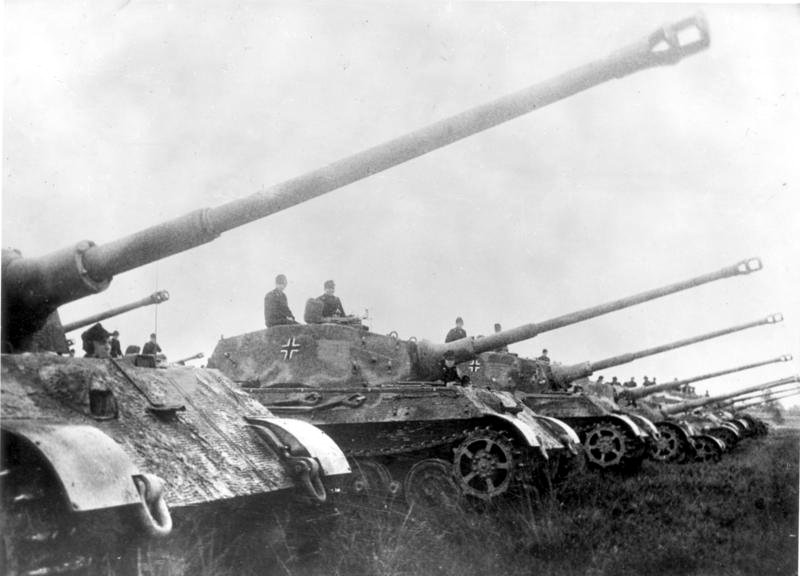
Germany’s Panzerkampfwagen VI Tiger Ausf. E, or Tiger I, entered service in 1942. It was a heavy tank whose main assets were thick armor that its common adversaries could not penetrate except from close range, and a powerful 88 millimeter gun that could wreck its foes from prodigious distances. The 88 mm gun’s range gave Tigers an extensive safe standoff distance within which they were practically invulnerable. Tigers were scary, and they exerted a powerful psychological hold on their enemies’ imagination: during World War II, few if any Allied tank crews relished the prospect of coming across Tigers. Below are some fascinating facts about the terrifying Tigers.
A Formidable Tank, but Plagued With Bugs and Difficult to Manufacture

Formidable and terrifying as they were, the Panzer VI Tigers nonetheless had some significant drawbacks. They were heavy, slow, and guzzled fuel at prodigious rates. They had a limited range, and were difficult to transport. Tigers were over-engineered and notorious for their mechanical unreliability and propensity to breakdown, and became immobilized when their overlapping wheels got jammed with snow and mud.
Another major drawback of the Panzer VIs is that they were expensive to produce and difficult to manufacture. Because of the high costs and difficulty of manufacture, a mere 1300 Tiger tanks were built during the war. To put that in perspective, that number was lower than the typical monthly production figures of the Soviet T-34s or American M4 Sherman tanks that the Germans had to face.
A Terrifying Tank

For all their shortcomings, when the Tiger tanks worked the way they should, they were terrifyingly good. Indeed, they exercised a psychological on enemy soldiers. There were numerous instances when enemy troops broke and fled when they heard a rumor that German Tiger tanks were headed their way. Fortunately for the rest of the world, the Tigers often did not work, and there were too few of them make a difference in the war’s ultimate outcome.
On the Western Allies lacked armor that could take out Tigers, other than upgunned Sherman Fireflys and M10 tank destroyers. So Tigers maintained their superiority until war’s end. On the Eastern Front, however, the Tigers’ superiority was increasingly challenged. T-34/85s, IS-2s, and IS-122s all had guns that could destroy Tigers from various ranges.
A Hard to Kill Battlefield Beast

In 1944, Tiger I production was discontinued in favor of the Panzerkampfwagen Tiger Ausf. B. More commonly known as the Tiger II or Royal Tiger, 492 of these formidable armored beasts were manufactured by war’s end. Tiger IIs weighed 77 tons, and replaced their predecessors’ thick flat armor with thicker sloped armor that was significantly more difficult to penetrate. They were very well protected, and between January to April, 1945, Tiger IIs were credited with destroying over 500 tanks on the Eastern Front at a cost of only 45 Tiger II.
Most of the lost Tiger II tanks were destroyed not by enemy action, but by their own crews to prevent their capture after they broke down or ran out of fuel. Nonetheless, Tiger IIs suffered most of their predecessors’ mechanical problems plus a few more. They were also even slower than the original Tiger I tanks, capable of only nine to twelve miles per hour cross country.

_________________
Some Sources & Further Reading
Green, Michael, and Brown, James D. – Tiger Tanks at War (2008)
History Halls – British Tanks of World War II: The Rugged Churchill
Tiger I Information Center – Panzerkampfwagen VI: The Legendary Tiger I
Zaloga, Steven – Armored Champion: The Top Tanks of World War II (2015)

