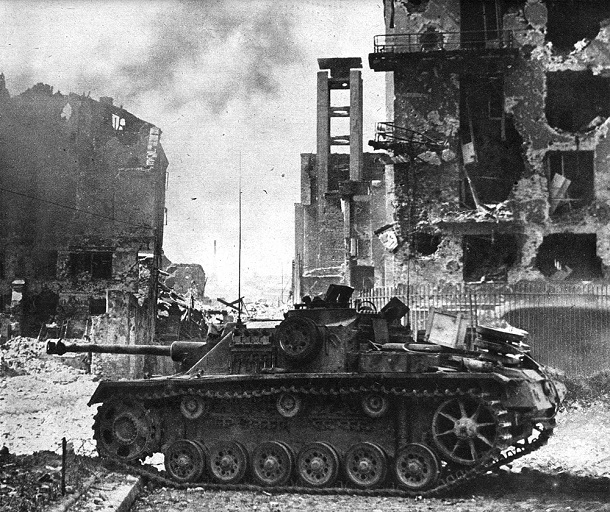
The Sturmgeschutz III (StuG III) was one of Germany’s most important and effective World War II armored fighting vehicles. Originally conceived as an infantry support weapon, it evolved into a highly successful tank destroyer. It eventually became the most-produced fully tracked armored vehicle of the German Army. Its relatively low cost, strong firepower, and battlefield adaptability made it a cornerstone of the Wehrmacht.
The StuG III Was Born as an Infantry Assault Gun

The StuG III was developed under the direction of General Erich von Manstein. In the 1930s, he advocated for a mobile, armored artillery piece that could directly support infantry assaults. It did not use a rotating turret. Instead, the gun was mounted in a fixed superstructure built on the proven chassis of the Panzer III. Elimination of the turret reduced production complexity and costs. It also lowered the vehicle’s silhouette, and made it harder to spot and hit. That design choice would define the StuG’s battlefield character: compact, defensive-minded, and lethal when used correctly. Reflecting its artillery origins, the StuG was more often crewed by artillerymen rather than tankers. Especially in the war’s early and later years.
Early StuG IIIs, beginning with the Ausfuhrung A in 1940, were armed with short-barreled 7.5 cm StuK 37 L/24 guns. They were optimized for firing high-explosive shells to destroy bunkers, machine-gun nests, and field fortifications. Those early models saw combat during the Battle of France and later in the Balkans, where they performed well in their intended infantry support role. Crews valued the vehicle’s low profile and thick frontal armor, which provided good protection against anti-tank rifles and light artillery. Then came the German invasion of the Soviet Union in 1941, which exposed a major weakness in early StuG designs.
A New Role: Tank Destroyer

The appearance of the Soviet T-34 and KV-1 tanks on the Eastern Front rendered the short-barreled gun inadequate in anti-tank combat. In response, German engineers rapidly upgraded the StuG III with longer, high-velocity guns. From the Ausfuhrung F onward, the vehicle was equipped with the 7.5 cm StuK 40 L/43, later replaced by the even more powerful L/48. That upgrade transformed the StuG III into a formidable tank destroyer. It could now knock out most Allied tanks at typical combat ranges.
As the StuG’s anti-tank capabilities improved, its battlefield role shifted dramatically. Its new shells were great against armor, but they had smaller explosive charges, which reduced their effectiveness against other targets. While it continued to support infantry, it increasingly served as a defensive weapon, mostly against tanks, deployed in ambush positions. Its low silhouette allowed it to conceal itself behind terrain or rubble. Its strong frontal armor – especially in later variants reinforced with applique armor and Schurzen side skirts – gave it excellent survivability. StuG III units achieved impressive kill ratios on the Eastern Front, particularly when operated by experienced crews.

Production efficiency was one of the StuG’s greatest strengths. Using Panzer III tank chasses allowed factories to continue producing a useful combat vehicle, even as Panzer IIIs became obsolete. StuG IIIs were significantly cheaper and faster to build than Panzer IVs or Panthers, and required fewer skilled labor hours. As a result, over 10,000 StuG III vehicles were produced. That made it the most numerous German armored fighting vehicle of the war. That mass availability helped compensate, at least partially, for Germany’s growing material shortages.
Significance and Legacy of the StuG III

The StuG III had limitations. The lack of a rotating turret restricted its ability to engage fast-moving targets. It could not respond quickly to threats from the flanks and rear. Crew visibility was limited. As a result, coordination with infantry was essential to prevent enemy soldiers from approaching with anti-tank weapons. Armor, except up front, was limited. In offensive operations, especially in fluid armored warfare, the StuG was less flexible than turreted tanks. In defensive battles – which became the norm for Germany after 1943 – those weaknesses were less pronounced.
StuGs were effective, but their vulnerabilities led to massive losses. Nonetheless, StuG units continued to fight until war’s end in Italy, Normandy, and on the collapsing Eastern Front. Many Allied tank crews came to respect – and fear – the vehicle’s ability to strike from concealment. In retrospect, the StuG III represents one of the most successful examples of pragmatic wartime engineering. It was not glamorous, nor was it technologically revolutionary. However, it perfectly matched German strategic needs as the war turned defensive. The combination of simplicity, firepower, and efficiency, earned the StuG III a reputation as a “soldier’s vehicle”. It remains one of the most studied and respected armored fighting vehicles of World War II.

_________________
Some Sources & Further Reading
History Halls – The Panzer III: Hitler’s Beast of Burden
Spielberger, Walter J. – Sturmartellerie (1967)
Latest Articles
- Edward England, the Humane Pirate Captain Deposed by His Men for Being Too Nice
- American Presidents: Abraham Lincoln, Hall of Fame Wrestler
- Henry Jennings: The Privateer-Turned-Pirate Who Set the Stage for the Caribbean’s Golden Age of Piracy
- Fighting Women: Tomoe Gozen, the Fearsome Female Samurai
- From the NFL to the Sands of Iwo Jima: Medal of Honor Recipient Jack Lummus

