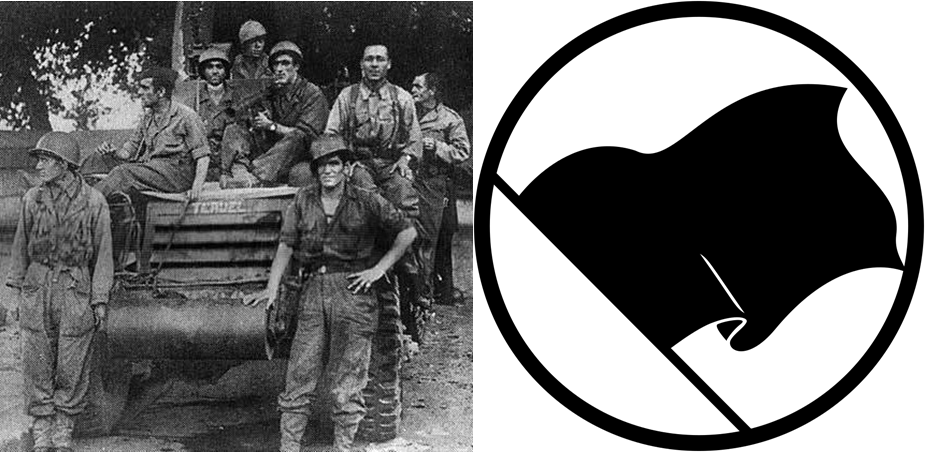
The 9th Company of the Regiment de marche du Tchad, nicknamed La Nueve, was one of WWII’s most extraordinary units. It was not remarkable because of its size, nor because it represented a major nation. It stood out because of who its soldiers were, and why they fought. La Nueve was composed overwhelmingly of Spanish Civil War Republican exiles, many of them anarchists. They had already fought and lost one war against fascism, and now found themselves continuing that struggle on foreign soil.
Spanish Civil War Anarchists

The story of La Nueve reflects the persistence of political conviction in the face of defeat, exile, and immense personal sacrifice. It highlights how the Spanish Civil War (1936 – 1939) and WWII were deeply interconnected conflicts. The company’s origins lay in the destruction of the Spanish Republic. Spain had endured a brutal civil war between the democratically elected Republican government and General Francisco Franco’s Nationalist forces. The Republicans were supported by a wide coalition of political forces, including liberals, socialists, communists, and anarchists.
Among those forces, the anarchists played an important role, especially in regions such as Catalonia and Aragon. They, they not only fought militarily, but also carried out sweeping social revolutions. Workers seized factories, peasants collectivized land, and anarchist militias attempted to build a society based on equality, voluntary cooperation, and the abolition of traditional hierarchies. Many La Nueve members were veterans of these anarchist militias, including units associated with organizations such as the Confederacison Nacional del Trabajo (National Worker Confederation) and the Federacion Anarquista Iberica (Iberian Anarchist Federation).
Spanish Republican Defeat, Flight, and Exile

Organizations like the Iberian Anarchist Federation and the National Worker Confederation did more than mobilize workers and peasants. They also created armed columns that fought fiercely against Franco’s forces. Anarchist figures such as Buenaventura Durruti became symbols of revolutionary resistance, and many anarchists saw themselves as fighting not merely to preserve a government, but to defend a new social order. The Republic’s defeat in 1939 was catastrophic for its supporters. Hundreds of thousands of Republican soldiers and civilians fled across the Pyrenees into France, seeking refuge from Franco’s repression.
Many of the refugees were interned in makeshift camps under harsh conditions. They had lost their homes, their political cause, and their country. However, many remained determined to continue the struggle against fascism, which they saw as a global threat. When WWII erupted, Spanish Republican exiles found themselves once again caught in a wider conflict. Some joined French military units or labor battalions, while others became involved in resistance activities. After France fell to Germany in 1940, many Spanish exiles were transferred to French colonies in North Africa.
A Years-Long Wait to Resume the Antifascist Fight

The Spanish exiles endured years of uncertainty in North Africa, waiting for an opportunity to resume the fight. That opportunity came after Allied forces invaded North Africa in 1942. Free French forces, under the leadership of General Charles de Gaulle, began to organize new units to participate in the liberation of Europe. They included the 2nd Armored Division, commanded by General Philippe Leclerc. Spanish Republicans, including large numbers of anarchists, volunteered eagerly. For them, this was not simply another war. It was a continuation of the struggle that had begun in Spain.

La Nueve was formally organized in 1943 as part of Leclerc’s division. Although officially a French military unit in the Free French forces, its character was overwhelmingly Spanish. Of its approximately 160 soldiers, 146 were Spanish Republicans, and Spanish was the primary language spoken within the company. The unit’s internal culture reflected the shared political and historical experiences of its members. The company was commanded by French officer Raymond Dronne, but its second-in-command, Amado Granell, was a Spanish Republican veteran, reinforcing the company’s Spanish identity.
The Hardened Republicans and Anarchists of La Nueve

Many La Nueve soldiers were anarchists. They brought with them a political outlook shaped by years of revolutionary struggle. Although they now served in a conventional army, their beliefs continued to influence their attitudes and behavior. They maintained strong bonds of comradeship, and often viewed their service not as obedience to a state, but as part of a broader fight against fascism and oppression. Their vehicles became powerful expressions of their identity and memory. The soldiers named their armored half-tracks after battles of the Spanish Civil War, including Guadalajara, Teruel, and Belchite.
Those names commemorated moments of resistance and sacrifice, and served as reminders of their fallen comrades and unfinished struggle. They also displayed the Spanish Republic’s tricolor flag, symbolizing their continued loyalty to the cause they had lost. When La Nueve entered combat in France after D-Day, its soldiers brought with them nearly a decade of combat experience. They had fought in conventional battles, guerrilla campaigns, and urban warfare. They were hardened veterans who understood both the physical and psychological realities of war. Their experience made them highly effective soldiers, capable of operating in difficult and dangerous conditions.
The Spanish Anarchists Who Liberated the French Capital

La Nueve’s most famous moment came during the liberation of Paris in August, 1944. As resistance fighters inside the city rose against German occupation, Leclerc’s division was ordered to advance toward the capital. La Nueve was chosen to spearhead the entry into the city, reflecting the confidence placed in its combat abilities. At 8 PM on August 24th, La Nueve’s armored halftrack vehicles entered Paris, accompanied by a squadron of tanks. They became the first Allied military unit to reach key positions in the city. A section led by Amado Granell was the first Allied unit to reach the Hotel de Vill, Paris’ city hall. It also became the first Allied unit to fire on German defenders in Paris.
Their arrival was greeted with jubilation by the population, which had endured years of Nazi occupation. However, the identity of these liberators carried deep irony. La Nueve’s soldiers were not French. They were Spanish exiles who had liberated another country’s capital from fascism, but whose own country remained under fascist rule. Lieutenant Granell was the first Allied officer to link up with leaders of the French Resistance in Paris. For the men of La Nueve, the liberation of Paris was both a triumph and a reminder of unfinished business. They hoped that the defeat of Nazi Germany would lead to the fall of Franco’s dictatorship.
Victory and Postwar Deception

Many La Nueve members believed that the Allies would eventually intervene in Spain, allowing the Spanish Republic to be restored. They saw themselves as the vanguard of that future liberation. The company continued to fight after Paris’ liberation, and participated in campaigns across eastern France and into Germany. They endured harsh winter conditions, fierce combat, and mounting casualties. Years of continuous warfare took a devastating toll on the company. By the end of the war in Europe in May, 1945, only a small number of the original Spanish members remained.
Despite their contributions, La Nueve was largely forgotten in the years after the war. The exiles’ hopes of Spain’s liberation after the war were also dashed. Political realities played a major role. Franco remained in power in Spain, supported by Western governments that saw his regime as a bulwark against communism during the Cold War. In France, national narratives of liberation often focused on French resistance. There was little room in the liberation saga for foreign fighters, especially those with anarchist and revolutionary backgrounds. The anarchist identity of many La Nueve soldiers made them particularly inconvenient figures in official histories. Their revolutionary ideals did not align with the political priorities of postwar governments. However, their contributions and sacrifices were undeniable. They had fought continuously against fascism for nearly a decade, from the streets of Madrid to the heart of Nazi Germany.
Significance and Belated Recognition of La Nueve

In recent decades, the story of La Nueve began to receive the recognition it deserves. Historians and memorials have acknowledged the role played by Spanish Republicans in the liberation of Paris and the defeat of Nazi Germany. The company came to symbolize the international nature of anti-fascist resistance, and the enduring power of political conviction. The anarchists of La Nueve represent a remarkable chapter in military and political history. They were men who had lost their revolution, but refused to abandon their ideals.
They fought not for national glory, but for a vision of freedom and justice that transcended borders. Their service in the Free French Army illustrates the complex relationship between ideology and necessity. It highlights how revolutionary militants adapted to the realities of conventional warfare. Their story reminds us that the antifascist struggle was not confined to national armies or governments. It was also carried forward by exiles, revolutionaries, and ordinary individuals who refused to accept tyranny. La Nueve stands as a testament to their courage, resilience, and unwavering commitment to the cause of freedom.

_________________
Some Sources & Further Reading
Bocanegra, Lidia – Spanish Republican Exiles: A Short History (2009)
History Halls – Volante Rossa: The Italian Anti-Fascists Who Went on a Revenge Spree After WWII
Libcom – The Anarchists Who Liberated Paris
Rickett, Rosy – Refugees of the Spanish Civil War and Those Left Behind (2014)
Latest Articles
- Henry Jennings: The Privateer-Turned-Pirate Who Set the Stage for the Caribbean’s Golden Age of Piracy
- Fighting Women: Tomoe Gozen, the Fearsome Female Samurai
- From the NFL to the Sands of Iwo Jima: Medal of Honor Recipient Jack Lummus
- The Zanj Rebellion: The African Slave Revolt That Rocked Medieval Mesopotamia
- The Dacian Falx: The Curved Ancient Sword that Shocked the Romans

