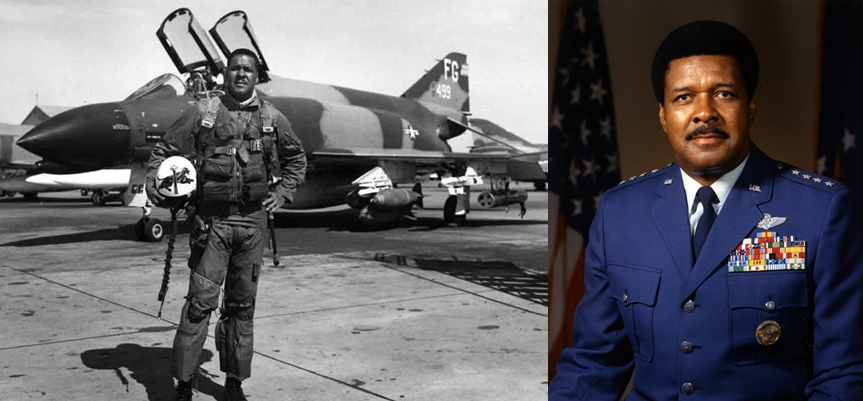
Daniel “Chappie” James Jr. was one of the most important figures in American military aviation. A pioneering leader, his career reflected both exceptional personal achievement, and the twentieth century’s broader social changes. Rising from humble beginnings in the segregated South, he became the United States military’s first African American four-star general. Chappie James’ life and career symbolized both professional excellence and the gradual breaking of racial barriers in the armed forces.
A WWII Tuskegee Airmen Instructor

Daniel James Jr. was born on February 11th, 1920, in Pensacola, Florida. His father was a blue collar worker, and his mother was a teacher who strongly valued education and discipline. Growing up in the Jim Crow South, James experienced racial segregation and discrimination firsthand. In his childhood, he developed a fascination with airplanes while watching military aircraft flying overhead near Pensacola’s naval air station. He began to dream of becoming a pilot. James attended Florida A&M University, a historically black college, where he joined the Reserve Officers’ Training Corps. He graduated in 1942 with a degree in physical education, and received his commission as a second lieutenant in the Army Air Forces during World War II.
The military was still segregated back then, and African American pilots trained separately as part of the Tuskegee program. Chappie James completed his flight training at Tuskegee Army Air Field, earned his wings, and joined the ranks of the pioneering African American military aviators who proved their abilities despite widespread prejudice. Although he trained during WWII, James did not see combat during that conflict. Instead, he served as a flight instructor, and trained other pilots for what became known as the Tuskegee Airmen. While that role kept him out of battle, it allowed him to develop valuable experience and establish a reputation as a skilled and disciplined officer.
Chappie James in Korea and Vietnam

Chappie James first saw combat during the Korean War. He flew 101 combat missions in fighter aircraft, including the F-51 Mustang and the F-80 Shooting Star jet. His performance in combat demonstrated both courage and technical skill. He became known as a reliable and highly capable pilot who could perform effectively under pressure. His success in Korea helped advance his career, and earned him respect among his peers and superiors. His career continued to progress during the Cold War era. By the time of the Vietnam War, James had reached senior leadership positions. He flew 78 combat missions in the F-4 Phantom II, one of the era’s most advanced fighter airplanes.
In addition to his combat duties, James played an important role in planning and executing air operations. One of his most notable contributions was his involvement in Operation Bolo in 1967. That mission was designed to trick North Vietnamese MiG fighters into attacking American aircraft under favorable conditions. By disguising American fighter planes to appear like vulnerable bombers, US forces successfully lured enemy fighters into an ambush. Seven MiG-21s were downed, the highest total kill of any Vietnam War mission. The operation’s success demonstrated James’s skill not only as a pilot, but also as a strategic thinker and leader.
Head of NORAD

Throughout his career, Chappie James became known for his strong personality, discipline, and professionalism. He demanded high standards from himself and from those under his command. He firmly believed that success should be based on merit, and worked tirelessly to prove his abilities through performance. He also became known as an inspiring speaker who emphasized patriotism, unity, and responsibility. In 1975, James achieved a historic milestone when he was promoted to the rank of four-star general. He became the first African American in American history to reach that level in any branch of the military.
That promotion marked a turning point in American military history, and reflected the progress made since the days of segregation. It also demonstrated the confidence that military leaders and the government had in James’ leadership. He was appointed commander of the Aerospace Defense Command (ADCOM) and commander in chief of the North American Aerospace Defense Command (NORAD). In that role, he was responsible for overseeing the defense of North American airspace. That included supervising radar systems, interceptor aircraft, and early warning networks designed to detect and respond to potential threats.
Legacy of Chappie James

Chappie James’ position carried enormous responsibility. He played a key role in protecting the continent during a tense and dangerous Cold War stretch. He retired from the Air Force in 1978 after more than 35 years of service. During his career, he flew over 4,000 hours and completed 181 combat missions in Korea and Vietnam. He received numerous military honors, including the Distinguished Service Medal, Silver Star, Distinguished Flying Cross, and Air Medal. After his retirement, James remained active as a public speaker and continued to advocate for leadership, discipline, and equal opportunity.
Unfortunately, James’ retirement was brief. He passed away on February 25th, 1978, aged 58, just weeks after leaving active duty. Daniel “Chappie” James Jr. is remembered as both a superb combat pilot and a pioneering leader who helped reshape the American military. His career demonstrated that determination, skill, and professionalism could overcome discrimination and open doors for future generations. His historic achievement as the first African American four-star general remains a powerful symbol of progress and excellence in American history.

_________________
Some Sources & Further Reading
McGovern, James R. – Black Eagle: General Daniel ‘Chappie’ James (1985)
Phelps, J. Alfred – Chappie: America’s First Black Four-Star General (1992)
Newest Articles
- American Presidents: Abraham Lincoln, Hall of Fame Wrestler
- Henry Jennings: The Privateer-Turned-Pirate Who Set the Stage for the Caribbean’s Golden Age of Piracy
- Fighting Women: Tomoe Gozen, the Fearsome Female Samurai
- From the NFL to the Sands of Iwo Jima: Medal of Honor Recipient Jack Lummus
- The Zanj Rebellion: The African Slave Revolt That Rocked Medieval Mesopotamia

