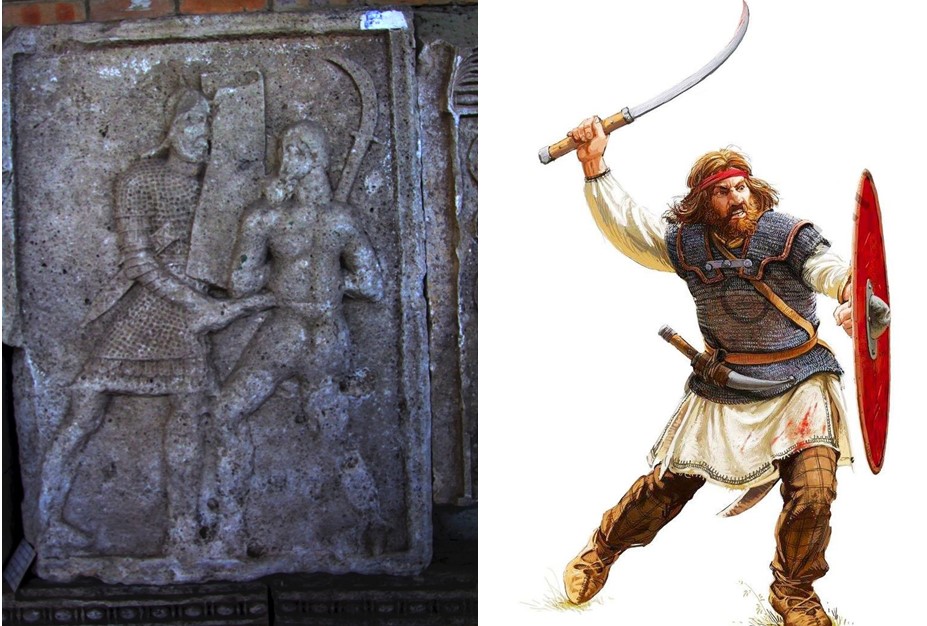
The Dacian falx was one of the most feared weapons encountered by Roman soldiers. A brutal curved blade designed specifically to defeat armor, it inflicted grievous wounds upon legionaries. Used by the warriors of Dacia, a powerful kingdom located in what is now Romania and surrounding regions, the falx became infamous during the Dacian Wars of the late first and early second centuries AD. Its effectiveness was so alarming that the Romans had to modify their military equipment in response.
A Terrifying Weapon that Bypassed Shields and Defeated Armor

The Dacian falx was essentially a curved blade mounted on a handle, with only the inside curve sharpened. It somewhat resembled a sickle, but was far larger and deadlier. There were two primary forms. The shorter version was wielded single-handed, while the longer and more terrifying two-handed version could exceed a meter in length. The blade curved inward toward the wielder, which allowed it to hook over shields and strike enemies behind their defenses. That design made it exceptionally suited for fighting heavily armored opponents like Roman legionaries. Unlike straight swords, which relied on stabbing or slashing motions, the falx was optimized for powerful chopping strikes. The inward curve concentrated the force of a blow onto a smaller surface area. That increased its ability to penetrate armor, helmets, and shields.
Even when a falx did not penetrate completely, it could crush bones or cause severe trauma. Roman helmets recovered from battle sites show deep, curved gashes consistent with falx strikes, evidence of the weapon’s destructive capability. The falx was especially effective because of how Dacian warriors used it. They launched swift charges, using the falx’s reach and power to strike at Roman soldiers before they could respond effectively. The two-handed version sacrificed defense for offense, as it required both hands and prevented the use of a shield. However, the Dacians compensated with speed, skill, aggressiveness, and ferocity, aiming to disable opponents quickly.
Heyday of the Dacian Falx

The Dacian falx gained its greatest fame during the wars between Rome and Dacia. Especially in the reign of Emperor Trajan, who ruled from AD 98 to 117. His opponent was the Dacian king Decebalus, an intelligent and determined leader who had already fought the Romans during the reign of Emperor Domitian. Decebalus’ forces made extensive use of the falx, and Roman soldiers quickly learned to fear it. The falx proved so effective that it exposed weaknesses in Roman armor.
Standard Roman helmets and segmented body armor (lorica segmentata) were designed to protect against straight blades and thrusting weapons. However, the falx’s curved shape allowed it to strike around or through those defenses. Roman soldiers suffered severe head and limb injuries, which shocked Roman commanders. In response, the Roman army made significant changes. Legionaries began to reinforce their helmets with extra metal crossbars to prevent blades from splitting the helmet open. They also added additional armor to their arms, known as manicae, and used greaves to protect their legs.
Such adaptations were unusual because Roman equipment was standardized, and Romans were slow to change. The fact that they modified their armor so specifically demonstrates the threat posed by the falx. It appears prominently in Roman art, especially on Trajan’s Column, a massive monument in Rome commemorating Trajan’s victory over Dacia. The column shows Dacian warriors wielding the distinctive curved weapon in battle against Roman legionaries. Those and other ancient carvings provide valuable visual evidence of how the falx looked and was used.
Significance and Legacy of the Dacian Falx

The Dacian falx was closely associated with warrior culture. Dacian society valued courage and skill in combat, and their weapons reflected their emphasis on aggressive, decisive fighting. The falx was not just a tool of war, but also a symbol of resistance against Roman expansion. It played a central role in the defense of Dacian strongholds, including the capital at Sarmizegetusa, which fell to Roman forces in AD 106 after a hard-fought campaign. Despite its effectiveness, the falx had limitations.
The two-handed version could not be used with a shield. The user was thus left vulnerable if the initial strike failed. It also required strength and skill to use effectively. Against disciplined Roman formations, especially after armor improvements were introduced, the falx lost some of its advantage. Nevertheless, it remained a deadly weapon in close combat. After Rome conquered Dacia, the falx gradually disappeared from widespread use, though its reputation endured. It became remembered as one of the few weapons that forced the Roman army to adapt its equipment significantly.
The falx’s impact on the Roman army secured its place in military history. Today, it is recognized as one of the ancient world’s most formidable edged weapons. Its design demonstrated a sophisticated understanding of how to defeat armored opponents. Its impact on Roman military equipment highlights its effectiveness. More than just a weapon, the Dacian falx represents the determination and ingenuity of the Dacian people, who challenged one of history’s greatest empires and left a lasting mark on the story of ancient warfare.

_________________
Some Sources & Further Reading
History Halls – The Gladius: The Sword With Which Rome Won an Empire
Schmitz, Michael – The Dacian Threat, 101-106 AD (2005)
Wilcox, Peter – Rome’s Enemies: Germanics and Dacians (1982)
Newest Articles
- The Johnstown Flood – Thousands Perished When A Dam Collapsed After Gilded Age Tycoons Modified it for their Private Resort
- The Jacquerie: The Medieval Peasant Uprising That Terrified France’s Aristocrats
- Things That Weren’t Thought Through: WWII’s Sticky Bomb Stuck to Users’ Hands Once Activated
- German Tanks of World War II – The Panzer 38(t), a Czech Tank in German Service
- Nicholas Alkemade: The WWII Airman Who Survived an 18,000 Foot Fall From a Bomber Without a Parachute

