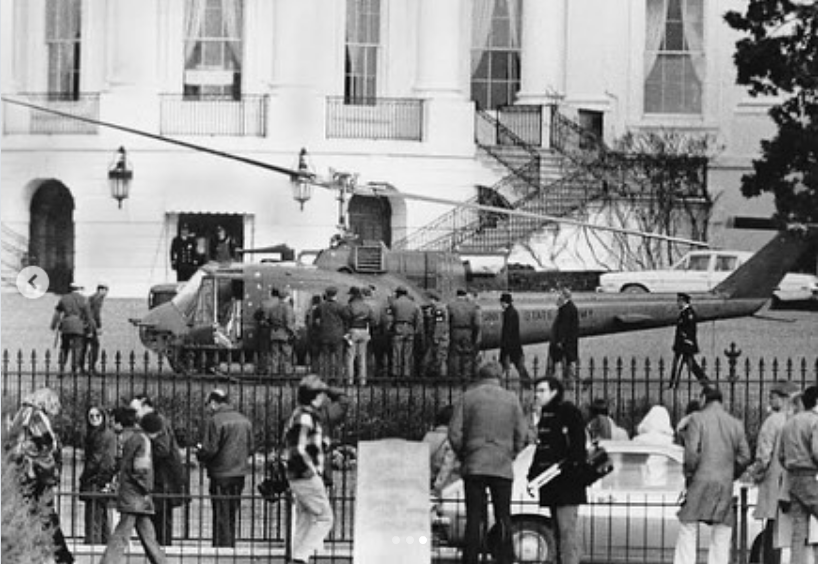
The 1974 White House helicopter incident was one of the most bizarre security breaches in American history. It was kicked off on February 17th, 1974, when US Army Private Robert Preston stole a military helicopter. He took it on a joy ride around Washington, DC, and eventually landed it on White House lawn. The incident exposed startling vulnerabilities in US airspace security. It also shocked officials already reeling from political turmoil during the final months of President Richard Nixon’s administration.
A Bummed Out Private

In 1974, Robert Preston was a twenty-year-old private in the United States Army stationed at Fort Meade, Maryland. He had enlisted in 1972 with dreams of flying helicopters in Vietnam, but flunked the training. He was still required to serve four years, though, so the Army made him a helicopter mechanic. The job involved maintaining aircraft rather than flying them, but it gave him familiarity with helicopters. Especially the Bell UH-1 “Huey,” a versatile aircraft widely used during the Vietnam War. Preston had a private airplane pilot’s license, but was not trained or authorized to pilot helicopters. However, his exposure to them allowed him to understand enough to attempt basic helicopter operation.
By early 1974, Preston was in a bad place. His dreams to fly a chopper in combat had been crushed, he had military disciplinary problems, and was mourning a recent breakup with his girlfriend. On the night of the incident, he had been arrested by civilian police for reckless driving. Upon his release, he returned to Fort Meade in an agitated and emotionally unstable state. Rather than calm down, he made a reckless and fateful decision. On a whim, he decided to take a chopper out for a spin. Shortly after 1:00 AM, Preston made his way to the airfield at Fort Meade. Security was lax enough that he was able to approach one of the Huey helicopters without being stopped. He climbed inside, started the engine, and took off.
A Helicopter Joy Ride Over the Nation’s Capital and Capitol Building

Preston’s helicopter theft represented a serious security failure. A low-ranking enlisted man with no authorization had managed to steal and operate military aircraft without immediate detection or intervention. When the base air controller realized that a Bell UH-1 “Huey” had been stolen, it raised the alarm. Preston flew around a bit, then headed toward Washington, DC, and navigated the helicopter over the sleeping capital. As he flew, he passed over major landmarks, including the Lincoln Memorial, Washington Monument, and the US Capitol. Radar operators and military officials became aware that an unauthorized helicopter was flying in restricted airspace. Confusion and lack of coordination slowed the response, however. No fighter jets or interceptors were immediately scrambled to stop him.
At 1:49 AM, Preston approached the White House and descended onto the South Lawn. It marked an unprecedented breach of presidential security. After briefly touching down, Preston lifted off again and began circling the White House. Secret Service agents and other security personnel rushed into position. They had no idea whether they were dealing with a confused soldier, a protester, or a potential assassin. Fortunately for Preston, this was decades before 9/11. The Secret Service was less trigger-happy, lacked surface-to-air missiles, and had no firm policies about how to handle aerial intruders.
The Wild End of the 1974 White House Helicopter Incident

Preston lifted off and flew back towards Fort Meade, but was intercepted by two Maryland State Police helicopters. He managed to evade one, then made a police car crash when he buzzed it. The other police chopper stayed on his tail, though. So Preston headed back to the White House, intending to surrender personally to the president. Even if Nixon had been inclined to personally deal with a nutjob, he wasn’t even DC, but in Florida. Preston circled the White House once more, and attempted a second landing.
This time, as he hovered low, the Secret Service opened fire with automatic weapons and shotguns. They did not know his intentions, and feared the helicopter could be used as a weapon. Agents fired about three hundred rounds, of which five struck Preston. Luckily for him, all were minor injuries. He managed to land on the South Lawn, then jumped out and ran toward the mansion, before he was finally tackled and wrestled to the ground by agents who reported that he was “laughing like hell”.
Preston was taken to the hospital and treated for his injuries. Upon his release, he was court-martialed for what came to be known as the 1974 White House helicopter incident. Initially charged with several counts of attempted murder and of having tried to commit suicide by crashing into the White House, Preston maintained that he had just wanted to draw attention to his unfair treatment, and demonstrate his helicopter piloting skills. He eventually pled guilty to wrongful appropriation and breach of peace, got a one year sentence, and a general discharge from the Army.
Legacy of the 1974 White House Helicopter Incident

The 1974 White House helicopter incident triggered immediate investigations and raised serious questions about security. Officials discovered that military base access procedures had been inadequate, allowing Preston to reach and operate the helicopter. Air defense systems also proved insufficient, as radar coverage and communication between military and civilian authorities were slow and ineffective. The fact that an unauthorized helicopter could reach and land at the White House shocked military leaders and security officials. As a result, reforms were implemented to strengthen base security and improve airspace monitoring, especially around Washington, DC.
Procedures were developed to ensure faster response to unauthorized aircraft, and coordination between defense agencies was enhanced. Those changes helped prevent similar incidents, and contributed to the modern air defense systems protecting the nation’s capital today. Robert Preston’s actions were not driven by political motives or an attempt to harm the president. Instead, they appeared to be the desperate act of a troubled young soldier under emotional strain. His flight and the resultant 1974 White House helicopter incident remain among the strangest security breaches in American history.

_________________
Some Sources & Further Reading
Newest Articles
- The Johnstown Flood – Thousands Perished When A Dam Collapsed After Gilded Age Tycoons Modified it for their Private Resort
- The Jacquerie: The Medieval Peasant Uprising That Terrified France’s Aristocrats
- Things That Weren’t Thought Through: WWII’s Sticky Bomb Stuck to Users’ Hands Once Activated
- German Tanks of World War II – The Panzer 38(t), a Czech Tank in German Service
- Nicholas Alkemade: The WWII Airman Who Survived an 18,000 Foot Fall From a Bomber Without a Parachute

