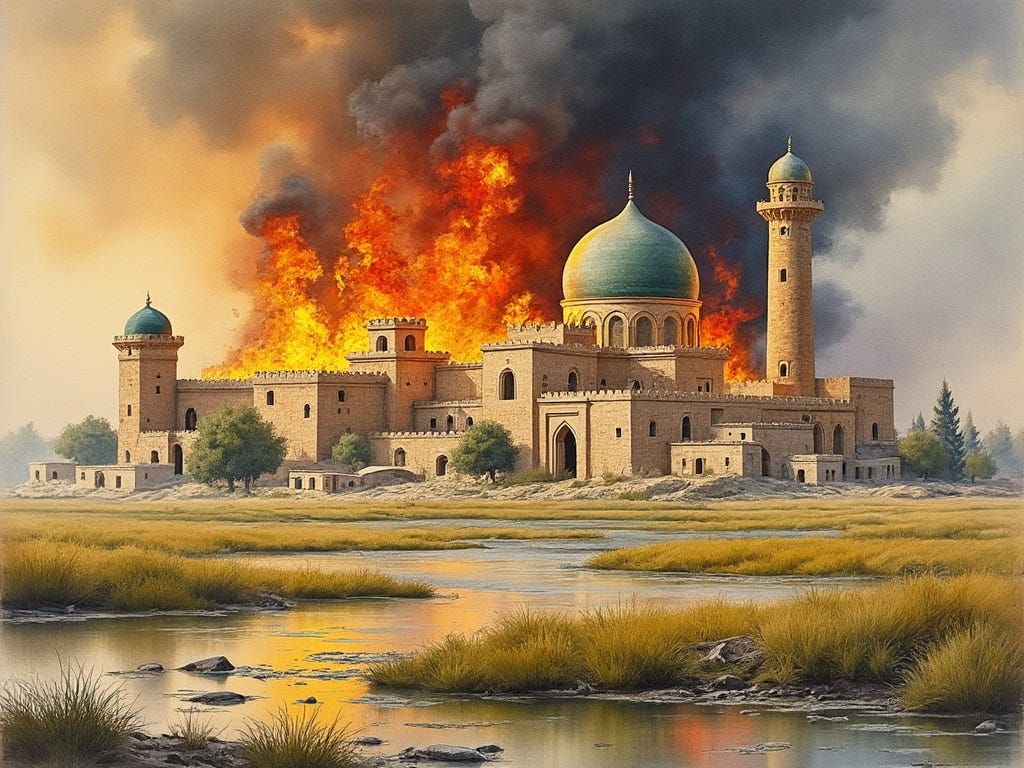
In 869, the Zanj (Arabic for “Blacks”) Revolt began in southern Iraq as an uprising by black slaves. The rebels were soon joined by other slaves and freemen, and the uprising morphed into a major revolt against the Abbassid Caliphate. By the time it was over, hundreds of thousands had been killed, with some casualty estimates running into the millions. The Abbassid Caliphate was fatally weakened, and went into a precipitous decline from which it never recovered.
The Fed Up Black Slaves of Medieval Mesopotamia

For generations, thousands of African slaves had toiled in massive field projects to drain the salty marshes of southern Iraq. The work was backbreaking, the slaves were underfed and brutally treated, and jammed by the thousands into crowded labor camps. The inhumane conditions bred resentment, and the slave camps became powder kegs that only awaited a spark.
The spark for the Zanj Revolt was provided in 869 by an obscure Arab or Persian mystic poet named Ali ibn Muhammad. He traveled around southern Iraq, addressed the downtrodden slaves, and informed them he had been ordered by God to lead an uprising for liberation. Preaching freedom and equality regardless of race or class, he began to recruit Zanj slaves, who welcomed what he had to say and what he promised to do.
They flocked to his side in such large numbers that he became known as Sahib al Zanj – Arabic for “Chief of the Zanj”. Ali’s egalitarian preaching appealed to other downtrodden people, who also rallied to him. Fighting began in September of 869, and the revolt was characterized as one of the bloodiest and most destructive rebellions the Middle East has ever known.
A Massive Uprising

The Zanj became expert guerrilla warriors, ambushing government troops in the marshes. They hid in the tall grass, and struck suddenly at columns of soldiers sent to root them. They then vanished back into the marshes. Try as they would, the forces of the Abbasid Caliphate were unable to stamp out the slave rebellion. It gathered steam, and spread throughout the region. From attacks within the marshes, the Zanj began to raid the surrounding villages and cities to seize supplies and free other slaves.

At the height of the Zanj Rebellion, the slaves came to control all of southern Iraq. That included the region’s biggest city, Basra, which they captured in 871. Their zone of operations continued to expand, and the territory under their control eventually extended to within fifty miles of the Abbasid capital of Baghdad. The rebels formed a government, ran a navy, collected taxes, and minted their own coins.
The tide finally turned in 881, when the government amassed a huge army that drove the rebels back into the marshes. Besieged, many rebels were induced to quit during the following two years, with generous terms offered to those who voluntarily submitted. The revolt finally came to an end in 883 with the capture of the Zanj’s last major bastion. In that battle, the rebels’ leader, Ali ibn Muhammad, was slain.

_________________
Some Sources & Further Reading
History Halls – Peasant Rebellions: When the Downtrodden Fight Back
Popovic, Alexandre – The Revolt of African Slaves in Iraq, in the 3rd/ 9th Century (1999)

