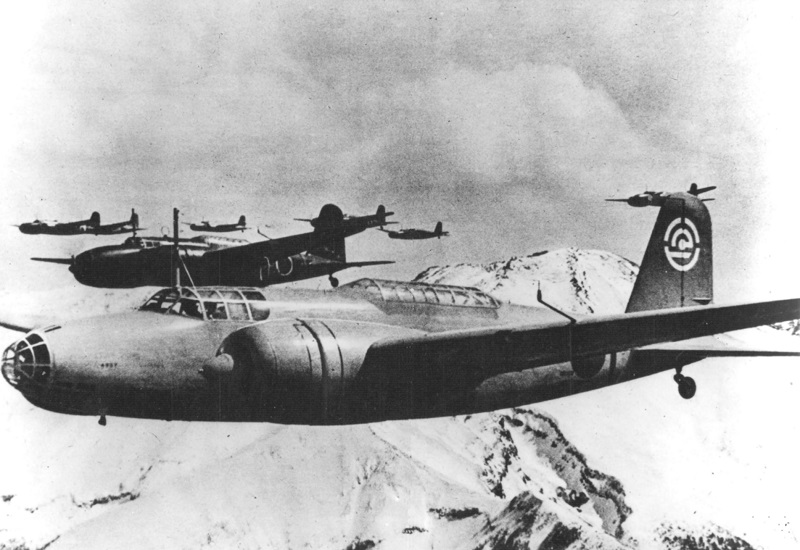
The Mitsubishi Ki-21, known to the Allies by the reporting name “Sally”, was the Imperial Japanese Army Air Force’s principal heavy bomber early in World War II. Conceived in the mid-1930s, the Ki-21 reflected Japan’s ambition to field a modern, long-range bomber comparable to contemporary Western designs. Although ultimately outclassed as the war progressed, the Ki-21 played a central role in Japan’s early air campaigns.
A Huge Japanese Technological Leap

In 1936, the Imperial Japanese Army issued a requirement for a new heavy bomber to replace obsolescent Ki-1s and Ki-20s. The new design had to carry a substantial bomb load over long distances, and operate at higher speeds. It also had to incorporate modern features such as retractable landing gear and an enclosed cockpit. Mitsubishi’s design team, led by Kiro Honjo, responded with an all-metal, mid-wing monoplane powered by two radial engines. The Mitsubishi Ki-21 drew inspiration from contemporary European bombers, particularly the Soviet Tupolev SB, which the Japanese had encountered during operations in China.
The resulting aircraft was sleek by Japanese standards of the time, and represented a significant technological leap. After flight testing, the Mitsubishi design was selected over a competing Nakajima prototype, and production began in 1938. Formally designated the Type 97 Heavy Bomber, it was a twin-engine airplane, initially powered by Mitsubishi Ha-5 radial engines. They were later replaced by more powerful Ha-101 and Ha-109 engines as performance demands increased. The aircraft had a maximum speed of roughly 430–480 km/h (270–300 mph) – respectable for a bomber back then. It had a range sufficient for deep-penetration missions across China and the Pacific. It had a crew of five or six, depending on the variant.
Early Success Against Weak Opposition Bred Overconfidence

Mitsubishi Ki-21 defensive armament initially consisted of several 7.7 mm machine guns mounted in nose, dorsal, ventral, and waist positions. Later versions added heavier 12.7 mm machine guns in an effort to counter increasingly capable Allied fighters. The bomb load typically ranged from 750 to 1,000 kilograms, carried internally, which helped maintain aerodynamic efficiency. Despite its modern design, the Ki-21 – as was common with 1930s Japanese warplanes – lacked armor protection and self-sealing fuel tanks. That made it vulnerable to fighter interception once Allied air defenses improved.
Ki-21s first saw extensive combat during the Second Sino-Japanese War. Beginning in 1938, it was used in strategic bombing raids against Chinese cities, railways, and industrial targets. Those operations demonstrated the aircraft’s long range and reliability, and allowed Japanese forces to strike deep into Chinese territory. Chinese fighter defenses were ineffective early in the conflict, so Ki-21s often operated with relative impunity. That reinforced Japanese confidence in the bomber. It also shaped doctrinal beliefs that speed and offensive power could substitute for heavy defensive protection.
Decline and Obsolescence of the Mitsubishi Ki-21

At the outbreak of the Pacific War in December, 1941, Ki-21s formed the backbone of the Japanese Army’s bomber force. They participated in attacks during the invasions of Malaya, the Philippines, Burma, and the Dutch East Indies. Ki-21s bombed airfields, ports, and troop concentrations in support of rapid Japanese advances. Early on, Allied air forces were often unprepared or flew outdated fighters, which allowed the Ki-21 to achieve considerable success. As modern fighters such as the P-40 Warhawk, Hurricane, and later the P-38 Lightning entered service, however, losses mounted rapidly.
By 1942–1943, it was clear that the Mitsubishi Ki-21 was obsolete. Its limited defensive armament and lack of protection made it highly vulnerable, and its performance was no longer competitive. Mitsubishi tried to extend its usefulness with improved variants such as the Ki-21-II, featuring more powerful engines and better armament. Such measures were only partially successful. Ki-21s were gradually replaced in frontline service by more advanced bombers like the Mitsubishi Ki-67 Hiryu (“Peggy”), which featured greater speed, armor, and firepower.

Nonetheless, Ki-21s continued to serve in secondary roles, including transport, training, and anti-submarine patrols, until war’s end. The Ki-21 stands as a symbol of Japan’s transition into modern aerial warfare. When first introduced, it was a capable and effective bomber that supported Japan’s rapid expansion across East and Southeast Asia. Its later vulnerability, however, highlighted the limitations of prewar Japanese aircraft design philosophy when confronted with sustained, technologically advanced opposition. Although overshadowed by later bombers, the Mitsubishi Ki-21 remains one of the most important Japanese aircraft of the early war.

_________________
Some Sources & Further Reading
Francillon, Rene J. – Japanese Aircraft of the Pacific War (1970)
Green, William – Famous Bombers of the Second World War (1959)
History Halls – World War II Bombers: Japan’s G4M Betty
Latest Articles
- Alexander the Great and Sisygambis, Mother of Persia’s King Darius III
- Unholy Holy Fathers: Pope Leo X’s Corruption Was So Brazen, it Triggered the Protestant Reformation
- Edward England, the Humane Pirate Captain Deposed by His Men for Being Too Nice
- American Presidents: Abraham Lincoln, Hall of Fame Wrestler
- Henry Jennings: The Privateer-Turned-Pirate Who Set the Stage for the Caribbean’s Golden Age of Piracy

