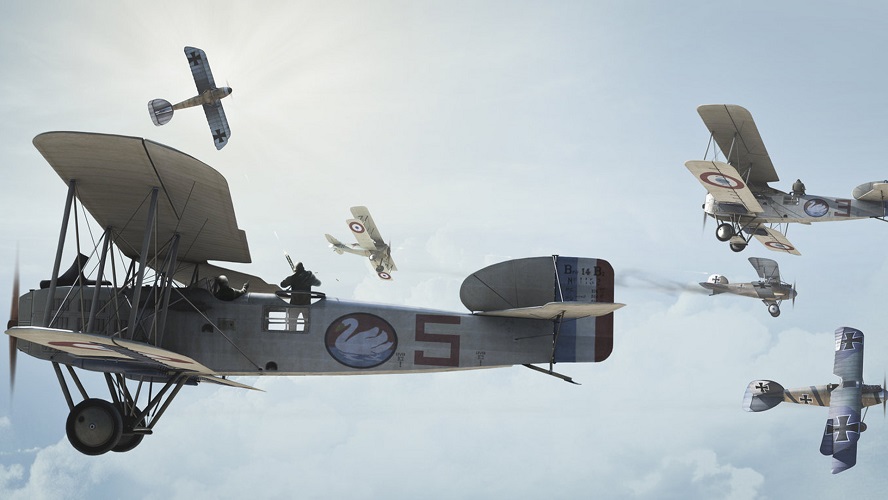
“Bloody April” refers to April, 1917, one of the darkest months in the history of British military aviation. That month, the British Royal Flying Corps (RFC) suffered catastrophic losses over World War I’s Western Front. The term captures not only the scale of the casualties, but also a turning point in air warfare. Bloody April exposed the brutal learning curve of early military aviation and the consequences of technological imbalance. Most importantly, it demonstrated the human cost paid by largely inexperienced aircrews thrown into the air without adequate preparation.
The Prelude to Bloody April

By early 1917, the war on the Western Front had settled into a grim stalemate. Trench systems stretched from the North Sea to Switzerland, and major offensives resulted in enormous casualties for limited territorial gains. Air power, still a relatively new element of warfare, had become essential to breaking this deadlock. Aircraft were no longer curiosities or mere reconnaissance platforms. They were now integral to artillery spotting, photographic intelligence, battlefield observation, and air superiority. Control of the skies meant better intelligence, more accurate artillery fire, and greater protection for ground troops. It was within this context that the RFC entered April, 1917 with ambitious objectives and inadequate means.
The immediate backdrop to Bloody April was the British Army’s Arras Offensive, launched on April 9th, 1917. The offensive was intended to support a wider Allied strategy, and relieve pressure on the French Army as it prepared its own major assault under General Robert Nivelle. To succeed, British ground forces required precise artillery fire and up-to-date intelligence on German positions. That placed immense pressure on the RFC. Its aircraft were tasked with flying daily reconnaissance and observation missions over heavily defended enemy territory.
British Aerial Commanders Overestimated their Force’s Capabilities

The RFC in the spring of 1917 operated under a doctrine that emphasized aggressive offensive patrols. Aircraft were expected to cross the frontlines, engage German planes whenever possible, and maintain constant aerial presence over enemy-held ground. The philosophy was clear: it was better to take the fight to the enemy, even at high cost, than to concede aerial dominance. However, that doctrine assumed a level of technological parity and pilot proficiency that the RFC increasingly lacked. The German air service, reorganized in late 1916 into the Luftstreitkrafte, had learned painful lessons from earlier in the war. Under the leadership of figures such as Oswald Boelcke, German aviation developed more coherent tactics. They emphasized formation flying, disciplined teamwork, and carefully planned engagements. That greatly improved their effectiveness.
German fighter units, known as Jagdstaffeln, were equipped with superior aircraft. They were also led by experienced pilots who had often been flying combat missions for years. Chief among the German aircraft was the Albatros D.III, a sleek, powerful fighter that outclassed many of the RFC’s machines. Faster, more heavily armed, and more maneuverable than most British reconnaissance aircraft, the Albatros gave German pilots a decisive edge. By contrast, many RFC squadrons still relied on outdated or vulnerable designs such as the B.E.2, F.E.2, and early versions of the R.E.8. Those airplanes were often slow, poorly armed, and difficult to defend against determined fighter attacks.
Overconfidence Led to Lopsided Losses

The British technological disadvantage was compounded by a severe disparity in pilot experience. The rapid expansion of the RFC during 1916 and early 1917 created an urgent demand for aircrew. Training programs struggled to keep pace, and many pilots arrived at the front with as little as twenty hours of solo flying time. Navigation, formation tactics, gunnery, and combat survival skills were often learned “on the job” under fire. Many novices did not live long enough to learn anything, and were killed in their few days of combat. By contrast, the Germans did not stint on training, and their pilots remained at the front until killed or incapacitated. That allowed German aces to accumulate experience and hone their skills over extended periods.
Bloody April and the Arras Offensive exposed the British weaknesses with brutal clarity. RFC aircraft flew incessantly over the front lines, directing artillery fire, photographing trenches, and observing troop movements. Those missions were inherently dangerous, as they often required slow, straight-and-level flight at predictable altitudes. That made the British airplanes ideal targets for German fighters and anti-aircraft fire. The casualty figures tell a stark story. During April, 1917, the RFC lost approximately 245 aircraft destroyed, and around 400 aircrew killed, wounded, missing, or captured. Some estimates place total personnel casualties even higher. On certain days, entire squadrons were effectively shattered.
The British Still Accomplished their Mission During Bloody April, but at an Extraordinarily High Cost

For young RFC pilots and observers, survival rates could be measured in days or even hours. The psychological toll was immense, as crews flew knowing that the odds were heavily against them. German losses during the same period were significantly lower, reinforcing the perception of a one-sided struggle. All in all, British losses were roughly four times greater than those of their German foes. Aces such as Manfred von Richthofen, the “Red Baron”, reached the peak of their fame during Bloody April. Richthofen alone claimed 22 victories that month, cementing his reputation as the war’s most lethal fighter pilot.
Richthofen’s success was partly a result of skill and leadership. It also reflected the systemic advantages enjoyed by German aviation at that moment. Despite the losses, the RFC continued its operations with grim determination. Senior commanders believed that maintaining aerial reconnaissance was essential, regardless of cost. Artillery spotting aircraft played a crucial role in the effectiveness of British guns at Arras, contributing to early successes in the offensive. In that sense, the RFC did not fail in its mission: it did what it had set out to do. It just paid an extraordinarily high price for doing so.
Restoring the Balance

Bloody April also highlighted the limits of early air power. Aircraft were fragile machines, vulnerable to weather, mechanical failure, and enemy fire. Parachutes were not issued to British aircrew, partly out of concern that pilots might abandon damaged aircraft too readily. A hit to the fuel tank or engine often meant death, either from fire or a fatal crash. Survivors frequently described the terror of being trapped in a burning aircraft with no means of escape. The month forced a reckoning within British aviation leadership. While the immediate demands of the Arras Offensive prevented any sudden change in policy, Bloody April accelerated reforms already underway.
Aircraft production was increased. Newer, more capable fighters such as the S.E.5, Sopwith Camel, and Bristol F.2 Fighter began to reach frontline squadrons in greater numbers later in 1917. Training programs were revised to emphasize combat readiness, and tactical thinking evolved toward more flexible and effective use of formations. The experience also contributed to the institutional independence of air power. In April, 1918, less than a year after Bloody April, the Royal Air Force was formed by merging the RFC and the Royal Naval Air Service. The heavy losses of 1917 had underscored the need for a unified, strategically minded air service that could balance offensive ambition with sustainable force management.
Reforms Were Made and Lessons Learned, but Too Late

For many British airmen who flew during Bloody April, the reforms and lessons came too late. Many were barely out of their teens. They were drawn by a sense of duty, adventure, or patriotism into aerial warfare while it was still being invented. Letters and diaries from the period reveal a mixture of fear, fatalism, and camaraderie. Pilots often spoke of living day to day, aware that chances of long-term survival were slim. The loss of friends and squadron mates became a constant, numbing presence.
Bloody April has since taken on a symbolic significance in the history of aerial warfare. It represents the moment when the romantic images of early aviators collided fully with the industrial reality of modern war. To be sure, individual heroism and skill still mattered. However, victory increasingly depended on production capacity, training systems, tactical doctrine, and organizational effectiveness. The skies over Arras in April, 1917 were not just a battlefield, but a testing ground for the future of military aviation.
The Significance and Legacy of Bloody April

In retrospect, Bloody April was not simply a British disaster or a German triumph. It was a transitional moment, marking the end of one phase of aerial warfare and the painful birth of another. The sacrifices of RFC aircrews helped sustain ground operations at a critical moment, and forced rapid adaptation that would later restore balance in the air. By the end of 1917, the Allies would regain much of the initiative. However, the memory of what happened that spring never went away.
Today, Bloody April is remembered less for strategic outcomes than for human loss. It stands as one of the most sobering chapters in the history of WWI. It demonstrated how in the starkest way possible how lack of experience and preparation, can lead to catastrophic consequences. The young men who flew into the skies over the Western Front in April 1917 did so with courage and resolve. Their story remains a powerful testament to the human price of technological and tactical transformation in war.

_________________
Some Sources & Further Reading
Hart, Peter – Bloody April: Slaughter in the Skies Over Arras, 1917 (2005)
History Halls – Who Shot Down the Red Baron?
Morris, Alan – Bloody April (1967)
Latest Articles
- Henry Jennings: The Privateer-Turned-Pirate Who Set the Stage for the Caribbean’s Golden Age of Piracy
- Fighting Women: Tomoe Gozen, the Fearsome Female Samurai
- From the NFL to the Sands of Iwo Jima: Medal of Honor Recipient Jack Lummus
- The Zanj Rebellion: The African Slave Revolt That Rocked Medieval Mesopotamia
- The Dacian Falx: The Curved Ancient Sword that Shocked the Romans

