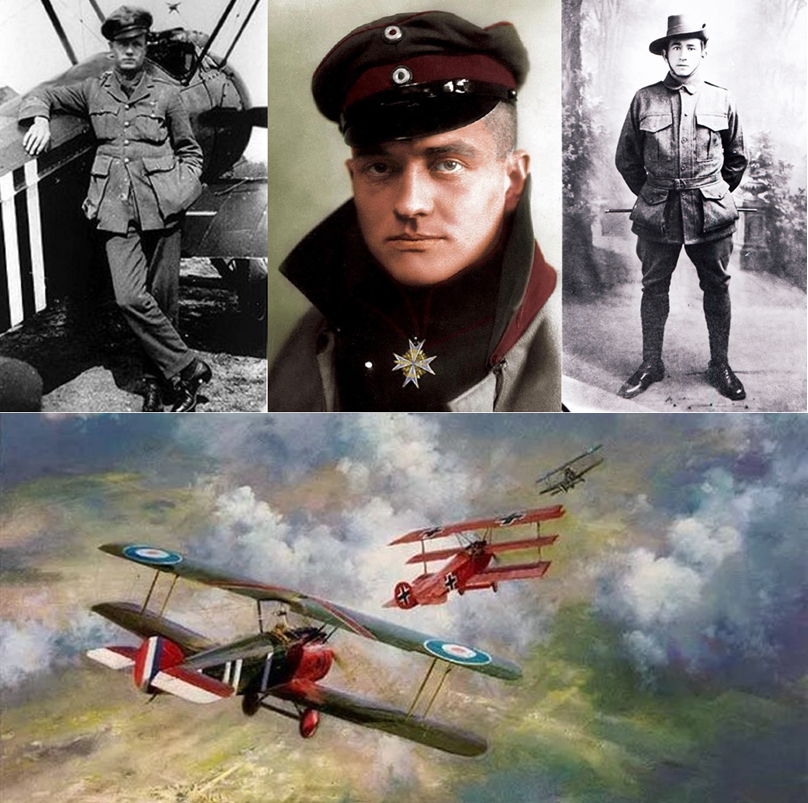
On the morning of April 21st, 1918, over the skies of the Somme River Valley in northern France, one of history’s most famous aerial duels came to a dramatic end with the shooting down and death of Rittmeister Manfred von Richthofen, better known as the “Red Baron”. His demise marked the loss of Germany’s greatest World War I fighter ace. Indeed, with 80 confirmed kills, he was the war’s highest scoring ace. It became a defining moment in the lore of early aviation. It also became the subject of controversy that has endured ever since.
WWI’s Greatest Fighter Ace

Manfred von Richthofen was born into a Prussian noble family in 1892. Initially a cavalry officer, he transferred to the fledgling German Air Service, the Luftstreitkräfte, in 1915. There, he soon proved himself a skillful pilot – and also revealed himself to be a natural showman. By 1917, Richthofen had earned the nickname “the Red Baron” because he flew a distinctive bright red Fokker Dr.I triplane. He might have been an attention seeker, but he backed it up. Richthofen racked up an impressive string of aerial victories that made him WWI’s deadliest ace, and brought him immense fame. The Germans celebrated him as a national hero, and the Allies respected and feared him.
At the time of his death, Richthofen commanded Jagdgeschwader 1, a fighter wing nicknamed the “Flying Circus” because of its brightly painted planes and mobility. By then, he was weary of war. He had suffered a serious head wound in July 1917, and never fully recovered from its lingering effects. Nonetheless, he continued to fly and fight, determined to fulfill his duty. By the eve of his death, he had scored 80 aerial victories – an unmatched record in WWI. His final flight took place during Germany’s Spring Offensive, as the German Army tried to break through Allied lines before American forces could fully deploy and irrevocably tip the scales.
Final Flight of the Red Baron

The skies over the Somme Valley were thick with aerial patrols on April 21st, 1918. The Royal Air Force (RAF), newly formed from the merger of the Royal Flying Corps and the Royal Naval Air Service, was heavily engaged in countering German air activity. That morning, Richthofen in the cockpit of his distinctive red fighter, led a patrol of Fokker Dr.I triplanes from his base at Cappy, France. It was to be his final flight. Among the opponents he was destined to meet in that day was No. 209 Squadron RAF, flying Sopwith Camels.
Its pilots included Canadian Captain Arthur “Roy” Brown, and a young relative novice pilot, Lieutenant Wilfrid “Wop” May. They would become central figures in the downing of the Red Baron. The chain of events leading up to that began around 10:30 AM, when a dogfight broke out between Richthofen’s formation and Allied aircraft over the Somme. May, flying his first combat patrol, had been ordered to stay out of the fighting. However, he became separated and was spotted by Richthofen, who immediately fell upon the vulnerable Camel.
Manfred von Richthofen’s Demise

Lieutenant May dove low, and headed into friendly lines, attempting to escape. The Red Baron followed and in so doing, he inexplicably broke one of his own cardinal rules of aerial combat: never pursue an opponent deep into enemy territory. Richthofen chased May over the Somme River across Allied lines at a dangerously low altitude, often less than 200 feet above the ground. Captain Brown saw his comrade in trouble, dove after Richthofen, and fired a burst from his machine guns. Witnesses on the ground later claimed to have seen Richthofen stagger in his cockpit immediately afterward.
At the same time, Australian anti-aircraft gunners and infantry along the valley opened fire with rifles and machine guns at the low-flying bright red triplane. Richthofen managed to land his plane in a field near the village of Vaux-sur-Somme. His Fokker hit the ground, bounced in the air, came back down, and eventually came to a rest relatively intact. However, its pilot had been mortally wounded, and was already dying when Australian troops reached him. Within minutes, the Red Baron, Germany’s top ace and WWI’s most famous pilot, was gone.
Who Shot Down the Red Baron?

The controversy over who killed Richthofen began almost immediately, and continues to this day. Three primary candidates emerged. The official Allied credit for the kill went to Captain Roy Brown. His report, accepted and backed by the RAF, claimed that he shot down Richthofen while diving to protect Lieutenant May. Brown’s Camel attacked from the side and slightly above, which might have provided an angle for a lethal shot. Awarding him the credit served as a morale boost for the RAF and for Allied propaganda. So there was little reason for officials to look too close to make sure that the report matched the evidence.
However, in the decades since the baron was shot down, ballistics studies have established with near certainty that the fatal shot could not have come from Captain Brown’s guns. All evidence indicates that it came from the ground, instead. Australian infantry and machine gunners along Richthofen’s flight path fired at the red triplane as it passed at low altitude. Medical examination of Richthofen’s body revealed a single bullet that entered from the right side of his chest and exited near his left nipple.

That trajectory is consistent with ground fire from below and to the right, not than from Brown’s aerial attack, from above. Gunners on the ground, such as Sergeant Cedric Popkin of the Australian 24th Machine Gun Company, are the most likely candidates. Other theories suggest that Richthofen may have been struck by rifle fire from Australian infantry rather than machine guns. Yet others point out that confusion and overlapping gunfire make it impossible to determine the precise source. Regardless, the balance of evidence favors ground fire.
The Fatal Bullet’s Trajectory

Medical officers who examined Richthofen’s body found that he had been struck by a single .303 caliber bullet. The shot passed cleanly through his chest, and damaged his heart and lungs before it exited. It was remarkable that he was able to maintain enough control to land his airplane despite such a wound – he should have lost consciousness within seconds. The trajectory is of a bullet that entered from below and to the right side. That angle is not consistent with fire from Brown’s Camel, but is consistent with ground fire from the valley. That evidence, along with the testimony of ground troops, has led most aviation historians to conclude that Captain Roy Brown could not have fired the fatal shot.
Nonetheless, Brown remained officially credited – a decision that reflected the desire for clarity and a heroic narrative. Allied troops who reached the crash site stripped souvenirs from the Red Baron’s aircraft before authorities intervened. Despite being an enemy, Richthofen was accorded full military honors. The Australians organized a funeral on April 22nd, 1918, at Bertangles Cemetery, near Amiens. Six RAF officers acted as pallbearers, and a guard of honor fired a salute. Photographs from the ceremony show Allied airmen paying respect to their fallen adversary, demonstrating a lingering chivalric ethos of the air war.
The Aftermath for Captain Brown and Lieutenant May

Back in Germany, Richthofen’s death was a severe blow to morale. The Red Baron had become a symbol of his country’s prowess, and his loss came at a critical time in the war. Propaganda quickly sanctified his memory, and portrayed him as a heroic martyr for the Fatherland. His demise marked the end of an era. Richthofen represented a romanticized “knight of the air” image, even though aerial combat had grown increasingly brutal and mechanized by 1918. His skill, discipline, and leadership left a lasting influence on military aviation. The Fokker triplane, though not technically superior to Allied aircraft, became an icon due to his association with it.
For Roy Brown, being credited with the kill brought him fame, but also lifelong unease. He himself doubted that he had fired the fatal shot. Nine days after his duel with the Red Baron, he was hospitalized for influenza and nervous exhaustion. That June, he was transferred from No. 209 Squadron to a flight school, where he served as an instructor. A few weeks later, he survived a bad air crash that left him hospitalized for five months. He returned to Canada in 1919, and worked as an accountant, as well as the owner of a small airline. He struggled with health issues until his death from a heart attack in 1944, at age fifty. As for Wilfrid May, the man Richthofen had pursued, he survived the war and went on to a distinguished aviation career in Canada, before he died of a stroke in 1952, aged fifty six.
The Legacy of the Red Baron

In the decades since Manfred von Richthofen was shot down, the circumstances of his death have continued to be a subject of fascination to historians and those interested in history. The manner of his demise demonstrates the mingling of chaos, random chance, and the human element in war. Whether he was brought down by an ace’s machine gun or by ordinary soldiers firing from the ground, his fall illustrated the risks of overzealous pursuit, and the thin line between glory and mortality.
The shooting down of the Red Baron on April 21st, 1918, was a moment that echoed far beyond the Somme’s muddy fields. It ended the career of the most celebrated pilot of the First World War, and became an enduring story of courage, controversy, and tragedy. Though debate continues over who fired the fatal shot, the fact remains that Richthofen’s pursuit of a novice pilot led him into a fatal trap. His death deprived Germany of its greatest ace, and simultaneously closed the chapter on the romantic age of air combat. It left his name forever embedded among the legends of aviation.

_________________
Some Sources & Further Reading
Australian, The, April 7th, 2007 – Unsung No. 1 With a Bullet
McGuire, Frank – The Many Deaths of the Red Baron: The Richthofen Controversy, 1918-2000 (2001)
Western Front Association – The (Other) Man Who Shot Down the Red Baron

