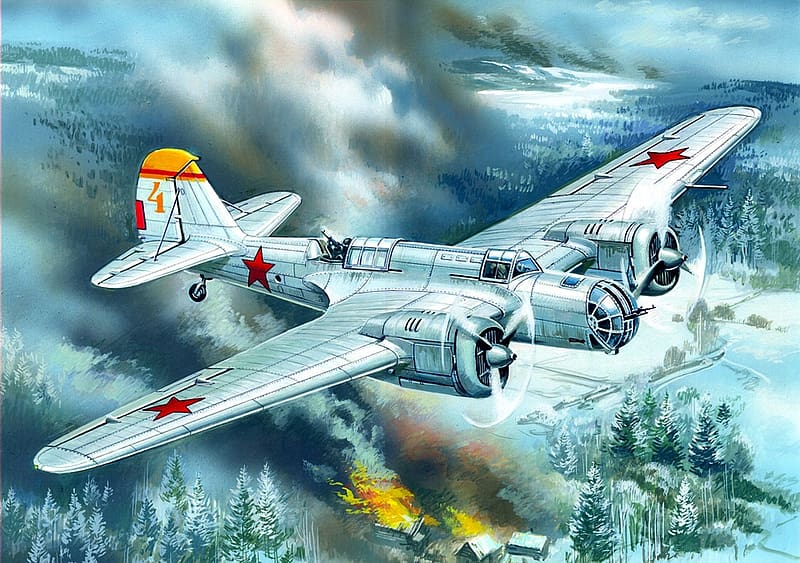
The Tupolev SB (Skorostnoi Bombardirovshchik, or “High-Speed Bomber”) was one of the most significant Soviet warplanes of the 1930s. Its story highlights how rapidly aviation technology advanced in the interwar years. When it first appeared, the SB was among the fastest bombers in the world, capable of outrunning many contemporary fighters. Within a few years, it was overtaken by newer designs. By the time the Soviets were thrust into World War II, it was obsolete. Nonetheless, the SB played a crucial role in shaping Soviet bomber doctrine, and provided valuable combat experience in several conflicts before and during the early stages of the war.
The Soviet Fast Bomber

Tupolev SB development work began in the early 1930s under the leadership of Andrei Tupolev and his design bureau. The Soviet Union was determined to modernize its air force. It aimed to move away from slow, fabric-covered biplanes, and toward all-metal monoplanes with higher speeds and greater operational reach. The SB reflected that ambition. It was an all-metal, stressed-skin aircraft with a sleek, aerodynamically clean profile. Its mid-mounted wings, retractable landing gear, and enclosed crew positions were advanced features for the time. It signaled a decisive break from earlier bomber designs.
The SB was powered by two liquid-cooled inline engines, initially license-built Hispano-Suizas produced in the USSR as the Klimov M-100. They were later by more powerful variants. Those engines gave the SB a top speed of around 430 km/h or about 267 mph in early versions. That k was exceptional for a bomber in the mid-1930s, at a time when many fighters struggled to exceed 400 km/h. The SB’s speed was its primary defense, and allowed it to dispense with heavy armor or large defensive gun arrays.
The Tupolev SB typically carried a crew of three. There was the pilot, a navigator/bombardier in the nose, and a radio operator who also manned a defensive machinegun. Armament was modest, consisting of a few 7.62 mm machine guns mounted in the nose, dorsal, and sometimes ventral positions. Bomb load varied depending on mission and configuration, but ranged from 600 – 1,000 kilograms (1,320 – 2,200 pounds) internally and externally. While not heavily armed, the SB’s speed and altitude performance initially made interception difficult.
Backbone of the Soviet Air Force in the Runup to WWII

Tupolev SB production began in 1935, and it quickly became the backbone of the Soviet bomber force. Thousands were built, and it became one of the most widely produced Soviet aircraft of its era. The SB was also exported and saw service with several foreign air forces, often under license or in modified forms. Spain, Czechoslovakia, and China were among the countries that operated variants of the bomber. The SB first saw combat in the Spanish Civil War, where it was supplied to the Republican forces.
The SB earned the nickname “Katyusha” among Republican crews. In the early stages of the conflict, the SB proved highly effective. Nationalist fighters struggled to intercept it, and its speed allowed it to carry out daylight bombing raids with few losses. However, as more modern fighters such as the Messerschmitt Bf 109 entered the conflict, the SB’s vulnerability became apparent. Losses increased sharply, demonstrating that speed alone was no longer sufficient protection. The SB also saw action in the Second Sino-Japanese War.
SBs flown by both Chinese and Soviet volunteer crews conducted bombing raids against Japanese targets. Again, early successes were followed by mounting losses as Japanese fighter opposition improved. Those experiences highlighted the rapid pace of aviation development and the short operational lifespan of even advanced designs. By the time WWII began, the SB was already nearing obsolescence. Newer bombers with greater payloads, better defensive armament, and higher speeds were entering service. Nevertheless, large numbers of SBs were still in frontline units when Germany invaded the Soviet Union in June, 1941.
Significance and Legacy of the Tupolev SB

SB units suffered horrific losses in the opening months of Operation Barbarossa, both in the air and on the ground. Poor coordination, inadequate fighter escort, and the overwhelming effectiveness of the Luftwaffe all contributed to the aircraft’s rapid attrition. Despite those losses, the SB was versatile. It continued to serve as a bomber, night bomber, reconnaissance aircraft, and even dive bomber at times. By late 1941, though, most SBs had been destroyed or replaced in frontline service by newer designs. Nonetheless, the SB’s influence persisted in non-combat roles such as training and supply drops.
The SB’s historical importance should not be underestimated. It’s introduction represented a major leap forward for Soviet aviation, introduced modern construction techniques, and influenced subsequent bomber designs. It trained an entire generation of Soviet bomber crews, and marked the USSR’s transition from 1930s aviation experiments to a mature, large-scale air industry capable of sustained wartime production. Just as importantly, its operational history provided hard lessons about combat, bomber survivability, and the need for constant technological innovation. Though ultimately eclipsed by more advanced aircraft, the SB stands as a symbol of the Soviet Union’s emergence as a serious aviation power in the years leading up to WWII.

_________________
Some Sources & Further Reading
History Halls – Petlyakov Pe-2: The Formidable Soviet Bomber Designed in a Gulag
Lake, Jon – The Great Book of Bombers (2002)
Latest Articles
- The Johnstown Flood – Thousands Perished When A Dam Collapsed After Gilded Age Tycoons Modified it for their Private Resort
- The Jacquerie: The Medieval Peasant Uprising That Terrified France’s Aristocrats
- Things That Weren’t Thought Through: WWII’s Sticky Bomb Stuck to Users’ Hands Once Activated
- German Tanks of World War II – The Panzer 38(t), a Czech Tank in German Service
- Nicholas Alkemade: The WWII Airman Who Survived an 18,000 Foot Fall From a Bomber Without a Parachute

