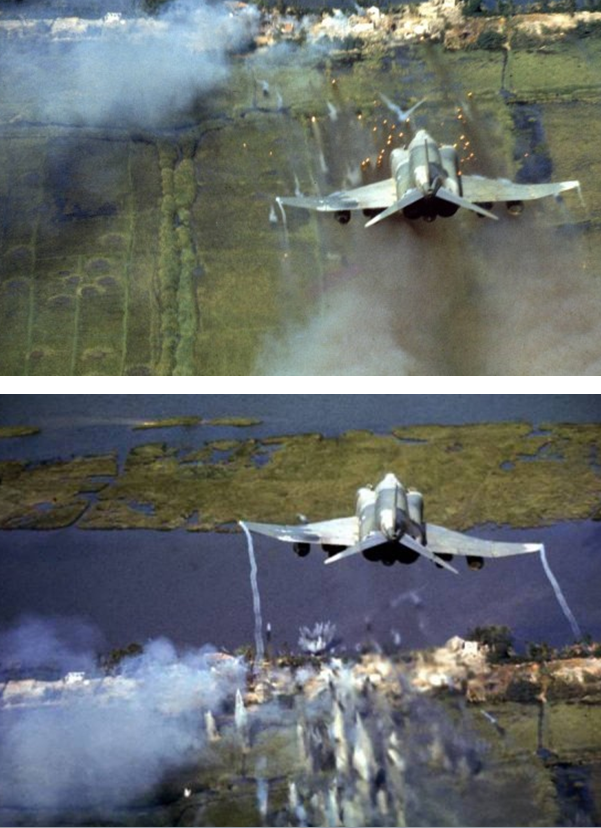
The McDonnell Douglas F-4 Phantom II was one of the Cold War’s most iconic warplanes. Its sheer power, versatility, and longevity reshaped air combat and left a deep imprint on aviation history. Originally conceived as a fleet defense interceptor for the US Navy, the Phantom evolved into a multirole workhorse. It served across US military branches, and in the air forces of more than a dozen other nations. Its distinctive silhouette, twin engines, and prodigious weapons load made it a symbol of American air power for decades.
An Impressive Debut

The origins of the McDonnell Douglas F-4 Phantom II lie in the early Cold War. When high-speed Soviet bombers armed with nuclear weapons first appeared, the US Navy sought a new generation of carrier-based fighters to defend task forces against them. In 1953, McDonnell Aircraft began work on a twin-engine design, initially known as the AH-1, intended as a supersonic interceptor. It was a large aircraft, whose early iterations emphasized missile armament over guns. That reflected a belief that future air combat would be fought at long range with radar-guided weapons, not close-in dogfights.
As requirements evolved, the design grew larger and more powerful. It incorporated advanced radar, greater fuel capacity, and a second crew member to manage the increasingly complex avionics. The result was the F4H-1, later redesignated the F-4 Phantom II under the 1962 tri-service aircraft naming system. The aircraft first flew on May 27th, 1958, and immediately demonstrated extraordinary performance. It could exceed Mach 2, climb rapidly to high altitude, and carry an unprecedentedly heavy weapons load for a fighter. The Phantom set multiple world records in the late 1950s and early 1960s, including speed and altitude records, helping to cement its reputation as a technological marvel.
A Distinctive Warplane

The McDonnell Douglas F-4 Phantom II was physically imposing. It was larger and heavier than most contemporary fighters, with a broad fuselage and, large wings. The Phantom has a distinctive appearance, with upturned wingtips and a downturned tail. That came about as a result of a series of design corrections in the days before computer modeling. To save space on aircraft carriers, the F-4’s vertical stabilizer was shortened. That negatively impacted the airplane’s directional stability. To correct the problem the tailplane was bent down (anhedral). That exposed the tailplane into the air flow much like ventral fin, which increased stability.
The wings were upturned (dihedral) for the same reason that airliner wings are upturned: to improve lateral stability. With the dihedral, the air flow attacks the wings from the top. In turns, the air flow increases the angle of attack on the turn’s side, and tries to bring the aircraft’s wings level (positive stability). As the airplane neared production, engineers discovered stability problems that required an overall five degree wing dihedral to correct. That would have been costly and required a significant redesign. So rather than bend the entire wing five degrees upwards, they bent only the wing’s outer part twelve degrees. That brought the wing’s average dihedral or upward bend to five degrees, and solved the problem.
The McDonnell Douglas F-4 Phantom II Was Adopted by All US Military Branches

The Phantom II was powered by twin General Electric J79 turbojet engines. They produced tremendous thrust, but at the cost of heavy fuel consumption and a prodigious smoke trail at military power. It was a feature that later pilots would both curse and accept as part of the Phantom’s character. The cockpit held two crew members in tandem. That pilot sat in in front, with a radar intercept officer, or weapons systems officer, in the rear. That division of labor allowed the Phantom to handle complex radar intercepts, navigation, and weapons employment more effectively than contemporary single-seat fighters.
The US Navy introduced the McDonnell Douglas F-4 Phantom II into service in 1961. The US Marines adopted it soon thereafter. Defense Secretary Robert McNamara wanted a unified fighter for all US military branches. So in a rare move, the Air Force adopted a Navy-designed fighter, liked it, and became its largest user. That it succeeded in Air Force service was a reflection of the Phantom’s versatile design and exceptional capabilities. The Navy and US Marine version was designated the F-4B, and the Air Force’s the F-4C.
The Phantom II in Vietnam

The Air Force’s McDonnell Douglas F-4 Phantom II differed in several respects from its naval counterpart. The Navy was focused on air-to-air interception to keep Soviet bombers off its task forces. The Air Force wanted more than just air-to-air capabilities. It wanted air-to-ground fighter-bomber capability, and a Phantom that could deliver both conventional and nuclear weapons. So Air Force F-4s incorporated changes to avionics, landing gear, and mission equipment to suit land-based operations. That the Phantom was capable of such versatility made it a cornerstone of American air power during the Vietnam War. There, it served as the primary fighter for both the US Navy and Air Force for much of the conflict.
Vietnam defined the Phantom’s combat reputation more than any other conflict. Entering the war in the mid-1960s, the F-4 was tasked with a wide range of missions. They included air superiority, ground attack, reconnaissance, and suppression of enemy air defenses. Initially, American doctrine assumed that advanced missiles would render traditional dogfighting obsolete, so early F-4 variants lacked an internal gun. In practice, missile reliability proved inconsistent. Moreover, restrictive rules of engagement often forced pilots into visual-range combat with agile North Vietnamese MiG-17s and MiG-21s. Those encounters exposed both the strengths and weaknesses of the Phantom. It was bigger, heavier, and less nimble than its adversaries. However, F-4s possessed superior speed, acceleration, and climb rate, which allowed skilled crews to dictate the terms of engagement. Over time, improved tactics, better training, and more reliable missiles significantly increased the Phantom’s effectiveness.
A 1950s Fighter Design Still in Service in the Twenty First Century

Prompted by early combat losses in Vietnam, the Navy established the Top Gun fighter weapons school in 1969. That dramatically improved kill ratios by emphasizing air combat maneuvering and realistic training. Later Phantom variants also incorporated an internal M61 Vulcan cannon or external gun pods. That restored a close-range option that pilots had sorely missed. Beyond air-to-air combat, the McDonnell Douglas F-4 Phantom II proved highly effective as a strike aircraft. It could carry a wide array of ordnance, from iron bombs and napalm to guided munitions and anti-radiation missiles. Specialized F-4Gs hunted and destroyed enemy surface-to-air missile sites, flying some of the most dangerous missions of the war. Phantom crews endured heavy losses in that “Wild Weasel” role, but successfully reduced the North Vietnamese air defenses threat.
The Phantom’s export success was equally remarkable. Allies around the world adopted the aircraft, and often tailored it to their specific needs. The United Kingdom purchased the Phantom for both the Royal Navy and the Royal Air Force. They fitted with Rolls-Royce Spey engines that improved low-altitude performance, but required significant airframe modifications. Israel employed the Phantom extensively in conflicts with its neighbors. It successfully used it as both a fighter and strike aircraft during the War of Attrition and Yom Kippur War. German, Japanese, Iranian, Turkish, and Greek Phantoms, among others, served for decades. Many underwent extensive upgrades that kept them relevant well into the twenty first century.
More than 5,000 Phantom IIs Were Built

Technologically, the McDonnell Douglas F-4 Phantom II marked a transitional era in fighter design. It embodied the shift toward missile-centric combat, sophisticated radar systems, and multirole capability, but still maintained the enduring importance of pilot skill, training, and adaptability. Its lack of an internal gun in early versions became a cautionary lesson in overreliance on emerging technology. That influenced the design philosophy of later fighters such as the F-15 and F-16, which combined advanced avionics with excellent maneuverability and internal cannons.
Despite its many strengths, the Phantom was not without drawbacks. It was expensive to operate, required significant maintenance, and demanded careful handling, especially at low speeds and during carrier operations. Its large radar cross-section and smoke-producing engines made it more visible than later-generation fighters. US F-4 production ended in 1979 after 5,195 were built – 5,057 by McDonnell Douglas, and the rest by Mitsubishi in Japan. 1,264 went to the US Navy and Marines, 2,874 to the US Air Force, and the rest to foreign buyers.

More advanced fighters entered service in the 1970s and 1980s, including the F-14 Tomcat, F-15 Eagle, and F-16 Fighting Falcon. So the Phantom gradually transitioned to secondary roles or was retired from frontline US service. Nevertheless, its longevity is a testament to its robust design and adaptability. The US Air Force continued to operate specialized F-4 variants into the 1990s, notably in reconnaissance and target drone roles. Converted QF-4s drones served as full-scale aerial targets. They allowed realistic testing of modern air-to-air missiles, and provided a final chapter in the aircraft’s long US service life.
Significance and Legacy of the McDonnell Douglas F-4 Phantom II

Culturally, the McDonnell Douglas F-4 Phantom II occupies a prominent place in aviation lore. Its unmistakable roar, smoky exhaust, and powerful presence made it a memorable sight for those who saw it in service, and an airshow favorite. Pilots often spoke of the Phantom with a mixture of respect and affection. They acknowledged its challenges, while praising its strength, speed, and ability to bring them home even after sustaining significant damage. In historical terms, the Phantom bridged the gap between the early jet age and the modern, highly specialized fighter era. It demonstrated that a single aircraft could effectively perform multiple roles, and shaped procurement strategies and operational doctrine for decades.
The more than 5,000 Phantoms built was an extraordinary number for a high-performance jet fighter. Many remain in limited service or reserve roles today, particularly in countries that have invested heavily in upgrades. The F-4 Phantom II was not a perfect aircraft, but it was a profoundly influential one. It fought in numerous conflicts, served with distinction across continents, and helped define the Cold War’s air combat environment. Its legacy lives on beyond museums and the memories of those who flew and maintained it. It also endures in the design principles and training philosophies that continue to shape modern air forces.

_________________
Some Sources & Further Reading
Angelucci, Enzo – The American Fighter (1987)
Coughlin, Geoff – McDonnell Douglas F-4 Phantom (2022)
History Halls – The F-86 Sabre
Peake, William R. – McDonnell Douglas F-4 Phantom: Production and Operational Data (2004)
Newest Articles
- The Johnstown Flood – Thousands Perished When A Dam Collapsed After Gilded Age Tycoons Modified it for their Private Resort
- The Jacquerie: The Medieval Peasant Uprising That Terrified France’s Aristocrats
- Things That Weren’t Thought Through: WWII’s Sticky Bomb Stuck to Users’ Hands Once Activated
- German Tanks of World War II – The Panzer 38(t), a Czech Tank in German Service
- Nicholas Alkemade: The WWII Airman Who Survived an 18,000 Foot Fall From a Bomber Without a Parachute

