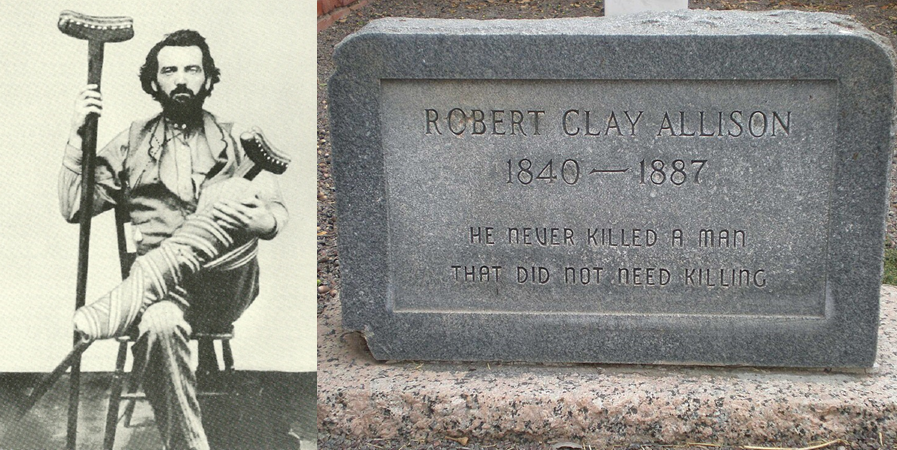
Clay Allison was one of the Old West’s most feared, unpredictable, and colorful gunfighters. He was known as much for his violent temper and bizarre antics, as for his deadly skill with a revolver. Allison earned a reputation that straddled the line between dangerous killer and frontier eccentric. Unlike some of his more famous contemporaries, he was never formally credited with a large number of killings. However, his willingness to use violence – and his utter lack of restraint when provoked – made him a legendary and terrifying presence across the frontier.
Clay Allison Might Have Been Unstable Because of a Head Injury

Robert Andrew Clay Allison was born on September 2nd, 1840, in Waynesboro, Tennessee. He grew up in a respectable middle-class family and received a decent education, which distinguished him from many other gunfighters. His father was a minister and farmer, and young Clay seemed destined for an ordinary life. However, the outbreak of the US Civil War changed everything. Allison joined the Confederate Army but was discharged early, possibly due to mental instability or medical reasons. Some accounts suggest he suffered a head injury during the war that affected his personality.
Like many former soldiers seeking opportunity or escape, Allison drifted west after the war. There, he quickly gained a reputation as a dangerous man and lethal gunslinger. The frontier proved fertile ground for Allison’s volatile nature. He worked as a cowboy, ranch hand, and buffalo hunter in Texas and New Mexico Territory. They were dangerous and rough occupations that often involved long periods of isolation, punctuated by sudden violence. Allison thrived in that environment, and quickly gained a reputation for fearlessness and an explosive temper. Unlike more calculating gunfighters, Allison was impulsive. He could be friendly and generous one moment, and homicidally enraged the next.
Earning a Reputation for Violence

Clay Allison first garnered attention in 1870, when he led a mob that broke into a New Mexico jail that housed a deranged man named Charles Kennedy. Kennedy had reportedly boasted of murdering travelers, and even of killing his own son. The Allison-led mob seized and lynched him. The bodies of missing travelers, and of his son, were later found in Kennedy’s property. Allison’s fame grew in 1874, when a notorious gunman named Zachary Colbert invited him to dinner at a salon. Mid-meal, Colbert suddenly drew his pistol and tried to kill Allison, but Allison was faster and shot him first.
His reputation was further enhanced during a range conflict in New Mexico known as the Colfax County War. It pitted established settlers and new title holders who accused the settlers of squatting. Allison sided with the settlers, and took part in the lynching of a pro-landowner gunslinger. The lynched man’s family vowed revenge, but when an uncle of the victim cornered Allison, the latter proved quicker on the draw and shot him dead. Allison was arrested for murder, but the charges were dropped after an inquiry determined that he had acted in self-defense.
A Feared and Unpredictable Gunslinger

In another notable incident, Clay Allison shot and killed a saloon keeper named Francisco Griego after an argument. After he killed Griego, Allison left, then returned to fire some more shots into the already dead man. It was a grim demonstration of his rage. One of the most famous stories about Allison illustrates both his fearsome reputation and his bizarre personality. After a night of heavy drinking, he ran naked through the streets of Cimarron wearing only his gun belt, firing his revolver and shouting wildly. That shocking display became legendary, and contributed to his image as a dangerous and unpredictable man. Such antics reinforced the idea that Allison was not entirely stable. It made others even more reluctant to confront him.
Despite his violent tendencies, Allison was not killed in a gunfight. That set him apart from many other Old West gunfighters. He had numerous confrontations, but managed to survive them all. In Dodge City, Kansas – a notorious cattle town – he ran afoul of local authorities, including Wyatt Earp and Bat Masterson. Allison was intoxicated and causing trouble, and the lawmen demanded he surrender his weapons. Remarkably, Allison complied peacefully on this occasion, and Earp and Masterson probably breathed a sigh of relief. Even legendary lawmen understood that a gunfight with Clay Allison would be dangerous and unpredictable.
A Deadly Gunfighter’s Ironically Mundane Death

Unlike some gunfighters who embraced outlaw lives, Allison eventually settled down. He married Dora McCullough in 1875, and by most accounts, he was devoted to her. The marriage had a stabilizing effect on him, but did not entirely smooth his rough edges. In 1876, one year into married life, Allison refused to surrender his pistols to a constable in Las Animas, Colorado, who informed him that it was illegal to carry guns within the town limits. That led to a gunfight that left the constable dead. Allison was charged with manslaughter, but the charges were dropped because the constable had fired first.
Allison eventually became a rancher near present-day Pecos, Texas, and focused on building a legitimate livelihood. Although he retained his reputation and temper, he became less involved in violent confrontations as he aged. Allison’s death in 1887 was ironically mundane, especially in light of his violent life. He died not in a gunfight but in a wagon accident. While hauling supplies, he fell from his wagon, and its wheel rolled over him and broke his neck. He gave up the ghost shortly afterward, at age forty six. Engraved on his tombstone is that “He Never Killed a Man That Did Not Need Killing”.
The Legacy and Legend of Clay Allison

Clay Allison’s accidental death was a quiet end for a man who had lived so violently. The man’s legacy remains complex. Unlike gunfighters such as Doc Holliday or Billy the Kid, Allison was not involved in famous showdowns that became part of American folklore. However, to contemporaries, Allison’s reputation was arguably just as intimidating. His unpredictability, violent temper, and willingness to kill made him one of the most feared men on the frontier. At the same time, he was not a simple villain.
Allison was capable of friendship, loyalty, and love, particularly toward his wife. In many ways Allison, a product of a violent time and place, embodied the chaotic nature of the Wild West. He was shaped by war, instability, and the absence of strong legal authority. He was both a dangerous killer and a frontier survivor. The legend of Clay Allison endures not because of a single famous gunfight, but because of the fear and fascination he inspired in all who came across him.

_________________
Some Sources & Further Reading
Clark, O. S. – Clay Allison of the Washita: First a Cow Man, then an Extinguisher of Bad Men (1922)
History Halls – Wild West Outlaws: Charlie Bowdre, the Regulator Turned Cattle Rustler
O’Neal, Bill – Encyclopedia of Western Gunfighters (1979)
Texas State Historical Association – The Life and Legacy of Clay Allison: Gunfighter and Rancher
Latest Articles
- Henry Jennings: The Privateer-Turned-Pirate Who Set the Stage for the Caribbean’s Golden Age of Piracy
- Fighting Women: Tomoe Gozen, the Fearsome Female Samurai
- From the NFL to the Sands of Iwo Jima: Medal of Honor Recipient Jack Lummus
- The Zanj Rebellion: The African Slave Revolt That Rocked Medieval Mesopotamia
- The Dacian Falx: The Curved Ancient Sword that Shocked the Romans

