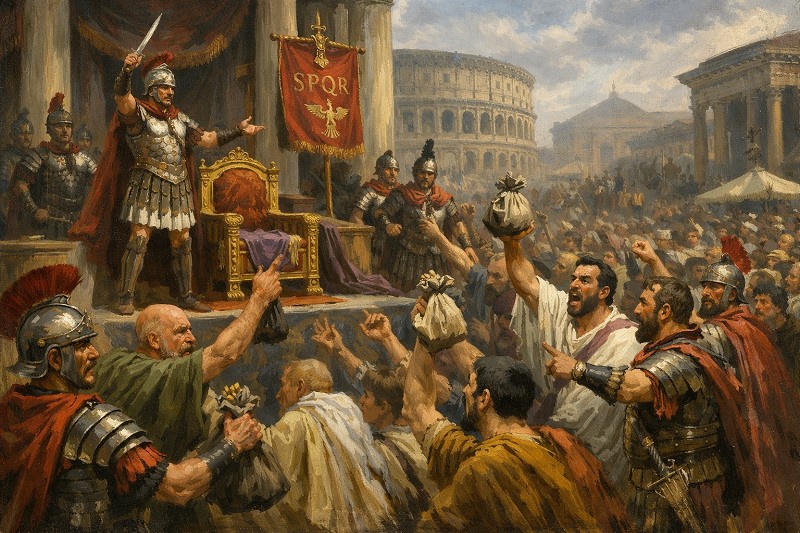
The Praetorian Guard’s auction of the Roman imperial throne in 193 AD was one of the most extraordinary and scandalous events in Roman history. It demonstrated, in the starkest possible way, how bad things had gotten. Political authority had decisively shifted away from traditional institutions like the Senate, and to the military, particularly the Praetorian Guard. The Praetorian throne auction was a shocking display of greed and opportunism. Soldiers entrusted with protecting the emperor murdered him, then literally sold the throne and empire to the highest bidder.
A Greedy Imperial Bodyguard

The Praetorian throne auction crisis began with the assassination of Emperor Commodus on December 31st, 192 AD. Commodus had ruled for twelve years, but his reign had increasingly alienated the Roman elite. He was seen as an erratic and self-indulgent ruler who did not get along with the political class. Instead, he relied heavily on personal favorites and the Praetorian Guard to maintain control. His death created a sudden and dangerous power vacuum. The Roman Senate quickly moved to restore order by proclaiming Pertinax, a respected senator and experienced military commander, as emperor.
Pertinax was widely regarded as a capable and honorable man. He had risen from relatively humble origins through military service and administrative competence. His accession was initially welcomed by the Senate and the public. It was hoped he would restore discipline and stability after the excesses of Commodus’s reign. However, Pertinax faced a serious problem: the imperial bodyguards. The Praetorian Guard, always susceptible to corruption absent a firm imperial hand, had grown accustomed to enormous financial rewards and lax discipline under Commodus. Pertinax, determined to reform the government and restore fiscal responsibility, tried to impose stricter discipline and limit excessive spending.
Murdering an Emperor and Selling the Throne

Pertinax had promised the Praetorian Guard a donative – a traditional bonus paid to soldiers upon an emperor’s accession. However, he soon discovered that he could not satisfy their inflated expectations. The Guard had become less a protective force and more a powerful political actor accustomed to influencing imperial succession. Many Praetorians resented Pertinax’s reforms and his attempts to restore discipline. They sprang into action on March 28th, 193 AD. After ruling for only 86 days, Pertinax was confronted by mutinous Praetorians who stormed the imperial palace.
Rather than flee, he tried to reason with the Guardsmen, and appealed to their sense of duty and loyalty. His courage and composure were admirable, but ineffective. The Praetorians murdered the emperor, severed his head, and displayed it on a spear as they returned to their barracks. With that brutal act, the Praetorian Guard demonstrated that it could remove an emperor at will. However, killing Pertinax created a new problem: who would replace him? Rather than support a candidate based on merit, legitimacy, or Senate approval, the Praetorians decided to sell the throne.
The Praetorian Throne Auction

The Praetorian Guard withdrew to their fortified camp after they murdered Pertinax. There, they announced to all and sundry that the empire was, in effect, for sale to the highest bidder. Two main contenders emerged to bid in the Praetorian throne auction. One was Titus Flavius Sulpicianus, a senior official and Pertinax’s father-in-law, who hoped to avenge his relative and secure power. He entered the Praetorian camp, began to negotiate with the Guardsmen, and offered a substantial financial reward. However, he was soon challenged by Didius Julianus, an extremely wealthy senator.
Julianus arrived at the Praetorian Guard’s camp and began to bid against Sulpicianus in what amounted to a public auction. The two men competed by offering increasingly large sums of money to each individual guardsman. It was not a symbolic gesture: the promises involved enormous payments, equivalent to many years’ wages for ordinary Praetorians. Julianus ultimately won by offering 25,000 sestertii per Guardsman, an astonishing amount. The Praetorians accepted his bid, proclaimed him emperor, and escorted him to the Senate.
Didius Julianus Won the Bid for a Shaky Throne

The Senate had little choice but to confirm Julianus as emperor, as armed Praetorians stood ready to enforce their decision. However, the people of Rome were outraged at the winner of the Praetorian throne auction. They viewed Julianus as a usurper who had purchased power rather than earn it through service or legitimacy. Crowds openly expressed their contempt, and jeered and insulted him in public. Julianus’s position was extremely weak. His authority rested entirely on the support of the Praetorian Guard, and even that support was based solely on financial promises.
Julianus had ascended the throne, but it was a shaky one. He lacked the Senate’s respect, the provinces’ loyalty, and the support of the legions stationed throughout the empire. News of the Praetorian throne auction spread quickly, and it provoked widespread anger and rebellion. Several powerful generals refused to recognize Julianus as emperor, and instead declared themselves rightful rulers. Most significant among them was Septimius Severus, commander of the Danubian legions. An experienced and ambitious leader, Severus presented himself as the avenger of Pertinax.
The Praetorian Throne Auction Plunged the Empire Into Civil War

Septimius Severus marched on Rome, enthusiastically supported by his troops. At the same time, other generals in Syria and Britain also declared themselves emperor. The Roman Empire was plunged into civil war. Julianus, who lacked strong military backing, found himself isolated and vulnerable. As Severus approached Rome, the Praetorian Guard realized they had made a serious mistake. Julianus was unable to secure the empire, and they could not secure it for him. They could bully and murder unarmed civilians and quell the occasional riot in the imperial capital, but taking on veteran legions like those now advancing upon Rome was beyond them. Through greed, they had placed their own position at risk.
The Praetorians tried to negotiate with Severus, but he would not trust them. As to Julianus, it was all up for him. The Senate, memories of his bidding in the Praetorian throne auction still fresh on their minds, abandoned him. On June 1st, 193 AD, after only 66 days in power, Julianus was sentenced to death and executed in the imperial palace. His brief reign ended in humiliation and failure, and Severus soon entered Rome as the new emperor. One of his first acts was to punish the Praetorian Guard for their treachery.
“Enrich the Soldiers, and Scorn Everybody Else”

The Praetorian Guard had never been known as a paragon of virtue. Indeed, over its existence, it had done many questionable things, from all kinds of corruption to extortion to murder. Brazenly auctioning off the imperial throne was too much even for Romans long accustomed to corruption and abuses of power. Disgusted with the Guard – a loathing shared by much of the Empire by then – Septimius Severus did away with them. To ensure against the possibility of another Praetorian throne auction, the new emperor disbanded the existing Guard. He stripped them of power, banished them from the city, and replaced them with loyal soldiers from his own legions.
The Praetorian throne auction of 193 AD exposed the dangerous reality of Roman politics. It showed that military force, not tradition or law, ultimately determined who ruled. The Praetorian Guard had reduced imperial succession to a financial transaction, undermining the legitimacy of the entire system. The event marked a turning point in Roman history. It demonstrated the fragility of civil authority and the growing dominance of the military. The empire would continue for centuries, but the illusion of orderly succession was permanently damaged. From then on, it was military power, and nothing but, that guaranteed the throne. Septimius Severus, who knew that all too well from personal experience, advised his sons on his deathbed: “enrich the soldiers, and scorn everybody else”.

_________________
Some Sources & Further Reading
Bedoyere, Guy De la – Praetorian: The Rise and Fall of Rome’s Imperial Bodyguard (2017)
Cassius Dio – Epitome of Book LXXIV
Herodian – Roman History, Book Two
Historia Augusta – The Life of Didius Julianus
History Halls – The Unintended Consequences of the Professionalization of the Roman Legion
Newest Articles
- The Johnstown Flood – Thousands Perished When A Dam Collapsed After Gilded Age Tycoons Modified it for their Private Resort
- The Jacquerie: The Medieval Peasant Uprising That Terrified France’s Aristocrats
- Things That Weren’t Thought Through: WWII’s Sticky Bomb Stuck to Users’ Hands Once Activated
- German Tanks of World War II – The Panzer 38(t), a Czech Tank in German Service
- Nicholas Alkemade: The WWII Airman Who Survived an 18,000 Foot Fall From a Bomber Without a Parachute

