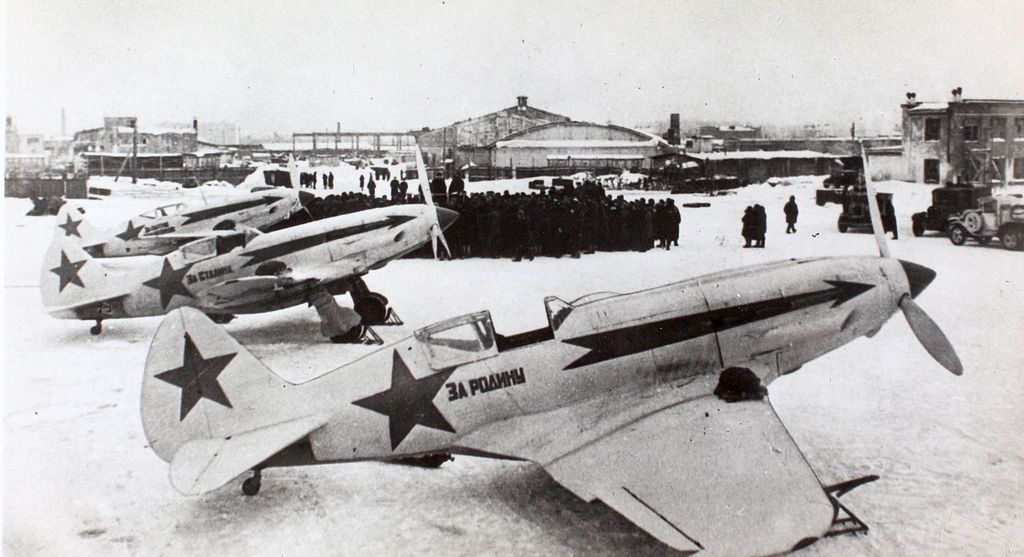
The MiG-3’s story reflects both the ambitions and the limitations of Soviet aviation early in World War II. A high-altitude interceptor, it was designed by the Mikoyan-Gurevich bureau and entered service shortly before the German invasion in 1941. The MiG-3 combined sleek aerodynamic lines with powerful performance at great altitude. However, it struggled at the low-to-medium altitudes where most of the Eastern Front’s aerial combat actually took place. Its development, deployment, strengths, and weaknesses shed light on the complex history of the Red Air Force’s early WWII struggles.
A Fighter that Excelled at Fast, High Altitude Interceptions

The MiG-3 originated as an improved version of the earlier MiG-1. Its predecessor was designed to meet a requirement for a fast interceptor able to operate above 7,000 meters/ 23,000 feet. Soviet planners feared high-altitude intruders such as reconnaissance aircraft and bombers, and wanted a fighters to counter them. The MiG-1 met the basic specification, but had handling and structural problems. So Mikoyan and Gurevich came up with a redesign. They refined the airframe, adjusted the wing position, strengthened the structure, and improved the engine installation. The result was the MiG-3, which entered production in late 1940. It retained the liquid-cooled Mikulin AM-35A inline engine, which provided excellent performance at altitude, especially in terms of speed.
One of the MiG-3’s defining features was its impressive high-altitude speed. It exceeded 640 km/h, or nearly 400 mph, at over 7,000 meters/ 23,000 feet. That made it one of the fastest fighters in the world at such altitudes when it entered service. Its long, streamlined nose, relatively light construction, and powerful engine gave it an aerodynamic efficiency unmatched by most contemporaries. It was theoretically ideal for intercepting high-flying reconnaissance aircraft such as the German Junkers Ju 86P or potential bomber threats. However, those theoretical advantages vanished once war broke out in 1941, and actual combat conditions diverged sharply from prewar assumptions.
Unfortunately for the MiG-3, Little Aerial Combat Occurred at High Altitude on the Eastern Front

The reality of the Eastern Front air war was that combat typically occurred at low or medium altitudes. Warplanes rarely tangled above 5,000 meters or 16,000 feet. At such lower altitudes, the MiG-3’s advantages evaporated. The AM-35A engine lacked low-altitude torque, which made acceleration sluggish and turning performance mediocre. German fighters like the Bf 109F enjoyed better all-around agility and climb rate at the heights where most engagements unfolded. Soviet pilots, many of whom had few training hours and little familiarity with high-performance aircraft, found the MiG-3 demanding. Its long nose and relatively rearward cockpit position restricted visibility, especially during takeoffs and landings. That led to numerous accidents. Its tendency to enter dangerous spins at the edge of the performance envelope also intimidated inexperienced aviators.
Armament was another weakness. Most MiG-3s were equipped with only one 12.7 mm UBS machine gun supplemented by two 7.62 mm ShKAS guns. That was relatively light armament, inadequate against modern, increasingly well-protected German fighters and bombers. Attempts to add more firepower such as with wing-mounted guns or underwing cannons introduced weight and drag. That eroded the aircraft’s high-altitude speed advantage, without significantly improving its low-altitude deficiencies. It was not all negative, though: the MiG-3 did have some strengths in actual combat. Skilled pilots discovered that it performed well in high-speed slashing attacks, and excelled in diving maneuvers. Its structural strength allowed steep, fast dives that some Luftwaffe fighters hesitated to follow. Unfortunately, it took skilled pilots to exploits those advantages, and skilled Soviet pilots were few early in the war.
Legacy of the MiG-3

In the war’s early months, MiG-3 units were among the first Soviet fighters to challenge German reconnaissance missions at altitude. At great heights, they scored some notable successes. They also contributed to the defense of Moscow in late 1941. Their speed enabled rapid interception runs against bomber formations approaching the city. Veteran pilots who mastered the aircraft appreciated its stability at high speed, and its ruggedness under combat stress. Nevertheless, by 1942 the MiG-3’s deficiencies had become too pronounced to ignore. Production ceased in favor of aircraft better suited to the Eastern Front’s operational realities, such as the Yakovlev Yak-1 and Lavochkin-Gorbunov-Gudkov LaGG-3, and later the more refined Yak-9 and La-5.
The AM-35A engine factory also shifted to producing the AM-38 engine for the Il-2 Sturmovik, cementing the MiG-3’s fate. Remaining MiG-3s soldiered on in diminishing numbers. They were often relegated to reconnaissance or secondary roles, and gradually disappeared from front-line units. In retrospect, the MiG-3 was an elegant, but mismatched tool. It was a high altitude interceptor built for a type of aerial war that rarely materialized on the Eastern Front. Its development nonetheless advanced Soviet understanding of high-speed aerodynamics and paved the way for later Mikoyan-Gurevich design bureau successes. Though overshadowed by later MiG aircraft, the MiG-3 remains a fascinating symbol of the Soviet Union’s early-war aviation challenges, and the rapid technological evolution forced by wartime realities.

_________________
Some Sources & Further Reading
History Halls – World War II Fighters: The Soviet Yakovlev Yak-9
Tessitori, Massimo – Mikoyan-Gurevich MiG-1/ MiG-3 (2006)

