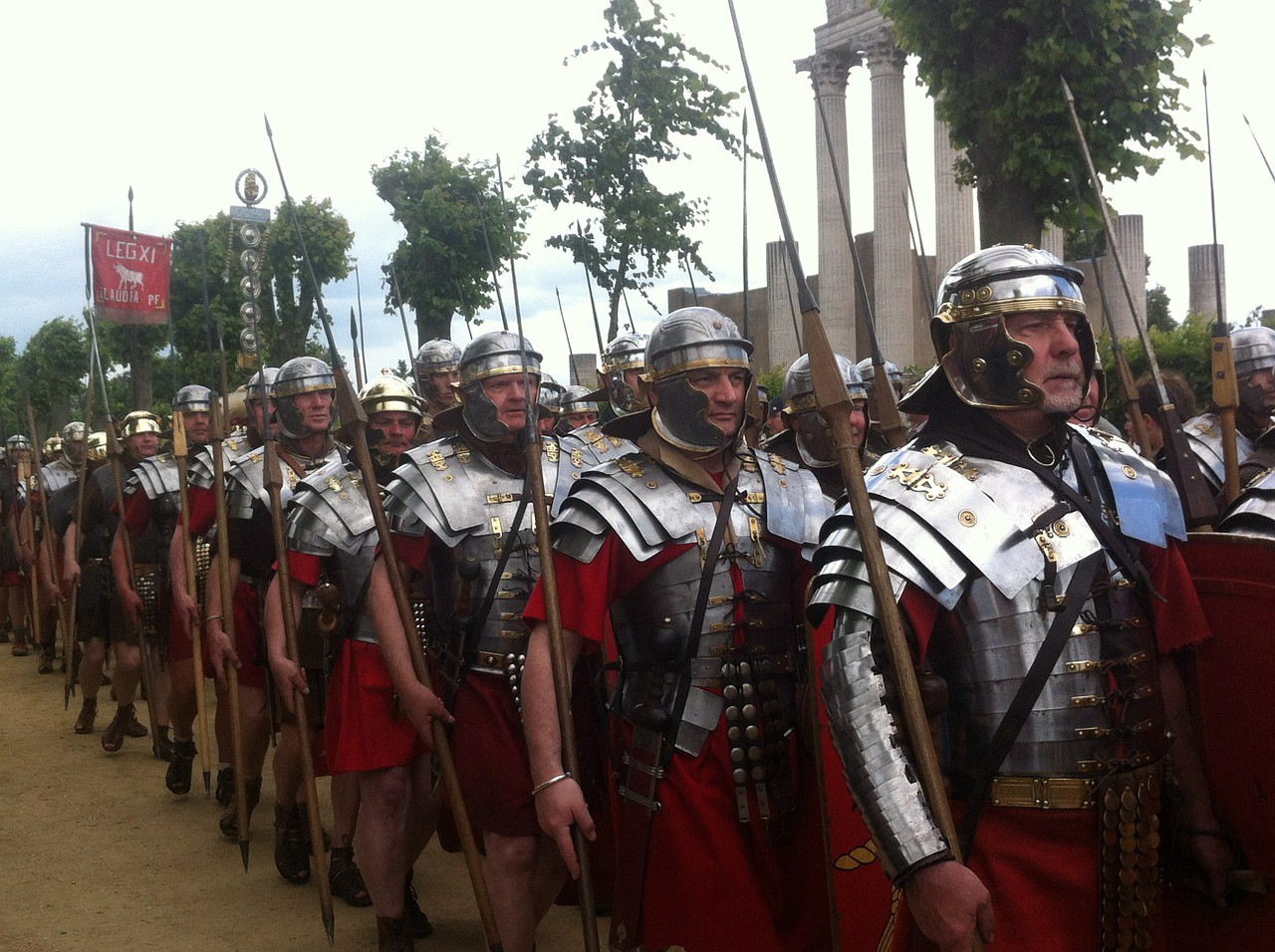
The Roman military was integral to the rise of Rome from an unheralded collection of villages by the Tiber River to an empire. For centuries, it was an effective but nonetheless ad hoc organization, until it was professionalized in the late second century BC. As seen below, that had unanticipated consequences that ushered in a period of internal strife, and led to the collapse of the Roman Republic.
Structure of a Roman Legion

The Roman military’s biggest unit was the legio, or legion, which existed for centuries and underwent many changes along the way. A mid Roman Republic legion at full strength had about 3000 heavy infantry soldiers. They were divided into maniples of 120 soldiers, each maniple (Latin manipulus, or “handful of spearmen”) divided in turn into of two 60-man centuriae, or centuries. The centuries were subdivided into the equivalent of squads of eight men, each known as a contubernium (“tent group”). There were also 1200 skirmishers and 300 cavalry, for a total of around 4500 men per legion. In the late Republic, the centuries were enlarged to 80 men, broken down into ten contubernia of eight men each. Six centuries were grouped into a cohort of 480 men.
A late Republic legion contained nine standard cohorts, plus a first cohort that was manned by the legion’s best soldiers. Unlike standard cohorts, the first cohort had five double strength centuries of 160 men each. That brought a fully manned legion to 5120 men. In practice, legions were seldom at full strength, and typically operated with around 4500 men. When the Roman Republic fell and was replaced by the Roman Empire, Augustus, the first emperor, kept thirty legions, stationed along the borders. They were supported by non-Roman auxiliary soldiers, who received Roman citizenship at the end of their service.
The Legion’s Chain of Command

In the Roman Empire, each legion was led by a legatus, or legate, usually a senator appointed by the emperor. Beneath him were six tribunes. One tribune, who served as the legion’s second in command, was from the senatorial class. He was known as the tribunus laticlavius, or “broad striped tribune”, in reference to the broad stripe on the togas of senatorial class men. The other five tribunes hailed from the lower but still prestigious equestrian class. They were, known as tribune angusticlavi, or “narrow striped tribunes”, in reference to the narrow stripe on the togas of equestrian class men.
The legion’s third in command was the praefectus castrorum, or camp prefect. He was usually a veteran from the lower classes who rose from the enlisted ranks. Camp prefect was typically the highest rank and position that an enlisted soldier could reasonably hope to reach in the Roman military. A camp prefect would have served for around twenty five years. That would have included a stint as centurion of the first cohort. Then came the centurions, officers promoted from the enlisted ranks to command the legion’s centuries and cohorts.
Transformation of the Roman Legion From a Phalanx to a More Flexible Unit

The most senior centurion in a Roman legion was the one in command of its first cohort. He was known as primus pilus, literally “first spear”. Next senior was the second cohort’s centurion, with descending seniority down to the most junior centurion in command of the tenth cohort. Within each cohort, seniority among the centurions was again in descending order, starting with the most senior in command of the first century. Beneath the centurions came optios, equivalent to modern company first sergeants, one for each century. They in turn were assisted by guard commanders, one per optio. Finally, at the base of the pyramid, were the common legionaries.
The Romans originally fought with spears in dense phalanx formations. They switched to a more spread out legion with sword-wielding legionaries because of the Samnite Wars, fought from 343 to 290 BC. Their Samnite enemies inhabited the Apennine Mountains south of Rome, and in that rough mountainous terrain, dense phalanxes proved to be unwieldy. Te Samnites were armed with swords and fought in flexible formations, based on a smaller subunit known as a maniple (“handfuls”). Their tactical flexibility allowed them to run rings around the Romans, and deal them a series of humiliating defeats. Worst of those was forcing an entire Roman army to surrender at the Caudine Forks in 321 BC.
Tactical Deployment of the Mid-Republic Legion

The Romans were a pragmatic lot who often learned from their mistakes, and did not shy from copying what worked from others. After the disaster at the Caudine Forks, the Romans abandoned the phalanx, copied the Samnites, and adopted the manipular system. Around 315 BC, the legions were broken into heavy infantry maniples of 120 men. In battle, each maniple formed up in three ranks of 40 men each. Until the late second century BC, Roman soldiers paid for their own equipment. So the maniples were arrayed in three layers, based on experience and wealth.
In front of the maniples were the velites, or skirmishers, often the youngest and nimblest soldiers. The first line of maniple heavy infantry were the hastate. They were armed with short swords, an oval shield, the scutum, and throwing spears, the pila. Then came the princepes, prosperous men in the prime of their lives, who could afford decent equipment. Finally came the triari, the oldest and often wealthiest men, who could afford the best equipment. Armed with spears, they formed the last battle line. They were seldom used, as battles were usually fought and won by the soldiers ahead of them. They were only committed to battle if things went wrong. As a result, “it has come to the triarii” became a common Roman saying to mean that things were desperate and require the use of one’s last resort.
The Marian Reforms

Legions used maniples for over two centuries, until they were replaced by larger cohorts of 480 soldiers in the Marian Reforms of Gaius Marius (157 – 86 BC). Germanic tribes had crossed the Alps, invaded southern Gaul, threatened Italy, and wiped out two Roman armies sent to repulse them. That threw the Italian Peninsula, always fearful of barbarians since Gauls had sacked Rome and devastated Italy in 387 BC, into a panic. To meet the crisis, Marius implemented widespread reforms. Until then, Roman soldiers had to furnish their own weapons and armor. So the Roman legions’ ranks were restricted to propertied citizens who could afford to arm and equip themselves. Marius opened the legions to all Roman citizens, including the poorest.
Poor Romans could not afford to pay for weapons, armor, and all the kit necessary to equip a legionary. So the Roman government furnished their weapons and armor, and also paid them salaries. That changed the army from what until then had been a middle class and patrician institution, into a professional force. For many legionaries after the Marian Reforms, service in the legion was transformed from an obligation and duty of citizenship, and into a professional career. As seen below, that led to an unintended shift in interests and loyalties.
The Unintended Consequences of the Professionalization of the Roman Legion

Since military service was now their career, many legionaries came to see their personal interests as most aligned with those who could advance their careers and reward their service. Most often, that meant their generals, not the government in Rome. Legionaries began to rely on their commanders for rewards during service, and for severance pay and retirement benefits when they were discharged. Unscrupulous generals took advantage of that. They put to their own use legions that were increasingly more loyal to their commanders than to the Roman government.
The result was a chaotic century of civil wars and internal strife. It finally ended with the collapse of the Roman Republic and its replacement with the Roman Empire. One of Augustus’ first acts when he consolidated power and became Rome’s first emperor was to further professionalize the legions. His chief goal was to break the legionaries’ dependence on their generals, and shift their loyalty to the emperor, instead. Enlistment terms were extended from ten years to twenty five, pay was standardized, and the legionary was guaranteed a land grant or cash payment at the end of his service. The legionary’s oath of allegiance, the sacramentum, was also switched from his commanding general to the emperor.

_________________
Some Sources & Further Reading
Goldworthy, Adrian – The Complete Roman Army (2003)
History Halls – The Gladius: The Sword With Which Rome Won an Empire
Watson, George Ronald – The Roman Soldier (1969)

