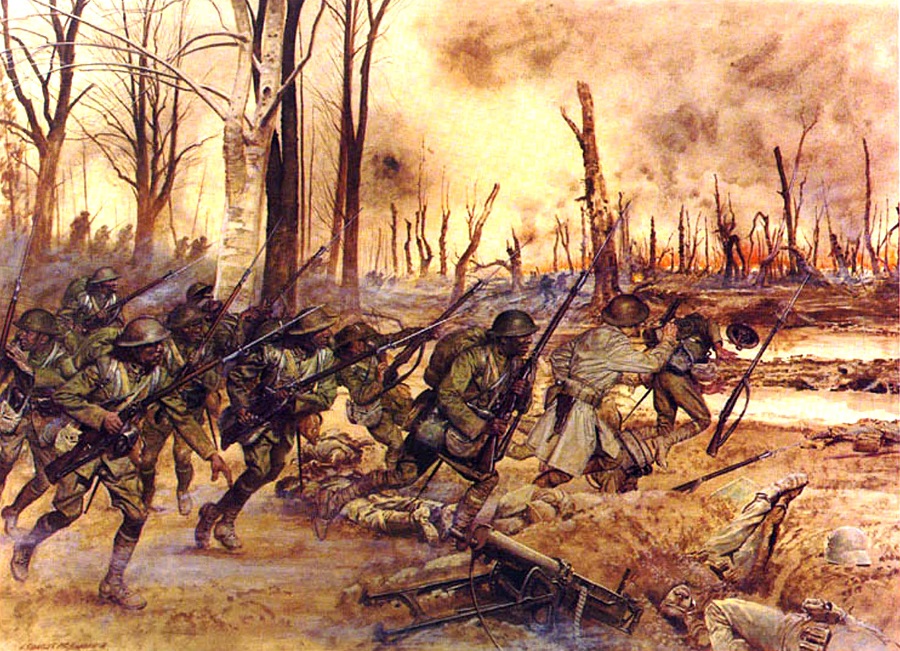
The Harlem Hellfighters, officially the 369th Infantry Regiment, occupy a singular place in the history of World War I. They also occupy a significant place in the story of African American military service. Their combat record and cultural impact made them one America’s most famous units in the war. Once guns fell silent, though, they returned to a nation that continued to deny them equality. Their story is one of courage under fire, perseverance in the face of discrimination, and an enduring influence that reached far beyond the battlefield.
Hopes that Military Service and Loyalty to the US Would be Rewarded With Racial Equality

In 1913, New York formed an African American National Guard unit, initially known as the 15th New York Infantry Regiment. It drew heavily from Harlem, which by the 1910s was becoming a center of Black cultural, political, and social life. The regiment attracted men from varied backgrounds: laborers, porters, stevedores, students, professionals, and musicians. While their motivations differed, many were united by a desire to prove their patriotism and their worth as soldiers in a society that often questioned both.
When the United States entered WWI in April, 1917, African American leaders urged Black men to enlist. They argued that loyal service would strengthen Black claims to citizenship and civil rights. At the time, the US Army was rigidly segregated and deeply shaped by racist assumptions. Many white officers believed that African Americans lacked the discipline or courage required for frontline fighting. So Black soldiers were often assigned to labor battalions, not to combat units. The 15th New York, federalized in 1917 and redesignated the 369th Infantry Regiment, quickly encountered these entrenched prejudices.
The US Army Loaned its Black Soldiers to the French

The 369th trained at Camp Whitman in New York, and later at Camp Wadsworth in South Carolina. There, the regiment was exposed to the contradictions of American democracy. While preparing to fight for freedom abroad, the men endured segregation and dehumanizing discriminatory treatment at home. Especially in the South, where Black soldiers faced the threat of racial violence from both local civilians and military police. Tensions were high, and Black soldiers were often punished more harshly than their white counterparts. Despite that, the regiment trained hard and maintained discipline, determined to demonstrate its competence.
When the 369th arrived in France in late 1917, it initially faced frustration and humiliation. General John J. Pershing’s American Expeditionary Forces was reluctant to place Black troops in combat roles alongside white American units. As a result, many African American regiments were relegated to labor duties, unloading ships and building roads. The 369th performed such work for several months. It bred resentment among men who had trained as infantry and were eager to fight. The regiment’s fortunes changed when Pershing agreed to “loan” several Black American units to the French Army, which was suffering from manpower shortages after years of brutal fighting. The French were not without their own prejudices, but they had long employed colonial troops from Africa and Asia. They were thus generally more willing to accept soldiers of different races.
The Harlem Hellfighters in French Trenches

The 369th was issued French helmets, rifles, and equipment, and placed under French command. The Harlem Hellfighters were finally about to go into combat and build their formidable reputation. Once in the trenches, the men of the 369th quickly earned their French allies’ respect. They fought in major campaigns, including the Champagne-Marne offensive and the Meuse-Argonne offensive. The 369th was the first Allied regiment to cross the Rhine into Germany. They served for an extraordinary 191 days on the front lines, longer than any other WWI American regiment.
The Harlem Hellfighters also made the greatest sacrifice of any American regiment during the war, suffering 1,500 casualties. Their service was marked by resilience under constant shelling, gas attacks, and raids, and a refusal to yield ground. One of the regiment’s most celebrated occurred in May, 1918, when two soldiers, Private Henry Johnson and Private Needham Roberts, fought off a German raiding party while on sentry duty. Although wounded, Johnson engaged the attackers with grenades, rifle fire, and eventually a knife, preventing the capture of his comrade.
Both men were awarded the French Croix de Guerre, and Johnson became one of WWI’s most decorated American soldiers. The incident became emblematic of the courage displayed by the regiment as a whole. It also became emblematic of racism in American military awards. Although many Black servicemen performed heroic deeds worthy of a Medal of Honor, not a single one received America’s highest honor in WWI – or WWII, for that matter. It took 97 years before Henry Johnson was finally awarded a posthumous Medal of Honor.
The Harlem Hellfighters Tasted Freedom and Equality in France that Were Denied them at Home

The nickname “Harlem Hellfighters” was bestowed upon the 369th by the Germans. They reportedly referred to the Black soldiers as “Hollenkampfer”, or fighters from hell, because of their ferocity. It captured both the danger they posed to the enemy, and the pride they inspired among supporters back home. The regiment also acquired other nicknames, including the “Black Rattlers”, a reference to their unit insignia and fighting spirit. Beyond combat achievements, the 369th exerted a powerful cultural influence through its regimental band, led by Lieutenant James Reese Europe.
Europe was already a prominent musician and bandleader before the war. Under his direction, the band became an international sensation. While stationed in France, they performed for Allied troops and civilians, introducing European audiences to syncopated rhythms that would later be recognized as early jazz. Their music was energetic, modern, and unmistakably American, and it helped to reshape perceptions of African American culture abroad. The band’s success had significant implications. In France, Black soldiers often experienced levels of social acceptance denied to them in the United States.
French civilians frequently welcomed them into homes and cafes. Interracial interactions, while not free of tension, were more common and less stigmatized. For many Harlem Hellfighters, the contrast was eye-opening. In France, they tasted freedom that stood in stark contrast to the segregation awaiting them at home. They got a foretaste of that even before they left Europe. When the 369th tried to board the USS Virginia for the journey back home, its captain had them removed “on the grounds that no blacks had ever traveled on an American battleship”.
Disappointment and Dashed Hopes

The regiment’s return to the US was marked by one of the most famous parades in New York City history. On February 17th, 1919, the Harlem Hellfighters marched up Fifth Avenue and then through Harlem, greeted by massive crowds. The parade was both a celebration of victory and a statement of pride. African American communities saw in the 369th proof of Black patriotism, bravery, and competence. White spectators were confronted with the undeniable achievements of soldiers they had often been taught to underestimate.
However, the parade could not mask the harsh realities that followed. Black men had rushed to enlist in the hopes that demonstrating loyalty to America would be rewarded with reduced racism. Instead, they returned home to even greater discrimination, as war’s end coincided with a period of intense racial violence. 1919 saw dozens of race riots erupt across the country. Many Black veterans, still in uniform, were attacked or harassed, their service offering little protection from racism. The promises that military service would lead to greater equality largely went unfulfilled in the immediate postwar years.
A Combat Record that Challenged Racist Narratives

Despite the disappointment, the legacy of the Harlem Hellfighters endured. Their wartime service became a powerful symbol in the struggle for civil rights. It was frequently invoked by activists who argued that a nation that asked Black men to fight and die for democracy abroad must extend democracy to them at home. The regiment’s record challenged prevailing racist narratives. It provided a foundation for later efforts to desegregate the armed forces, which would not occur until President Harry S. Truman’s executive order in 1948.
Individually and collectively, the men of the 369th left a lasting mark. Many veterans went on to become community leaders, professionals, and activists. James Reese Europe continued to influence American music until his untimely death in 1919. The spread of jazz, accelerated by the band’s performances overseas, became one of America’s most significant global cultural contributions. Over time, recognition of the Harlem Hellfighters has grown. Monuments, books, films, and educational programs have sought to preserve their story and to integrate it more fully into the national narrative of WWI. In recent decades, long-overdue honors have been awarded. They include the posthumous Medal of Honor presented to Henry Johnson in 2015, correcting a historical injustice that had persisted for nearly a century. As of 2026, the lineage of the 369th is perpetuated by the 42nd Infantry Division Sustainment Brigade.
Legacy of the Harlem Hellfighters

The story of the Harlem Hellfighters is not merely one of battlefield heroism, though that alone would be enough to secure their place in history. It is also a story about the contradictions of American ideals. One about a nation capable of extraordinary sacrifice and valor, yet deeply flawed in its treatment of its own citizens. The men of the 369th fought for a country that did not fully accept them. In doing so, they forced that country to confront its own hypocrisy.
In the end, the legacy of the Harlem Hellfighters lies in both what they achieved and what they represented. They proved, beyond any doubt, their effectiveness as soldiers and their loyalty as Americans. At the same time, they exposed the moral rot of segregation and discrimination. Their courage in the trenches of France and their dignity in the face of injustice at home continues to resonate. They made the Harlem Hellfighters more than icons of military excellence. They also made them symbols of the long and ongoing struggle for equality in American life.

_________________
Some Sources & Further Reading
Newest Articles
- Henry Jennings: The Privateer-Turned-Pirate Who Set the Stage for the Caribbean’s Golden Age of Piracy
- Fighting Women: Tomoe Gozen, the Fearsome Female Samurai
- From the NFL to the Sands of Iwo Jima: Medal of Honor Recipient Jack Lummus
- The Zanj Rebellion: The African Slave Revolt That Rocked Medieval Mesopotamia
- The Dacian Falx: The Curved Ancient Sword that Shocked the Romans

