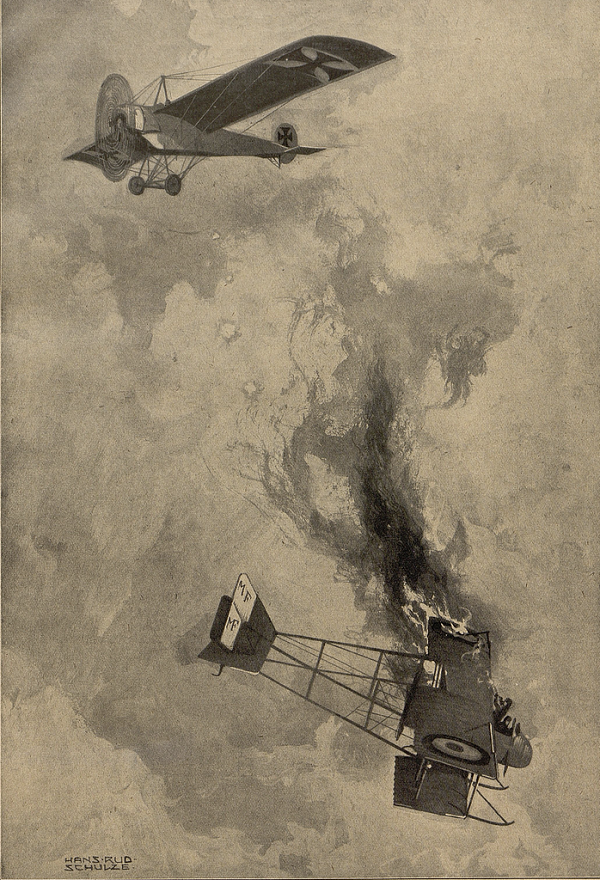
The “Fokker Scourge” was a brief but pivotal period in World War I’s air war over the Western. From July, 1915, to early 1916, German fighters – especially Fokker Eindeckers – temporarily gained an alarming advantage over Allied air forces. The phrase itself was largely a creation of the British press and later historians. However, it captures the sense of shock and vulnerability felt by Allied aviators at the time. It was caused by the Germans’ introduction of a technological breakthrough that changed aerial combat: a synchronization gear that allowed a machinegun to fire forward through a spinning propeller without destroying it.
The Improvised Origins of Aerial Combat

The Fokker Scourge had an outsized psychological and tactical impact relative to the actual number of Allied planes downed. To understand why, it is important to place it in the context of early air warfare. In 1914 and early 1915, aerial combat was still experimental, improvised, and largely secondary to operations on the ground. At war’s outbreak, airplanes were used primarily for reconnaissance and artillery spotting. Pilots and observers flew in unarmed or lightly armed aircraft. They sometimes carried pistols, rifles, or even bricks to throw at enemy machines. Encounters between opposing aircraft were initially rare, and often ended with waves or mutual curiosity rather than combat.
As the war settled into trench stalemate, aerial reconnaissance became vital. Accurate maps of enemy trench systems and troop movements could mean the difference between successful artillery bombardments and disaster. That made reconnaissance aircraft prime targets, so both sides sought ways to deny the enemy the use of the air. The problem was how to arm aircraft effectively. Early solutions included mounting machine guns on flexible mounts for observers or placing them above the propeller arc. However, aiming was difficult, and reloading dangerous.
Shooting Down Enemy Airplanes Was Extremely Difficult Early in WWI

Some Allied aircraft, such as the British Vickers Gunbus and the French Voisin III, used a pusher configuration. The placement of the propeller at the rear allowed allowing a forward-firing gun. Those designs had some success, but were often slower and less agile than tractor aircraft with propellers in front. The critical innovation that led to the Fokker Scourge was the interrupter, or synchronization, gear. The basic idea – timing a machinegun to fire only when the propeller blades were out of the way – had been explored before the war.
French aviator Roland Garros famously used crude metal deflector plates on his propeller blades in early 1915. Bullets that struck the blades were deflected, rather than destroying them. It worked, but was inefficient and dangerous. Garros was forced down behind German lines in April, 1915, and his aircraft was captured intact. The Germans handed the problem to Dutch aircraft designer Anthony Fokker, whose team developed a far more elegant mechanical solution. Fokker’s system linked the machinegun’s firing mechanism to the engine’s rotation, which ensured that bullets passed safely between the blades.
The Innovative Mechanism that Birthed the Fokker Scourge

By the summer of 1915, Fokker’s synchronization mechanism was fitted to a series of aircraft collectively known as the Fokker Eindecker, or “single-decker,” including the E.I, E.II, and E.III variants. The Fokker Eindecker, a relatively simple monoplane with wing-warping rather than ailerons, was not especially advanced aircraft in many respects. It had a modest engine, and a maximum speed that was not dramatically better than contemporary Allied machines. What set it apart was its single, synchronized Spandau machine gun, rigidly mounted to fire straight ahead.
That forward firing configuration fundamentally changed air combat. Rather than maneuver to bring a flexible gun to bear, the pilot could now aim the entire aircraft at the enemy. That transformed dogfighting into a three-dimensional duel of positioning, nerve, and marksmanship. The synchronization gear and forward firing machinegun of the Eindecker effectively turned the airplane itself into a weapon. German pilots quickly adapted to this new style of combat with new tactics. They attacked from above and behind, dove onto unsuspecting Allied reconnaissance aircraft, and fired short, deadly bursts before breaking away. Their effectiveness birthed the Fokker Scourge.
A Demoralizing Stretch for Allied Airmen

From the Allied perspective, the appearance of the Eindecker was deeply unsettling. British and French pilots found themselves suddenly outclassed, especially when flying slow, unarmed, or poorly defended reconnaissance aircraft. Losses mounted during the second half of 1915, particularly among British squadrons of the Royal Flying Corps. The sense of helplessness was amplified by the fact that many Allied pilots did not immediately understand how the Germans were firing through their propellers. Rumors spread of secret weapons and invincible aircraft.
The British press seized on the issue. It popularized the phrase “Fokker Scourge”, and portrayed it as a dire threat to the war effort. Morale suffered. Royal Flying Corps pilots referred bitterly to being sent up in what they considered obsolete “death traps”. Aircraft like the B.E.2c, designed for stability rather than agility, were especially vulnerable. Stable platforms were excellent for observation, but nearly defenseless against a nimble fighter attacking from a superior position. What made the Fokker Scourge even more notable is that it coincided with the emergence of the fighter ace as a cultural figure.
Birth of the Fighter Ace

German pilots who flew the Fokker Eindecker scored the first significant tallies of aerial victories, and gained fame and prestige. Among the most notable was Max Immelmann, whose name became synonymous with early fighter tactics. Immelmann was credited with developing the climbing turn maneuver known as the “Immelmann turn”, though the exact origins are debated. Alongside pilots like Oswald Boelcke, he helped establish the principles of fighter combat that dominated the rest of the war. They revolved around altitude advantage, surprise, and coordinated attacks.
The German high command recognized the propaganda value of those successes. Aerial victories were celebrated, pilots were decorated, and the fighter arm began to acquire an elite status within the military. Despite its fearsome reputation, the Fokker Scourge was neither absolute nor permanent. In reality, German numerical superiority in the air was limited, and the Eindecker itself had serious shortcomings. Its wing-warping system made it less maneuverable than later aircraft, its performance degraded at higher altitudes, and it was fragile.
Restoring the Balance

The Germans lacked a fully developed doctrine for massed fighter operations throughout much of 1915. Eindeckers were often deployed individually or in small numbers. That limited their ability to achieve decisive air superiority across the front. Allied losses, while painful, were not catastrophic in purely numerical terms. The Fokker Scourge was as much psychological as material, magnified by media coverage and the shock of sudden technological inferiority. The Allies moved quickly – by wartime standards – to counter the German advantage. New aircraft designs that emphasized speed, climb rate, and forward-firing armament, were rushed into service.
On the French side, the Nieuport 11, known as the “Bebe”, entered service in early 1916. Though lightly built, it was fast and agile. It was armed with a Lewis gun mounted above the wing, which fired over the propeller arc. British squadrons soon adopted the Nieuport as well. Britain also introduced the Airco DH.2 and the FE.2b, pusher fighters that could carry forward-firing guns without synchronization gear. While not perfect solutions, those aircraft restored some balance and allowed Allied pilots to go on the offensive again. By mid-1916, newer German fighters like the Albatros series were beginning to replace the Eindeckers. The technological monopoly that defined the Fokker Scourge had ended, however. The synchronization gear was no longer a secret, and both sides used it extensively for the rest of the war.
Significance and Legacy of the Fokker Scourge

The Fokker Scourge occupies an important place in the history of aerial warfare. Not because it lasted long, but because it demonstrated how a single technological innovation could temporarily reshape the balance of power in the air. It forced the Allies to rethink aircraft design, pilot training, and tactical doctrine at a critical moment in the war. It also marked the transition from aircraft as auxiliary tools to aircraft as weapons systems in their own right. They became able to independently influence the battlefield.
Fighter-versus-fighter combat, ace culture, and the relentless cycle of innovation that characterized later air wars all originated in this period. In hindsight, the Fokker Scourge was less a decisive German triumph than a warning shot. It showed that control of the air did not depend on numbers alone. Aerial supremacy could be contested through engineering, tactics, and the ability to adapt quickly. That lesson was learned painfully in the skies over France and Flanders in 1915. It would shape military aviation for the rest of the twentieth century.

_________________
Some Sources & Further Reading
Bradbeer, Thomas G. – The Battle for Air Supremacy Over the Somme (2025)
Duffy, Christopher – Through German Eyes: The British and the Somme, 1916 (2006)
History Halls – WWI Fighters: The Sopwith Camel, the Allies’ Deadliest Warplane
Newest Articles
- The Johnstown Flood – Thousands Perished When A Dam Collapsed After Gilded Age Tycoons Modified it for their Private Resort
- The Jacquerie: The Medieval Peasant Uprising That Terrified France’s Aristocrats
- Things That Weren’t Thought Through: WWII’s Sticky Bomb Stuck to Users’ Hands Once Activated
- German Tanks of World War II – The Panzer 38(t), a Czech Tank in German Service
- Nicholas Alkemade: The WWII Airman Who Survived an 18,000 Foot Fall From a Bomber Without a Parachute

