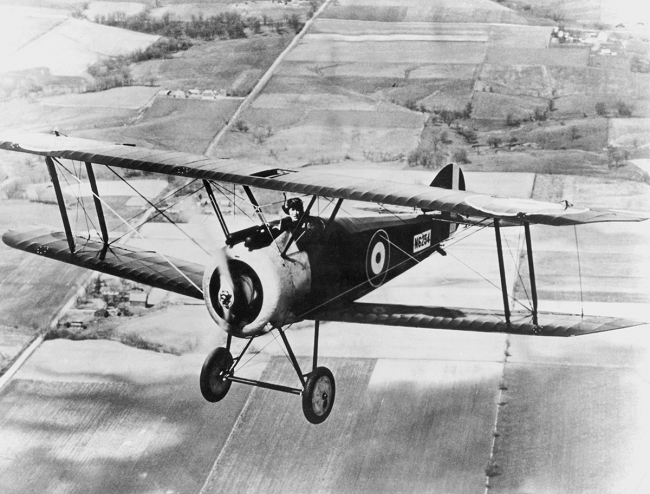
The Sopwith Camel, introduced in 1917, was one of World War I’s most iconic and formidable fighter airplanes. Designed by the Sopwith Aviation Company, it was intended as a successor to the successful Sopwith Pup. The Camel quickly earned a reputation for its lethal agility, exceptional maneuverability, and demanding flight characteristics. It became the highest-scoring Allied fighter of the war, credited with more than 1,200 enemy aircraft destroyed. It terrified the enemy, but was also for a terror for inexperienced pilots who flew it. The very traits that made the Camel so deadly in combat also made it tricky to handle for novices.
An Unusual Fighter

The Camel was conceived as part of Britain’s effort to regain air superiority during the mid-war period. In 1916, Allied pilots suffered heavy losses during a stretch that came to be known as the “Fokker Scourge”. The introduction of the Sopwith Pup, a highly maneuverable but slow and lightly armed fighter, balanced things somewhat. Aircraft design advanced at warp speed during the war, however, and within a few months, the Pup was outclassed by newer enemy warplanes. By early 1917, the Luftstreitkrafte had regained a dangerous edge with fighters such as the Albatros D.III and D.V. Sopwith’s new design aimed to counter them with greater firepower and performance. Officially designated the Sopwith F.1, the aircraft earned the nickname “Camel” due to the hump-shaped metal fairing over its twin .303 Vickers machine guns. It was an unusual feature at the time.
Many earlier British scouts mounted only a single gun or placed their weapons outside the fuselage. The centrally mounted, synchronized Vickers guns gave Camel pilots easily aimed concentrated firepower. Structurally, the Camel was a compact, highly engineered biplane with a wooden frame covered in fabric and doped linen. It used various rotary engines, most famously the 130 horsepower Clerget 9B and the 150 horsepower Bentley BR1. They produced significant gyroscopic forces because the entire engine rotated around the crankshaft. That was a manageable quirk in most airplanes, but in the Camel it was amplified by the aircraft’s deliberate design. Engineers had concentrated all major masses – engine, guns, fuel tank, and pilot – within the first seven feet of the fuselage. That made the center of gravity unusually forward, which as seen below, had its pros and cons.
A Fighter that Was Deadly to Both Friend and Foe

Concentrating the Sopwith Camel’s center of gravity forward produced a fighter with astonishing turn rates. Especially to the right, where the engine’s gyroscopic torque augmented the roll and yaw. Skilled pilots could whip the Camel through extraordinarily tight, quick maneuvers that allowed them to out-turn many German opponents. Enemy airmen often commented with frustration on the Camel’s ability to instantly “twist” into firing position. The aircraft excelled in low-altitude dogfighting and offensive patrols. Its power and maneuverability allowed it to dive on enemy airplanes or balloon positions, strike quickly, and escape. However, the same qualities that made the aircraft deadly in combat also made it dangerous to inexperienced flyers. The fighter it replaced, the Sopwith Pup, was an extremely forgiving airplane that was easy for novice pilots. By contrast, the Camel’s sensitivity to control input, torque effects, and sharp stall characteristics led to many accidents.
More British pilots were killed learning to fly the Camel than were lost in combat. Instructors repeatedly warned newcomers that the machine demanded finesse, coordination, and constant attention. The Camel could enter an uncontrollable spin if mishandled, and its takeoff behavior – yawing sharply because of engine torque – was notorious. In operational service, the Camel quickly proved its worth. Units such as No. 4, No. 9, No. 10 (Naval), and No. 70 Squadrons of the Royal Flying Corps – later the Royal Air Force – used it to sweep the skies over the Western Front. Camels were instrumental in blunting the “Bloody April” losses of 1917 by replacing older scouts like the Pup and Triplane.
Legacy of the Sopwith Camel

Ace pilots such as William Barker, Roy Brown, and Raymond Collishaw achieved remarkable success flying the Sopwith Camel. Roy Brown, in particular, is associated the Camel because he flew one when he was controversially credited with shooting down Manfred von Richthofen, the Red Baron, in April, 1918. The Camel was adaptable, which led to several specialized variants. The F.1 was the standard fighter version, while the 2F.1 Naval Camel had folding wings for shipboard use. The latter served with both the Royal Naval Air Service, and later the RAF. Camels were launched from platforms mounted on warships. They participated in one of the world’s first carrier-based raids against the Zeppelin sheds at Tondern in 1918.

Ground-attack versions appeared as well, and some units used Camels in trench-strafing and close-support roles during the German spring offensives. By late 1918, technological progress brought newer aircraft to front. The Sopwith Snipe, SE5a, and various French types gradually surpassed the Camel in performance. Even so, its legacy remained secure. After the war, surviving Camels served in training roles, experiments, and in smaller conflicts. Their numbers diminished rapidly, though, as air forces demobilized. Today, the Sopwith Camel stands as a symbol of early air combat: compact, powerful, unforgiving, and deadly. It epitomizes rapid wartime innovation, and the bravery of pilots who mastered one of WWI’s most challenging, yet effective fighters.

_________________
Some Sources & Further Reading
Bruce, J.M. – The Aeroplanes of the Royal Flying Corps Military Wing (1982)
History Halls – Who Shot Down the Red Baron? An Enduring Aviation Controversy
Robertson, Bruce – Sopwith: The Man and His Aircraft (1970)
Newest Articles
- American Presidents: Abraham Lincoln, Hall of Fame Wrestler
- Henry Jennings: The Privateer-Turned-Pirate Who Set the Stage for the Caribbean’s Golden Age of Piracy
- Fighting Women: Tomoe Gozen, the Fearsome Female Samurai
- From the NFL to the Sands of Iwo Jima: Medal of Honor Recipient Jack Lummus
- The Zanj Rebellion: The African Slave Revolt That Rocked Medieval Mesopotamia

