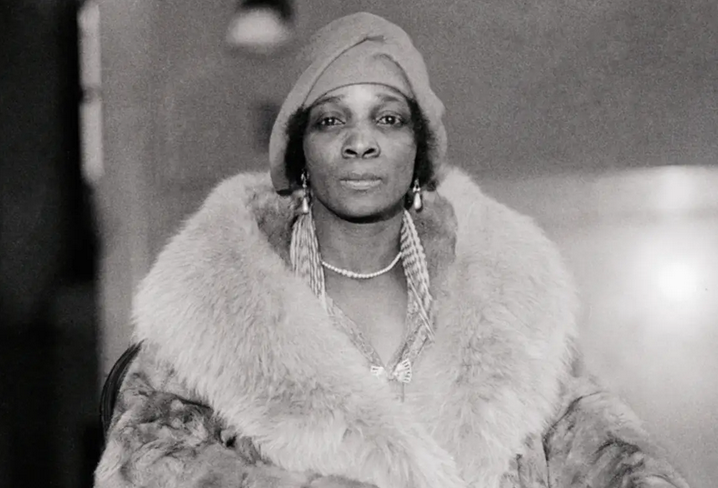
Stephanie St. Clair was one of the most formidable and fascinating figures in Harlem during the Prohibition era. A Black immigrant woman, she built a criminal empire, and openly defied both white and Black male power structures. She also fought police corruption, and advocated for the civil rights of Harlem’s residents.
A Caribbean Immigrant in Harlem

Known as “Madame St. Clair” or “Queenie,” Stephanie St. Claire was a numbers queen, political agitator, and cultural lightning rod. Her life vividly exposes the intersections of race, gender, crime, and power in early twentieth-century New York. She was born around 1897 on the Caribbean island of Martinique, then a French colony. Like many Caribbean migrants, she arrived in New York in the 1910s, drawn by opportunity and pushed by colonial limitations. The Harlem to which she moved was transforming rapidly at the time.
The Great Migration was reshaping the neighborhood into the cultural and demographic center of Black America. Alongside the flowering of the Harlem Renaissance, a dense underworld economy grew. For newcomers with few legal avenues to wealth, especially Black women, the underground offered both risk and possibility. St. Clair learned English, and absorbed American racial realities with clear-eyed fury. Back then, the numbers game was an illegal lottery played daily by tens of thousands of working-class Black Harlemites. St. Clair grasped that Harlem’s most reliable cash machine was that racket.
Stephanie St. Clair and the Numbers Game

Key for the numbers game’s popularity was its affordability. For a few cents, players bet on three-digit numbers derived from things like stock exchange figures or racetrack totals. It was gambling, but it was also communal and informal, woven into everyday life. Crucially, the money the numbers game circulated within the neighborhood. Bankers – those who ran the games – provided jobs, extended informal credit, paid rents, and funded local businesses. By the early 1920s, the numbers racket was Harlem’s economic bloodstream, and Stephanie St. Clair was at its heart.
What set St. Clair apart was not just success, but method. She ran her operation with discipline, secrecy, and a fierce insistence on autonomy. Unlike many bankers who relied on male enforcers or fronted for white gangsters, St. Clair wanted full control. She employed runners and bookkeepers, paid promptly, and cultivated loyalty through reliability rather than fear. She also insisted on being treated as an equal in a world that denied Black women authority almost reflexively. Her reputation grew quickly, but so did the list of her enemies.
Taking on the Mob

Stephanie St. Clair’s foes included both the New York Police Department, and white organized crime figures eager to muscle into Harlem’s lucrative rackets. When the Mafia tried to move in on and take over Harlem’s numbers game, St. Clair successfully resisted them for years. It began during Prohibition, when Dutch Schultz, born Arthur Flegenheimer, emerged as the most aggressive of numbers racket figures. Schultz, a brutal Jewish-American gangster, controlled much of New York’s bootlegging. He aimed to add Harlem’s numbers games to the rackets under his control.
Schultz’s strategy was simple: bribery and intimidation, backed up by unbridled violence and viciousness. Many Harlem bankers capitulated. St. Clair did not. The conflict between her and Schultz was both personal and symbolic. She saw his takeover as outright colonial theft – white criminals extracting wealth from a Black community through terror. Schultz, for his part, reportedly dismissed her as an annoyance until she proved unmovable. Through her enforcer Ellsworth “Bumpy” Johnson, she attacked Schultz’s businesses and those who paid him protection. As the violence escalated, St. Clair did something almost unheard of for a criminal figure: she went public.
Challenging the NYPD

Stephanie St. Clair ran ads in Black newspapers accusing the police of corruption. She named names, provided lists of cops on the take, and called for federal intervention. She framed herself not as a gangster but as a businesswoman under siege by a racist, rigged system. The ads were extraordinary. At the time, speaking openly against police could invite swift retaliation. St. Clair published statements denouncing NYPD officers for taking bribes from Schultz and allowing his gunmen to terrorize Harlem. She appealed to the governor, the courts, and the public, insisting that Black citizens deserved equal protection under the law.
The irony was sharp: an illegal lottery banker who demanded legal justice. Despite the messenger, however, the message resonated. Many Harlemites knew exactly what St. Clair was talking about. Her defiance came at a cost, though. The police intensified their efforts to bust her for gambling and interfere with her operations. She was arrested and charged on numerous occasions, but even incarceration failed to silence her. From behind bars, she continued to issue statements, claiming political persecution and racial bias.
The End of an Era

The confrontation with police enhanced the reputation of Stephanie St. Clair in Harlem, and sharpened her anger. Amidst that, her rival Dutch Schultz was indicted for tax evasion. While he was ultimately acquitted, his power began to wobble. The broader underworld was shifting, and federal pressure on organized crime intensified. Schultz was assassinated in 1935, gunned down in a Newark restaurant restroom on orders from fellow mobsters. St. Clair reportedly reacted with satisfaction rather than surprise. As he lay on his hospital death bed, she sent a telegram “As ye sow, so shall ye reap”.
The story did not end with Schultz’s demise, though. After her rival’s fall, St. Clair did not simply reclaim her throne. The numbers racket itself was changing, becoming more centralized and less personal. She eventually partnered with her enforcer Ellsworth “Bumpy” Johnson, the infamous Harlem gangster. Their relationship was complicated. Johnson admired her intelligence and respected her experience. However, he operated within a male-dominated criminal culture that often sidelined women. St. Clair remained influential, but her era as an uncontested queen was ending.
A Complicated Figure

What made Stephanie St. Clair stand out was not just her criminal success, but her political consciousness. She was explicit about race, power, and injustice in ways that few figures, law abiding or not, were willing to be. She framed Harlem’s underground economy as a response to exclusion from legitimate markets. She condemned police corruption not as individual bad behavior, but as a systemic assault on Blacks. Long before civil rights leaders spoke in national forums, St. Clair was using the press to articulate a radical critique of American inequality.
St. Clair was a deeply complicated figure. Her numbers operation profited from gambling addiction and poverty. Violence surrounded her world, even if she did not personally wield it. She lived well while many of her customers struggled. There is no clean moral ledger in her story, and St. Clair herself did not pretend otherwise. She demanded respect, not sainthood. Gender is inseparable from her legacy. In an era when women – especially Black women – were expected to be deferential, she was commanding, confrontational, and unapologetically ambitious. She dressed elegantly, spoke sharply, and refused to minimize herself. Male contemporaries often described her as “difficult” or “crazy” – labels historically attached to women who refuse submission. The nickname “Madame Queen” captured both admiration and discomfort. She was not supposed to exist, and yet she did.
The Legacy of Stephanie St. Clair

By the late 1930s, Stephanie St. Clair had largely retired and withdrawn from public life. She met and married Sufi Abdul Hamid, a Black mystic and labor leader. The marriage ended when she shot him in 1938 for cheating on her. She got a two to ten year sentence, and was released in the early 1940s. She lived quietly thereafter, reportedly supported by investments and residual income, and passed away in 1969. For decades afterward, she lingered in the footnotes of gangster histories, overshadowed by flashier male figures. Only more recently has she been reexamined as a key player in Harlem’s political and economic history. Today, Madame St. Clair stands as a reminder that power in marginalized communities has often taken unconventional forms.
St. Clair was a criminal, to be sure, but also an immigrant entrepreneur, a media strategist, a proto–civil rights agitator. She was a woman who stared down both the mob and the police, and refused to blink. Her life exposes uncomfortable truths: that the line between crime and survival can be razor thin, and that resistance does not always wear respectable clothes. In the end, St. Clair did not seek redemption or approval. She sought control – over her labor, her money, and her dignity. In a city and a century that offered Black women little of such things, that alone makes her story extraordinary.

_________________
Some Sources & Further Reading
History Halls – Rachel Wall: America’s First Female Pirate
Latest Articles
- The Johnstown Flood – Thousands Perished When A Dam Collapsed After Gilded Age Tycoons Modified it for their Private Resort
- The Jacquerie: The Medieval Peasant Uprising That Terrified France’s Aristocrats
- Things That Weren’t Thought Through: WWII’s Sticky Bomb Stuck to Users’ Hands Once Activated
- German Tanks of World War II – The Panzer 38(t), a Czech Tank in German Service
- Nicholas Alkemade: The WWII Airman Who Survived an 18,000 Foot Fall From a Bomber Without a Parachute

