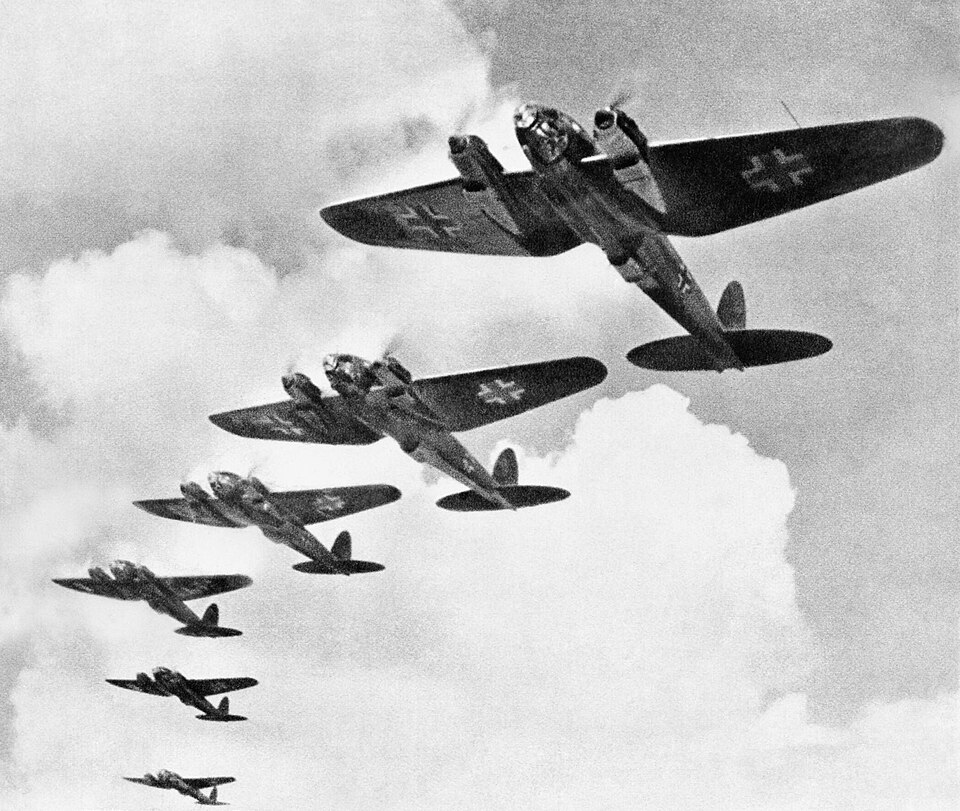
The Heinkel He 111 was one of the most recognizable and widely used German World War II bombers. A sleek, fast, and initially advanced aircraft, its distinctive silhouette with a fully glazed “greenhouse” nose became synonymous with the Luftwaffe’s bombing campaigns in Europe. Developed under the guise of a high-speed commercial airliner, the He 111 evolved into a front-line medium bomber. It played a major role in the conflicts leading up to WWII and during its early years. Though ultimately outpaced by newer designs, it served throughout the conflict, undergoing constant adaptation to meet Germany’s strategic needs.
A Bomber Born as a Civilian Airliner

In 1934, the Reich Air Ministry sought a fast, twin-engined aircraft that could function in both civilian and military roles. In reality, the Luftwaffe, then still officially nonexistent due to the Versailles Treaty’s restrictions, intended it primarily as a bomber. Ernst Heinkel and his engineers designed a sleek, modern machine featuring a narrow fuselage, elliptical wings, and an aerodynamic profile. What emerged as the Heinkel He 111 was one of the fastest aircraft in Europe when it first flew in 1935. Early prototypes even set speed records, helping to mask its true purpose. Lufthansa operated a small number of transport variants, but the design was always fundamentally a bomber.
The first major production models, He 111Bs, entered service with the newly unveiled Luftwaffe in 1936. They were quickly tested in combat when several were sent to support General Francisco Franco during the Spanish Civil War. There, flying with the Condor Legion, the He 111 demonstrated both its strengths and limitations. Its speed, defensive guns, and bomb load made it more capable than many contemporary bombers. He 111s played a key role in the infamous 1937 attack on Guernica. Lessons from Spain prompted improvements: stronger structures, more powerful engines, and revised defensive armament.
The Iconic Bomber of the Early Blitzkrieg

By the outbreak of WWII in 1939, the definitive He 111P and He 111H models had come into service. They incorporated a new, fully glazed nose. It gave the crew excellent visibility, and allowed the pilot, bombardier, and navigator to work more efficiently. The He 111H, powered mostly by Junkers Jumo 211 engines, became the most numerous variant. It could carry around 2,000 kg/ 4400 pounds of bombs internally, and more externally when required. Although slower than some new fighters emerging at the time, it was still robust, stable, and relatively easy to fly. Those qualities were appreciated by the crews during the blitzkrieg in Poland, Norway, the Low Countries, and France. In those early campaigns, the Heinkel He 111 formed the backbone of the Luftwaffe’s medium bomber force.
He 111s operated in close coordination with ground advances, and attacked railways, bridges, airfields, and enemy troop concentrations. In these operations, they performed effectively because German air superiority largely protected bombers from fighter interception. Things were different in the Battle of Britain, however, against determined resistance from the Royal Air Force. There, He 111s struggled against faster, better-armed fighters such as the Hawker Hurricane and Supermarine Spitfire. Their sturdy construction and ability to absorb damage saved many crews. However, the aircraft’s relatively slow speed, limited defensive gun coverage, and lack of self-sealing fuel tanks made it increasingly vulnerable. Nevertheless, the He 111 continued in service and adapted to new roles. One of its most important later functions was as a launch platform for the V-1 flying bomb when it became operational in 1944.
Legacy of the Heinkel He 111

Modified He 111H-22 variants carried V-1 flying bombs under their wings, and released them over the North Sea toward Britain. The bomber also saw widespread use on the Eastern Front. There, the vast distances and often thin Soviet air defenses initially made it valuable for both bombing and transport missions. It frequently served in supply roles, and delivered cargo to isolated German units – although it was not a great transport. That was made clear during the Stalingrad airlift, where the limited load capacity of Heinkel He 111 bombers pressed into service as cargo planes prevented them from making a decisive difference.
As Allied fighters and anti-aircraft defenses improved, the He 111’s obsolescence became clear. Newer bombers such as the Junkers Ju 88 were faster, more agile, and capable of a wider range of tasks. As a result, production gradually tapered off. He 111s were still manufactured until 1944, however, due to inertia and the lack of a fully adequate replacement. After the war, a number of surviving He 111s found a curious second life in Spain. There, the aircraft had been built under license as the CASA 2.111.
He 111s had an unexpectedly long service life. Equipped with Rolls-Royce Merlin engines due to shortages of German power plants, Spanish variants flew into the 1960s. They appeared in several classic war films, including 1969’s The Battle of Britain. The Heinkel He 111 remains an iconic aircraft: a symbol of early Luftwaffe success, later of its limitations. It was ultimately surpassed by newer designs, but its long service life and central role in key campaigns made it one of WWII’s most significant bombers.

_________________
Some Sources & Further Reading
Dressel, Joachim – Bombers of the Luftwaffe (1994)
History Halls – WWII Bombers: Junkers Ju 88, Germany’s Most Successful Bomber
Kober, Franz – Heinkel He 111 Over All Fronts (1991)
Latest Articles
- Alexander the Great and Sisygambis, Mother of Persia’s King Darius III
- Unholy Holy Fathers: Pope Leo X’s Corruption Was So Brazen, it Triggered the Protestant Reformation
- Edward England, the Humane Pirate Captain Deposed by His Men for Being Too Nice
- American Presidents: Abraham Lincoln, Hall of Fame Wrestler
- Henry Jennings: The Privateer-Turned-Pirate Who Set the Stage for the Caribbean’s Golden Age of Piracy

