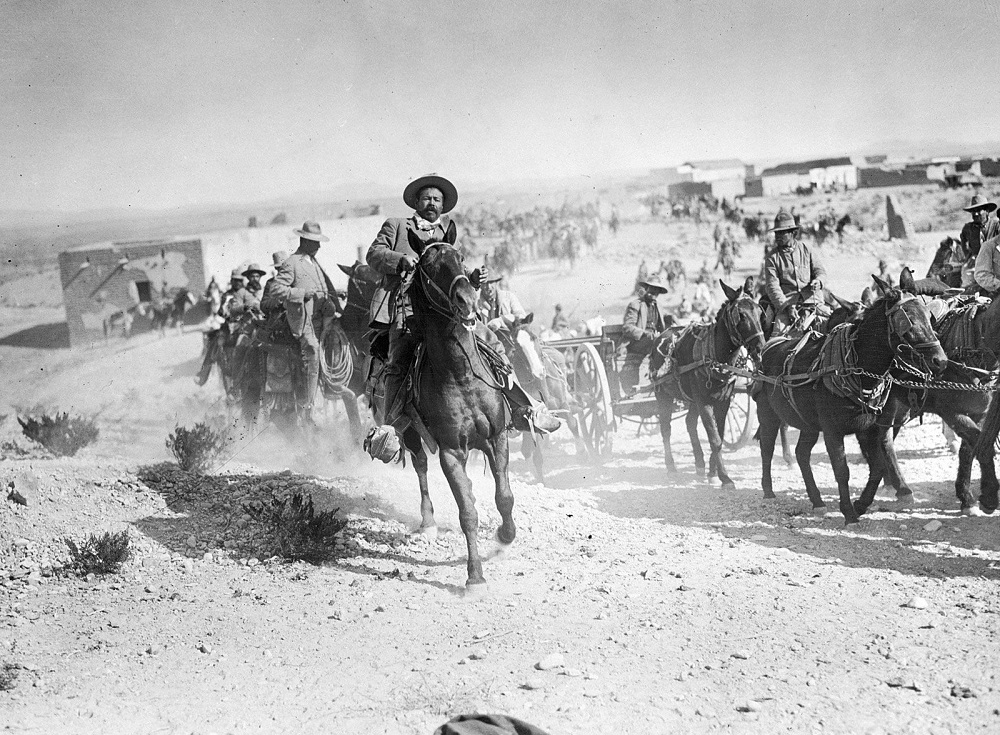
Pancho Villa’s 1916 raid on Columbus, New Mexico, was one of the most startling cross-border attacks in United States history. It was the moment when the Mexican Revolution’s turbulence violently spilled over onto American soil. In the early hours of March 9th, 1916, Villa and several hundred men rode across the desert to Columbus. They attacked the small border town, killed US civilians and soldiers, looted property, and set parts of the settlement ablaze. The Columbus Raid shocked the American public, embarrassed the Wilson administration, and triggered a massive but ultimately inconclusive military response. To understand why it happened and why it mattered, the raid has to be placed in the context of Villa’s shifting fortunes, US–Mexican relations, and the larger chaos of revolutionary Mexico.
Pancho Villa’s Beef With the United States

By 1916, the Mexican Revolution had been raging for more than five years. What began in 1910 as an uprising against the long dictatorship of Porfirio Díaz had fractured into a multi-sided civil war. It involved regional strongmen, revolutionary idealists, and opportunists. Pancho Villa, born Doroteo Arango in the state of Durango, became one of the conflict’s most famous and feared figures. Charismatic, ruthless, and unpredictable, Villa commanded the Division del Norte, which at its peak controlled much of northern Mexico. For a time, Villa was more than just a rebel bandit in the American imagination. He was a revolutionary general who enjoyed a measure of respect and even admiration in the United States.
That relationship began to sour after 1914. Villa had allied himself with Venustiano Carranza against the dictatorship of Victoriano Huerta. However, the US had tacitly tolerated Huerta’s seizure of power. When Huerta fell, Carranza and Villa soon turned on each other. Carranza, more conservative and politically astute, eventually gained the upper hand. The US, seeking stability along its southern border and access to Mexican resources, recognized Carranza’s government in October, 1915. That decision was a turning point for Villa, as it deprived him of diplomatic legitimacy and access to American arms. He also saw it as ingratitude and an insult, after he had served American interests by fighting Huerta.
What Motivated the Columbus Raid?

Villa’s military situation deteriorated rapidly. In a series of battles in 1915, particularly at Celaya, his forces were decisively defeated. Carranza’s general Alvaro Obregon made effective use of trenches, barbed wire, and machine guns to shatter Villa’s once-powerful army. By early 1916, Villa had reverted to guerrilla warfare, and operated with smaller, more mobile bands in northern Mexico. His resources were thin, his men hungry, and his authority challenged by desertions and internal dissent. In that context, the US loomed large in Villa’s thinking as both a former supporter and a perceived betrayer.
Villa’s motives for the Columbus Raid have long been debated. Some contemporaries and later historians emphasized revenge. Villa believed that the US had turned against him by recognizing Carranza and allowing Carranza’s agents to buy arms on American soil, while denying the same to Villista forces. Others pointed to more practical considerations: the need for supplies, horses, ammunition, and food. Columbus was close to the border, had a small US Army garrison, and contained commercial stores that could be looted. There were also rumors, never conclusively proven, that Villa hoped to provoke a US military intervention in Mexico. He believed that would destabilize Carranza’s government, revive Villa’s reputation as a national hero, and improve his prospects.
An Attack Based on Bad Intelligence

Columbus itself was a modest frontier town of about 300 residents, located just three miles north of the Mexican border. Adjacent to it was Camp Furlong, a US Army post garrisoned by elements of the 13th Cavalry Regiment. The town’s proximity to Mexico made it a hub for trade, smuggling, and occasional violence. Nothing, however, had prepared Columbus’ residents for what happened in the pre-dawn darkness of March 9th. Around 4:00 AM, Villa’s force, estimated at around 600 men, crossed into the US and split into groups. Some attacked the town, and others targeted Camp Furlong.
The Columbus Raid was chaotic and brutal. Villista fighters rode through the streets shouting “Viva Villa! Viva Mexico!” as they fired rifles and set buildings on fire. Several houses and businesses were looted and burned, including the Commercial Hotel. Civilians were caught in the crossfire, some shot in their homes as they tried to flee or defend themselves. Villa’s raid was based on bad intelligence. Spies sent into Columbus had reported back that the garrison numbered only about thirty men. In reality, it had more than three hundred and fifty soldiers.
Beating Back the Columbus Raid

US soldiers were initially surprised, but quickly organized a defense. Despite the initial shock, the defenders managed to repel the attack. Machine guns were brought into action, and within minutes the raiders found themselves under heavy fire. Far heavier fire than Villa’s spies had led him to expect. The fighting lasted roughly ninety minutes. By the time Villa ordered a withdrawal back into Mexico, the raiders had suffered significant losses. Estimates of Villista casualties range from sixty to over a hundred killed, with many bodies left behind on US soil. On the American side, eight civilians and ten soldiers were killed, with several others wounded. For a small town, the toll was devastating, and the psychological impact was enormous.
News of the raid spread rapidly across the US. Newspapers portrayed it as an outrageous invasion, and often described Villa in sensational terms as a barbarian or madman. Public outrage was intense, particularly in the Southwest, where fears of further attacks ran high. President Woodrow Wilson faced immediate pressure to respond decisively. At the same time, he had to balance domestic anger with uncomfortable realities. A war with Mexico would be costly and politically risky, especially as Europe was already engulfed in World War I. So Wilson chose a middle course: a punitive expedition to capture Pancho Villa, without formally declaring war on Mexico.
The Punitive Expedition

On March 14th, 1916, President Wilson ordered General John J. Pershing to lead American troops into northern Mexico. The Punitive Expedition eventually numbered more than 10,000 soldiers. It was the first large-scale overseas deployment of US forces in the twentieth century. It also served as a testing ground for new technologies, including motorized transport and military aircraft. Pershing’s mission was straightforward in theory, but as it turned out, nearly impossible in practice. Villa was a master of mobility, familiar with the harsh terrain of Chihuahua. He was also supported, at least passively, by local populations hostile to foreign troops.
The US Army, though modernizing, struggled with supply lines, poor maps, and unfamiliar conditions. Tensions with Carranza’s government further complicated matters. While Carranza initially tolerated the expedition, clashes between US and Mexican government forces soon occurred. The most notable clash occurred at Carrizal in June, 1916, where several American soldiers were killed or captured. Meanwhile, Villa remained elusive. Though wounded in a skirmish later in 1916 and increasingly marginalized, he avoided capture. The Punitive Expedition dragged on for months, without achieving its primary objective. As diplomatic tensions mounted and the prospects of US involvement in WWI increased, Wilson ordered Pershing’s forces to withdraw. By February 1917, the last American troops had left Mexican territory. Villa, battered but alive, had once again slipped through the net.
A Failed Gamble

The Columbus Raid had consequences far beyond the immediate violence. Militarily, it exposed weaknesses in US border defenses and accelerated reforms in the Army. Many officers who served under Pershing, including George S. Patton, gained experience that proved valuable in later conflicts. Politically, the raid hardened American attitudes toward Mexico, and reinforced perceptions of instability south of the border. It contributed to the deterioration of US–Mexican relations during a critical period, even as both governments tried to avoid outright war.
For Pancho Villa, the Columbus Raid was a gamble that ultimately failed. It did not restore his fortunes or topple Carranza. Instead, it brought heavy US military power, however imperfectly applied, into northern Mexico and further isolated him politically. Over the next few years, Villa’s role in the revolution diminished. In 1920 he accepted an amnesty and retired to a hacienda, only to be assassinated in 1923. However, the Columbus Raid ensured his lasting place in American memory. It fixed his image as the only foreign military leader to attack the continental US since the War of 1812.
Significance and Legacy of the Columbus Raid

Historically, the Columbus Raid stands at a crossroads between the nineteenth-century frontier and the modern era. It was one of the last cavalry raids carried out by mounted men using tactics of earlier conflicts. At the same time, the response to it showcased emerging features of twentieth-century warfare. Mechanization, air reconnaissance, and large-scale logistical operations all played important roles in the Punitive Expedition that followed. Symbolically, the raid underscored how deeply intertwined America and Mexico were, bound together by geography, revolution, and mutual suspicion.
In the end, Pancho Villa’s attack on Columbus was not just an act of banditry or revenge. It was a desperate maneuver born of revolutionary defeat, political betrayal, and personal defiance. The raid revealed the volatility of the Mexican Revolution. It also highlighted the limits of American power, and the ease with which a local conflict could ignite international crisis. More than a century later, the burned buildings of Columbus and the unanswered questions about Villa’s intentions still echo as reminders of a moment when the US-Mexico border briefly became a battlefield.

_________________
Some Sources & Further Reading
Braddy, Haldeen – Pancho Villa at Columbus (1965)
McGaw, William C. – Southwest Saga: The Way it Really Was (1988)
Rakocy, Bill – Villa Raids Columbus, N. Mex., Mar. 9, 1916 (1981)
History Hall’s Newest Articles
- The Brink’s-Mat Robbery: Britain’s Biggest Gold Heist
- Fighting Women: Artemisia I of Caria Led Her Ships at the Battle of Salamis
- Alexander the Great and Sisygambis, Mother of Persia’s King Darius III
- Unholy Holy Fathers: Pope Leo X’s Corruption Was So Brazen, it Triggered the Protestant Reformation
- Edward England, the Humane Pirate Captain Deposed by His Men for Being Too Nice

