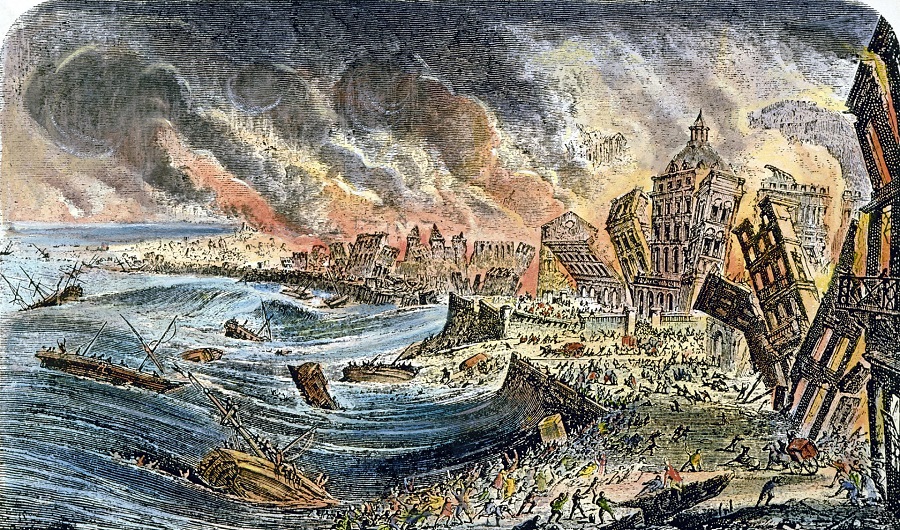
November 1st, 1755, started well in Lisbon. As the Sun rose that morning, the Portuguese capital’s citizens began to celebrate the religious Feast of All Saints. Back then, Lisbon was one of Europe’s most prosperous cities with one of the world’s busiest seaports. It would lay in ruins by the time church and cathedral bells tolled noon. The culprit, the 1755 Lisbon earthquake, also raised thorny questions that helped fuel the Enlightenment.
The Destruction of Lisbon

Lisbon was nearly wiped out on the Feast of All Saints, 1755, by a devastating earthquake with a magnitude of 9.0. Its shocks were felt as far away as Finland, North Africa, and even the Caribbean. The tremors started around 9:40 AM, and fissures nearly twenty feet deep suddenly appeared in the city’s streets. The religious festival that day added a macabre twist to the disaster. To celebrate the saints, much of the city’s population was gathered in houses of worship when the tremors began.
Thousands of worshipers were crushed to death as churches and cathedrals collapsed atop them. As the tremors subsided, another danger arose as fires erupted all over the city. Individual fires scattered across the city joined together to engulf the city in an uncontrollable inferno. A massive earthquake and a city-wide blaze were bad enough. More was in store for Lisbon on that tragic day, though, as the catastrophe took yet another macabre turn. It began as shaken and frightened survivors sought to escape the conflagration and rubble that had once been proud buildings.
A Macabre Twist for Worshipers Beseeching God’s Mercy

Thousands of shocked and frightened Lisboans rushed to the city’s harbor. There, the large open squares of the royal palace promised safety from both the fires and falling debris. When they got there, however, they were further alarmed by an odd sight. The harbor had no water, and ships rested on a bare seabed. Befuddled survivors stepped out into the harbor, and walked atop its bottom. Priests appeared, and the people gathered around them as they prayed for God’s mercy, and begged His forgiveness for whatever sins had occasioned such divine wrath. Thousands were still fervently praying and beseeching the Lord’s forgiveness in the harbor when the sea came roaring back.
A series of huge tsunami waves rushed into and refilled the harbor. They destroyed moored boats, crashed into quays, and engulfed the lower part of Lisbon on the shore of the Tagus. The newly built marble quay of Cais De Pedra vanished into the river. The first three tsunami waves were the largest, and they completed the destruction brought about by the earthquake and fire. Tens of thousands of terrified survivors who had rushed to the open space of the docks and the waterfront quay for safety, lost their lives to the tsunamis. Their numbers included thousands of faithful, who perished in the midst of their fervent prayers for God’s mercy.
Legacy of the 1755 Lisbon Earthquake

The exact number of lives lost in the 1755 Lisbon earthquake, fire, and tsunami, is unknown. Because of the dearth of records, and the chaos that followed the disaster, the figure is probably forever unknowable. Best estimates, however, are that as many as sixty thousand people perished in Lisbon alone. The grand total for the entire region of Lisbon and its environs is as high as one hundred thousand fatalities. Many more were injured, lost their homes, livelihoods, or any combination of the preceding.
The calamity consequences went beyond the loss of lives and damage to people and property. The 1755 Lisbon earthquake struck just as the Enlightenment had begun to get into full swing. It prompted discourse and exchanges that furthered the development of theodicy – the philosophy around the question of evil. People questioned whether a just and good God could have allowed what had happened to happen. Why had God sent an earthquake to crush His worshipers by the thousands in cathedrals and churches as they gathered in prayer to celebrate the Feast of All Saints and glorify His name? The question was compounded and made thornier yet by the macabre twist of survivors who fervently prayed for God’s mercy, only for Him to send a tsunami that drowned them in Lisbon’s harbor.

_________________
Some Sources & Further Reading
Encyclopedia Britannica – Lisbon Earthquake of 1755
European History Online – The Lisbon Earthquake (1755)
Hakai – The Earthquake That Brought Enlightenment
History Halls – Mount Pelee and the Destruction of Saint Pierre
Latest Articles
- Henry Jennings: The Privateer-Turned-Pirate Who Set the Stage for the Caribbean’s Golden Age of Piracy
- Fighting Women: Tomoe Gozen, the Fearsome Female Samurai
- From the NFL to the Sands of Iwo Jima: Medal of Honor Recipient Jack Lummus
- The Zanj Rebellion: The African Slave Revolt That Rocked Medieval Mesopotamia
- The Dacian Falx: The Curved Ancient Sword that Shocked the Romans

