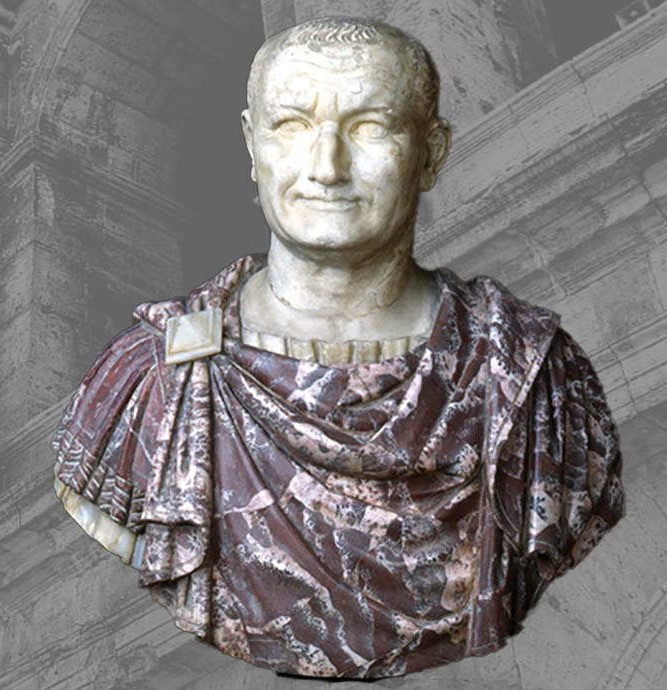
Roman Emperor Vespasian was a self-made man. He rose from humble origins to become the most powerful ruler in the world, and found the Flavian Dynasty. In future generations, others from similarly humble backgrounds were able to emulate his example, but Vespasian was the first to pull it off. Below are some interesting facts about this interesting ancient ruler.
An Emperor’s Humble Origins

Titus Flavius Vespasianus (9 – 79 AD) was born in a small Italian village into an undistinguished family. His ancestors included a common legionary who rose through the ranks to become a centurion, a debt collector, and a minor money lender with a niche clientele of barbarians. Vespasian began his public life by entering the cursus honorum (the career ladder of Roman officialdom) as a military tribune. A capable and shrewd figure, he rose through military and civilian positions of ever greater responsibility.
It was not always a steady rise, however. Early in his career, he was appointed to a minor magistracy whose responsibilities included cleaning Rome’s streets. He reportedly did such a poor job, that an exasperated Emperor Caligula stuffed handfuls of street muck down Vespasian’s toga. His first big break came during the invasion of Britain in 43 AD. He displayed exceptional brilliance in command of a Roman legion, and played a key role in early battles on the rivers Medway and Thames that broke the back of organized native resistance.
A Roller Coaster Public Career

Vespasian was next detached to subdue southwest Britain, which he did by leading his forces along the coast all the way down to Cornwall. His military accomplishments earned him the admiration and esteem of Caligula’s successor, Emperor Claudius, who rewarded him with a consulship. His rise was interrupted though, when he displeased Claudius’ wife. Through her machinations, he was forced to retire from public life. Vespasian’s career was revived after Claudius’ death, when he reemerged from retirement and won favor with the new emperor, Nero.
However, his career was once again derailed when he gave offense by falling asleep while Nero was giving a lyre recital. Vespasian was forced into yet another retirement. Things got so bad for him this time around, that he had to work as a muleteer to make ends meet. His fortunes revived when he was appointed to suppress the Great Jewish Revolt in 67 AD. He was busily engaged in that, when Nero was forced from power and driven to suicide in 68.
The Year of the Four Emperors

In the scramble for power that followed Nero’s death without an heir, things became chaotic. Rival governors and generals fought each other, and mounted the throne in quick succession. By April, 69 AD, the year was already known as “The Year of the Three Emperors”. Vespasian reasoned why not four? He secured support in the Roman east, declared himself emperor, sent his forces to Rome. By year’s end, he had won, and the Year of the Three Emperors became the Year of the Four Emperors.
Once on the throne, Vespasian proved to be a capable emperor – and just as importantly, a normal ruler. That was a refreshing change after the string of mad, bad, crazy, or weak emperors who had ruled Rome since Augustus’ death in 14 AD. He restored stability and good governance, and launched a massive building and public works program that produced an economic boom. As a person, Vespasian had a reputation for wit and amiability. As emperor, he seldom stood on ceremony, had a blunt and even coarse mannerism, and was given to forthright speech.
An Emperor Who Kept His Sense of Humor to the End

The founder of the Flavian Dynasty never forgot his humble origins, and resisted the temptation to put on airs, to which most Roman emperors succumbed. One of Vespasian’s schemes to raise revenues involved a tax on public urinals, which was widely ridiculed. His son and designated heir, Titus, took him to task for that, and argued that it was beneath imperial dignity to collect money from bodily excreta. In response, Vespasian held a coin beneath his son’s nose, and asked whether he could smell any urine.
He concluded the lesson by telling Titus: “money does not smell”. It became a Latin proverb. Vespasian stayed down to earth until the end. Starting with Julius Caesar, who was declared a god after his assassination, Roman emperors who died in good repute were deified after death. As he lay on his deathbed and felt that the end was near in 79 AD, Vespasian, in a final illustration of his lifelong penchant to not take himself too seriously, joked just before his last breath: “dear me, I think I am becoming a god”.

_________________
Some Sources & Further Reading
Levick, Barbara – Vespasian (2016)
Suetonius – The Lives of the Twelve Caesars: Vespasian

