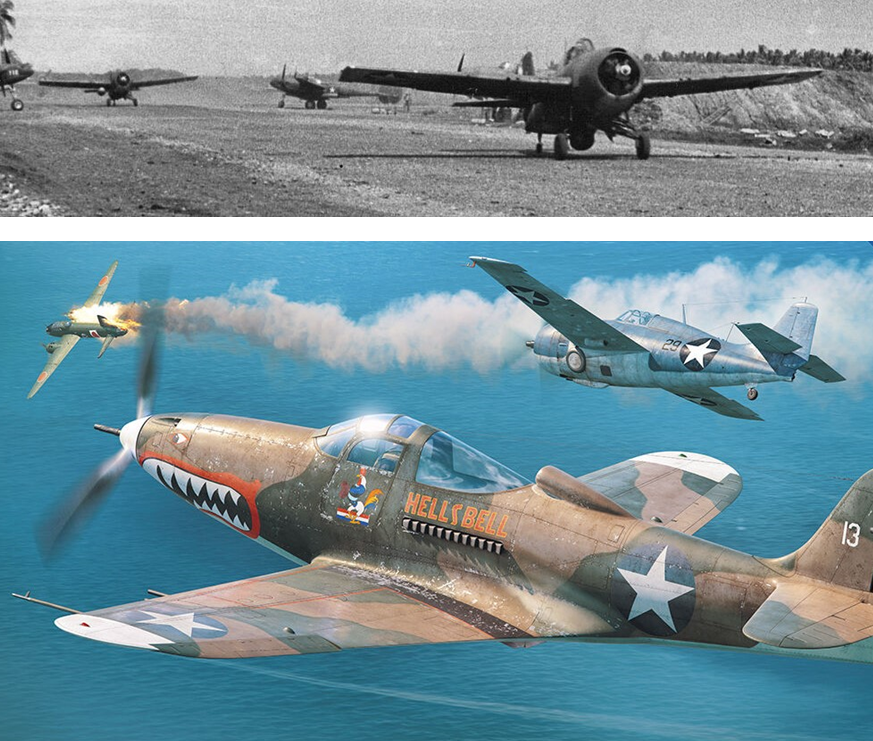
The Cactus Air Force was a ragtag but determined collection of US Marine Corps, Navy, and US Army Air Forces (USAAF) pilots and aircraft that defended Henderson Field on Guadalcanal during the grueling World War II campaign fought from August 1942 to early 1943. Named after the Allied codename for the island, “Cactus”, this small and battered unit played an outsized role in shaping the battle’s outcome. It protected friendly ground forces, interdicted Japanese reinforcements, and wore down enemy air and naval power. Often outnumbered, poorly supplied, and operating in primitive conditions, the Cactus Air Force became a symbol of resilience and improvisation.
The Ragtag Cactus Air Force

The Battle for Guadalcanal, which started in August 1942, was the first major Allied offensive in the Pacific. After the victory at Midway, the US sought to halt Japanese expansion in the Solomon Islands. Control of Guadalcanal, particularly the unfinished Japanese airstrip later christened Henderson Field, was vital. Whoever held the field could dominate the seas around the island, and disrupt supply lines in the South Pacific. When US Marines seized the airfield in early August, they immediately understood its value. However, defending the airstrip required aircraft, and the US Navy’s carriers had withdrawn after suffering losses. As a result, responsibility for local air defense fell to whatever land-based planes could be assembled at Henderson Field.
The initial contingent of what became the Cactus Air Force consisted of US Marine Grumman F4F Wildcat fighters, and SBD Dauntless dive bombers, hastily flown to Guadalcanal on August 20th, 1942. When the aircraft carrier USS Enterprise was damaged and had to withdraw for repairs, elements of its air group, most notably Scouting Squadron Six (VS-6), which flew SBD Dauntlesses, were transferred to Henderson Field and continued to fly from there. They were a welcome addition to the CAF. As the campaign progressed, the unit expanded to include TBF Avenger torpedo bombers, Army P-400 Airacobras, the export version of the P-39, Boeing B-17 heavy bombers, Royal New Zealand Air Force Hudson light bombers, plus Marine and US Navy fighter, bomber, and patrol plane reinforcements.
Difficult Conditions at Henderson Field

Despite the influx of airplanes, things remained precarious, and the availability of aircraft was always touch and go. Planes were often patched together from wrecks, and mechanics often had to work wonders in primitive workshops. The organization was equally ad hoc. Marine Air Group 23 formed the backbone, but detachments from different services rotated in and out. At times, the group included Royal New Zealand Air Force personnel. The mixed composition reflected necessity rather than design; survival demanded cooperation among Marines, sailors, airmen, and soldiers alike.
Henderson Field was not a comfortable base. The airstrip had been barely completed by the Japanese when the Marines captured it, and improvements came slowly. The field was often pounded by ground artillery, bombarded from sea by heavy guns from Japanese battleships and cruisers, or bombed from the air by enemy aircraft. Fuel and ammunition were in short supply, and spare parts nearly nonexistent. Pilots often flew missions in aircraft riddled with bullet holes, patched with whatever materials were at hand. Ground crews worked in mud and tropical heat, and had to battle disease as well as enemy fire.
A Precarious Existence

Daily life reflected the Allies’ tenuous hold on Guadalcanal. Cactus Air Force pilots slept in foxholes near their planes to be ready for dawn scrambles. The withdrawal of the American carriers necessitated the withdrawal of the supply ships they were supposed to protect. Many sailed away before they had unloaded the supplied needed by the invasion force disembarked on the island. Short of everything, including food, meals for CAF personnel often consisted of captured Japanese rice, supplemented by meager rations. Malaria, dysentery, and fatigue were constant companions. Despite that, morale remained surprisingly resilient, buoyed by the knowledge that their work was vital to holding Guadalcanal. In the meantime, the enemy launched relentless efforts to retake Henderson Field.
The Japanese knew that they had to neutralize the Cactus Air Force, so they could move reinforcements down the island chain by night – an operation known to the Allies as the “Tokyo Express”. By day, Japanese bombers, often escorted by fast and agile Mitsubishi A6M Zero fighters, sought to pound the airfield into uselessness. Every day, CAF pilots scrambled to intercept incoming raids. The pattern became grimly familiar. Radar or coast watchers would warn of incoming formations. The limited number of Wildcats – later reinforced by Army P-400s – would climb to intercept, knowing they were usually outnumbered. Though less maneuverable than the Zero, the Wildcat could absorb punishment, and American pilots employed diving attacks and teamwork to offset Japanese advantages. Meanwhile, SBDs and Avengers struck Japanese ships attempting to reinforce Guadalcanal or bombard Henderson Field.
The Cactus Air Force Played a Key Role in Securing Guadalcanal

The tempo was unrelenting, and Cactus Air Force pilots often flew multiple sorties a day. They would take off, complete a mission, return to refuel and rearm as quickly as ground crews could manage, then take off again. Aircraft losses were heavy, and replacements scarce. Still, the Cactus Air Force bled the Japanese, and made them pay dearly for every bombing raid or resupply run. The CAF’s impact extended across several dimensions, first of which was air superiority. The CAF never achieved total aerial superiority, but it nonetheless denied the Japanese uncontested skies. Enemy bombers rarely reached Guadalcanal without losses, which reduced their effectiveness and limited the damage they inflicted on ground forces. The CAF also had impacted the campaign with naval interdictions. SBDs and Avengers taking off from Henderson Field repeatedly struck Japanese transport and warships.
In a series of naval battles around Guadalcanal, airplanes flying from Henderson were decisive in sinking or damaging enemy vessels. As a result, they discouraged, and eventually ended, Japanese daylight resupply runs. The Cactus Air Force also furnished close air support to the forces on the ground. In a precursor to modern joint operations, CAF pilots frequently bombed and strafed Japanese ground forces attempting to break through Marine and Army lines. That support was vital in repelling several major Japanese offensives. Last but not least was the psychological impact of Guadalcanal’s aerial defenders. The CAF became a symbol for both sides. For the Americans, it represented a lifeline and proof that Guadalcanal could be held. For the Japanese, its persistent resistance was a constant frustration that complicated every operation.
Incredible Resilience

Among many Cactus Air Force clashes, some stand out. On August 24th, 1942, during the Battle of the Eastern Solomons, CAF aircraft participated in sinking the Japanese light aircraft carrier Ryujo. In September and October, they inflicted heavy losses on Japanese transports and destroyers attempting to reinforce Guadalcanal. In November, during the climactic Naval Battle of Guadalcanal, aircraft from Henderson Field helped cripple Japanese battleships and transports, and tipped the balance toward Allied victory. Individual pilots emerged as aces and heroes. Marine aviators like John L. Smith, Marion, and Joe Foss racked up impressive kill tallies despite constant risk. Their feats boosted morale at home, and underscored the effectiveness of the CAF.
Despite successes, the toll was immense. Aircraft losses often outpaced replacements. By late October, 1942, there were stretches when only a handful of fighters remained operational. Pilots and ground crews suffered exhaustion, malnutrition, and disease. Many veterans referred to Guadalcanal as “the meat grinder”. The fact that the CAF endured at all testified to the resilience of its pilots and ground crews. Logistics were often the greatest challenge. Supplying Guadalcanal required dangerous convoys vulnerable to Japanese naval power. Fuel shortages sometimes forced commanders to limit sorties to the most urgent missions. Mechanics cannibalized damaged airplanes wrecks for usable parts, and munitions had to be carefully rationed.
From Defense to Offense

As the campaign progressed into late 1942, Allied strength gradually increased. More aircraft and better supplies arrived as the US Navy gained the upper hand in the surrounding seas. By December, the Cactus Air Force was evolving into a more organized and better equipped force. Eventually, in early 1943, it was absorbed into the Thirteenth Air Force, which expanded operations across the Solomon Islands. By then, the Japanese had conceded the struggle for Guadalcanal, and evacuated their remaining troops in February, 1943.
The Cactus Air Force had played a decisive role in making the Japanese positions untenable. Its pilots had ferociously defended Henderson Field and ensured it remained in American hands, then went on the offensive. Their story was one of improvisation, endurance, and determination against steep odds. Though few in number, CAF pilots and ground crews played an outsized role in ensuring victory in the Guadalcanal campaign, which in turn marked a strategic turning point in the Pacific War. From that point onward, Japan was increasingly on the defensive.
The Legacy of the Cactus Air Force

The impact of the Cactus Air Force went beyond the physical: it also left a legacy in terms of doctrine and morale. It demonstrated the value of land based airpower in joint operations, the importance of radar and coast watcher networks, and the necessity of improvisation and resilience in primitive conditions. For the men who served, it was a crucible that forged enduring bonds and produced legends among aviators of the US Army Air Forces, the US Navy, and left its most prominent mark upon Marine Corps aviation.
The Cactus Air Force was never a formal organization in the conventional sense. It was a ragtag collection of pilots, planes, and support crews from different services and countries, thrown together under desperate circumstances. Yet, their contribution far outweighed their numbers. They kept Henderson Field operational, shielded Allied ground forces, inflicted unsustainable losses on Japanese forces, and helped secure the first major Allied victory on the road to Tokyo. In the words of many veterans, they were “a force held together with wire and guts”. Their success proved pivotal in turning the tide of the Pacific War.

_________________
Some Sources & Further Reading
Astor, Gerald – Semper Fi in the Sky: The Marine Air Battles of World War II (2005)
Clubb, Timothy L. – Cactus Air Power at Guadalcanal (1996)
History Halls – World War II Fighters: Japan’s Mitsubishi A6M Zero
Sherrod, Robert Lee – History of Marine Corps Aviation in World War II (1952)

