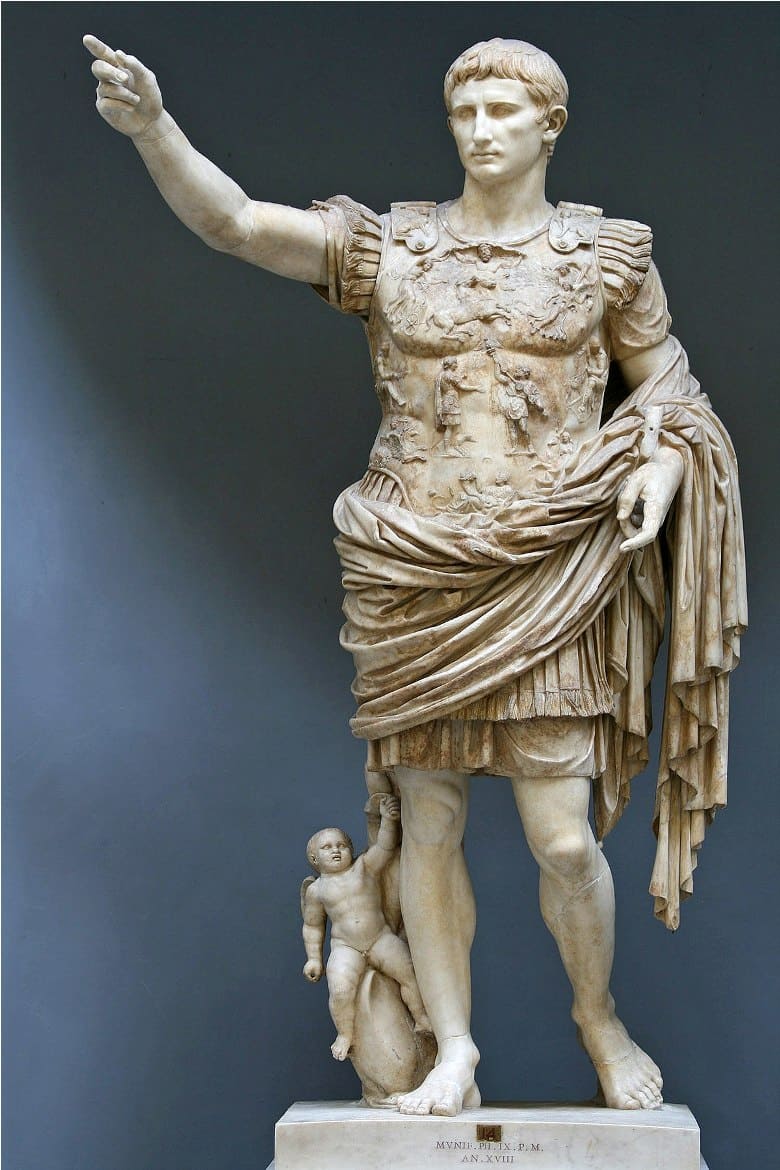
[This is the second of two articles about Gaius Octavius, and his rise from an underestimated teenager to Augustus, the Roman Empire’s first emperor. For Part I, click here]
After Julius Caesar’s assassination in 44 BC, his eighteen-year-old grandnephew, Gaius Octavius, set out on a dangerous course to secure his political future. All underestimated the teenager, but Octavius proved the doubters wrong, as he outmaneuvered everybody to secure supreme power in the western half of the Roman Republic, while his partner Mark Antony took charge of the eastern half. Below are some fascinating facts about Octavius’ further rise to sole ruler, his establishment of the Roman Empire, and how he went from Octavius to “Augustus”.
Octavius Made Himself the Roman World’s Sole Ruler

After they slaughtered the Roman conservative faction and broke its back for good, Octavius and Mark Antony next went to war against Julius Caesar’s assassins. They defeated them, and exacted revenge.In subsequent generations in the Roman Empire, what remained of the patrician class was gradually killed off. Patricians were caught up in or were falsely accused of conspiracies against various emperors, until they became virtually extinct. After they crushed their enemies, Octavius and Mark Antony swore friendship. To seal their power-sharing agreement, Antony married Octavius’ sister.
The duo then divided the Roman world. Antony was given the east, while Octavius stayed in Rome and ruled the west. However, they fell out when Antony fell in love with Cleopatra in Egypt, married her, and abandoned Octavius’ sister. The future emperor used that family insult as a pretext to attack Antony. He defeated his former ally in 31 BC at the Battle of Actium, and became Rome’s sole ruler. He then seized Egypt and the eastern provinces, which finally brought the entire Roman world under his control.
Replacing the Republic With an Empire

Octavius reorganized the state, and did away with the Roman Republic, whose political structure, created for a city-state, had proven impractical to govern a vast empire. The Republic’s frayed institutions had led to a century of chaos and bloodshed, until Octavius assumed sole power. In gratitude for his restoration of stability and ending generations of chaos, the Roman Senate granted Octavius the honorific title “Augustus”, by which he is commonly known. In place of the Republic, Augustus established the Roman Empire, with himself as its de facto dictator.
Roman elites had loathed Augustus’ uncle Julius Caesar because of the perception that he wanted to be king – a title and position abhorred by Romans. The Republic had a legal office of dictator, who had semi-absolute and semi-monarchical powers. However, a dictator’s term was limited to a maximum of six months. In 82 BC, Sulla got himself appointed dictator with no time limit on his office, but resigned the following year. By contrast, Julius Caesar had himself appointed dictator for ten years, then extended the term to life. That made Caesar king in all but name, so Rome’s conservatives did away with him. As seen below, Augustus heeded the lesson, and avoided his uncle’s mistake.
The Last Words of Augustus

The office of dictator was formally abolished after Caesar’s assassination. The Senate offered to revive the position in 23 BC to make Augustus dictator. Aware of his uncle’s fate, Augustus declined. However, he accepted the executive powers of a consul for life, as well as those of a tribune – whose person was theoretically inviolate. Thus, Augustus effectively assumed the powers of a dictator for life, without the title – an arrangement followed by his successors. The Roman Republic was replaced by the Roman Empire, with Augustus as dictator in fact but not in name.
The Empire was stable, autocratic, and a de facto monarchy. Its establishment initiated a period known as the Pax Romana, in which the Roman world enjoyed two centuries of peace and prosperity. Augustus held power from 43 BC, first in conjunction with Mark Antony until 31 BC, and thereafter alone until his death in 14 AD. As he lay on his deathbed, Augustus likened the role he had played as emperor to that of an actor in the theater. As he breathed his last, his final words to those gathered around were: “Have I played the part well? Then applaud as I exit”.

_________________
Some Sources & Further Reading
Eck, Werner – The Age of Augustus (2002)
Goldsworthy, Adrian – Augustus: First Emperor of Rome (2014)
Severy, Beth – Augustus and the Family at the Birth of the Roman Empire (2003)
Suetonius – The Lives of the Twelve Caesars: Augustus

