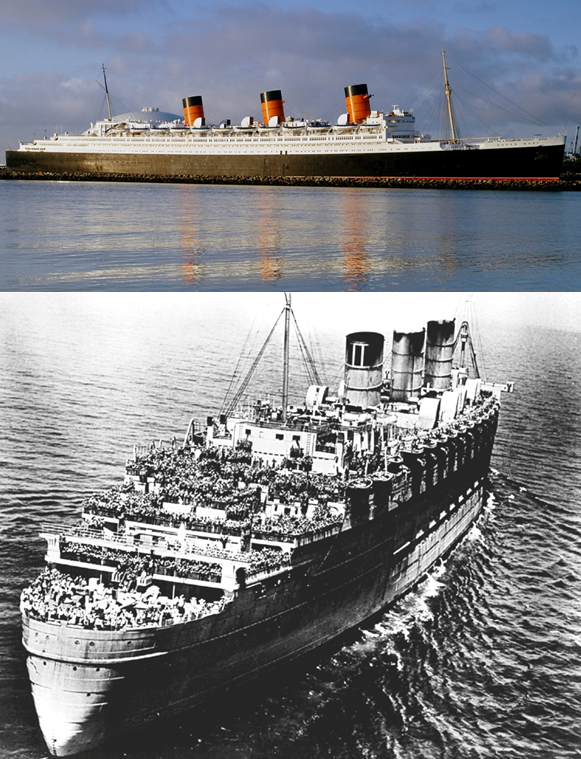
RMS Queen Mary, launched in 1934 and entering service in 1936, was one of the most luxurious transatlantic ocean liners ever built. Along with her sister ship, the RMS Queen Elizabeth, she represented the pride of the Cunard Line and the epitome of interwar British shipbuilding. However, when World War II broke out in September, 1939, Queen Mary’s glamorous civilian career was cut short. Within months, she was pressed into military service, and repainted in drab grey that earned her the nickname “The Grey Ghost”. Stripped of her luxury fittings, she was transformed into one of the war’s most important troop transports. Below are some interesting facts about that iconic ship’s wartime career.
An Engineering Marvel

RMS Queen Mary was an engineering marvel. She measured 1,019 feet from bow to stern, displaced over 80,000 tons, and could steam at more than 30 knots. She could carry more than 2,000 passengers in great comfort, plus a crew of over 1,000. That made her not only an icon of peacetime travel, but also a potential strategic asset in wartime. Indeed, she was designed with potential wartime use in mind. When war arrived, it found her mid-voyage in the Atlantic, steaming to New York. With the outbreak of hostilities, transatlantic shipping was immediately threatened by German U-boats, surface raiders, and aircraft.
The Queen Mary continued on to her destination with no small amount of trepidation. Two decades earlier, in World War I, an earlier Cunard Line passenger ship on a transatlantic crossing, the Lusitania, had been torpedoed and sunk by a German U-boat. More than one thousand passengers and crew lost their lives in that maritime disaster. There was a sigh of relief when Queen Mary arrived safely and docked in the Cunard Line’s berths in New York Harbor. There she remained for months, eventually joined by her sister ship the Queen Elizabeth, awaiting the British government’s decision on what to do with her.
The Transition from Peacetime to Wartime Service

The British Admiralty realized that the RMS Queen Mary, with her enormous capacity and unmatched speed, could outpace most threats and move massive numbers of troops across oceans. In March, 1940, she was requisitioned for government use. She had to be converted from a luxury liner intended to transport passengers in comfort, and into a troop transport, intended to cram the maximum number possible of military personnel into any available space. She was sent to Sydney, Australia, for a remake. There, her elegant furnishings, paintings, tapestries, more than six miles of carpeting, 220 cases of china, crystal, and silver sets, were removed and stored in warehouses. Her interiors were refitted with bunks and mess halls, while lounging chairs were removed from her upper decks, to be replaced with antiaircraft guns and lookout posts.
The Queen Mary was painted battleship grey, to make her less visible at sea. From then on, she became known as the “Grey Ghost”. The transformation was staggering. Instead of hosting a couple of thousand wealthy passengers, she could now carry up to 15,000 troops at once – far more than any other ship of the time. With wartime modifications, her maximum load reached over 16,000 troops and crew on a single voyage. It is a record for the most people carried on one ship that remains unbeaten to this day. To accommodate that many more passengers, toilets and bathrooms had to be expanded drastically, and so were the kitchens and galleys. No potential space into which troops could be crammed was left unused. Even her swimming pool was drained, and fitted out with bunks.
RMS Queen Mary Relied on Speed for Protection

To protect against magnetic mines, a degaussing cable was wrapped around the RMS Queen Mary’s hull. Convoys, the usual method of protection for slower merchant ships, were not necessary. Instead, she steamed across the oceans independently, zig-zagging to make herself a harder target. She was only escorted by warships when traversing especially dangerous waters. High speed was her greatest defense against the greatest threat faced by merchantmen in the Atlantic: German submarines. U-boats, which typically cruised at around 17 knots on the surface and much slower underwater, could not keep pace. Even if submarines sighted her, she could simply outrun them – which is exactly what she did on May 25th, 1944.
That day, U-853 spotted the Queen Mary and maneuvered to attack her. The fast liner simply outran the German submarine before it could launch a torpedo. Protected by technology from magnetic mines, and by speed from submarines, the Queen Mary ferried British and Allied forces across the Atlantic, carried Australian and New Zealand divisions to the Middle East, and later became vital in transporting American forces after the United States entered the war in December, 1941. From 1940 to 1946, she repeatedly circumnavigated the globe, transporting troops to Europe, the Middle East, Africa, and the Pacific. Her sister ship, Queen Elizabeth, performed similar duties, and the two liners became vital to rapid Allied manpower movements.
RMS Queen Mary “Shortened the War by at Least a Year”

The RMS Queen Mary carried Australian soldiers from Sydney to Suez. She mostly traveled alone, and was escorted by warships only in dangerous waters. On return trips, she often carried prisoners of war, wounded soldiers, or evacuees. Her speed allowed her to cross the Atlantic in just four days. That made her indispensable for building up Allied forces in Britain in preparation for the eventual invasion of Nazi-occupied Europe. Winston Churchill himself recognized her value. He later wrote that the Queen Mary and Queen Elizabeth, by moving the equivalent of entire armies more quickly and safely than any other ships, “shortened the war by at least a year”.
Conditions on board were a far cry from the Queen Mary’s prewar luxury and glamour. Her staterooms were filled with rows of bunks stacked three or four high. Soldiers crowded into mess halls where meals were served in shifts around the clock. Ventilation was poor, and in tropical waters the heat was suffocating. Sanitary conditions were basic, and seasickness was common. Despite these hardships, morale during voyages was often high. Soldiers knew that traveling on Queen Mary meant a fast and relatively safe passage compared to slower, more vulnerable troopships. Entertainment was improvised, with music, cards, and camaraderie filling the long days at sea.
Queen Mary’s Most Tragic Voyage

Many of the RMS Queen Mary’s prewar crew from her luxury liner days continued on and adapted to her new military role. Naval gunners were stationed on deck, anti-aircraft weapons were installed, and blackout conditions were enforced at night to avoid enemy detection. She did not escape tragedy during the war, however, and one of the most tragic incidents in Queen Mary’s wartime service occurred on October 2nd, 1942. While carrying 10,000 American troops to Britain, she was escorted by the Royal Navy cruiser HMS Curacoa off the coast of Ireland.
As Queen Mary zig-zagged to avoid submarines, a fatal miscalculation led to a collision. The massive liner, which displaced more than 80,000 tons, sliced through the smaller, 4,200-ton cruiser. The Curacoa was cut in two, and sank within minutes. Because of the ever-present threat of enemy submarines, the Queen Mary was under strict orders to never stop, no matter what. Not even to help pick up survivors. So she steamed on with her human cargo. Of the Curacoa’s crew of 430, only 99 survived. The incident was a sobering reminder of the risks in even supposedly safe waters. The tragedy was kept secret during the war to maintain morale.
A Versatile Ship

RMS Queen Mary was not only a fast troopship, but also a fast transport for high-profile passengers. Winston Churchill traveled on her several times, including voyages to meet Franklin D. Roosevelt and other Allied leaders. On board, Churchill used her staterooms as offices and conference rooms. For security reasons, his presence was kept secret until after the voyages. The ship also carried entertainers, medical personnel, and Red Cross workers, all of whom contributed to the morale of the troops she ferried across the oceans. As the Allies prepared for the D-Day invasion, Queen Mary brought tens of thousands of American soldiers to Britain. Her massive capacity meant that entire divisions could be moved at once, speeding up the manpower buildup for Operation Overlord.
After D-Day, Queen Mary continued to transport troops, reinforcements, and supplies, as well as ferry wounded soldiers back across the Atlantic for treatment. Toward the end of the war, she shifted to transporting troops to the Pacific theater. With the end of the war in Europe in May, 1945, and Japan’s surrender in August, her military role shifted again. She was now employed in the repatriation of soldiers, sailors, and airmen back to their homelands. Queen Mary played a prominent role in Operation Magic Carpet, the vast program to return American servicemen home from Europe. She also carried thousands of war brides – women who had married Allied servicemen – to new lives in the United States and Canada.
The Legacy of Queen Mary’s Wartime Career

By 1946, RMS Queen Mary’s military service was complete. So she returned to the Clyde shipyards in Scotland to be refitted as a luxury liner once more. Her wartime grey paint was stripped, her interiors restored, and she reentered civilian service in 1947. Her wartime service had been extraordinary. She carried more than 800,000 troops during the conflict, sailed more than 600,000 miles, and made significant contributions to the logistics of Allied victory. Her ability to move entire divisions in a single voyage, while being nearly invulnerable to submarine attack, made her unique among the world’s ships. Her story also illustrates the adaptability of civilian items in wartime: a ship built for luxury became a weapon of logistics.
For many veterans, the memory of steaming aboard the “Grey Ghost” was a defining moment of their wartime experience. During the war, Queen Mary transitioned from a glamorous icon of peacetime travel to one of history’s most valuable troopships. Her enormous capacity, unmatched speed, and global operations allowed her to transport hundreds of thousands of troops safely across dangerous seas. Despite tragedies like the collision with HMS Curacoa, she earned a reputation for reliability and safety. Today, preserved as a museum ship in Long Beach, California, RMS Queen Mary stands as a reminder not only of the golden age of ocean liners but also of the crucial role such ships played in securing Allied victory in World War II.

_________________
Some Sources & Further Reading
Britton, Andrew – RMS Queen Mary (2012)
Ellery, David – RMS Queen Mary: The World’s Favorite Liner (2023)
Duncan, William J. – RMS Queen Mary: Queen of the Queens (1969)

