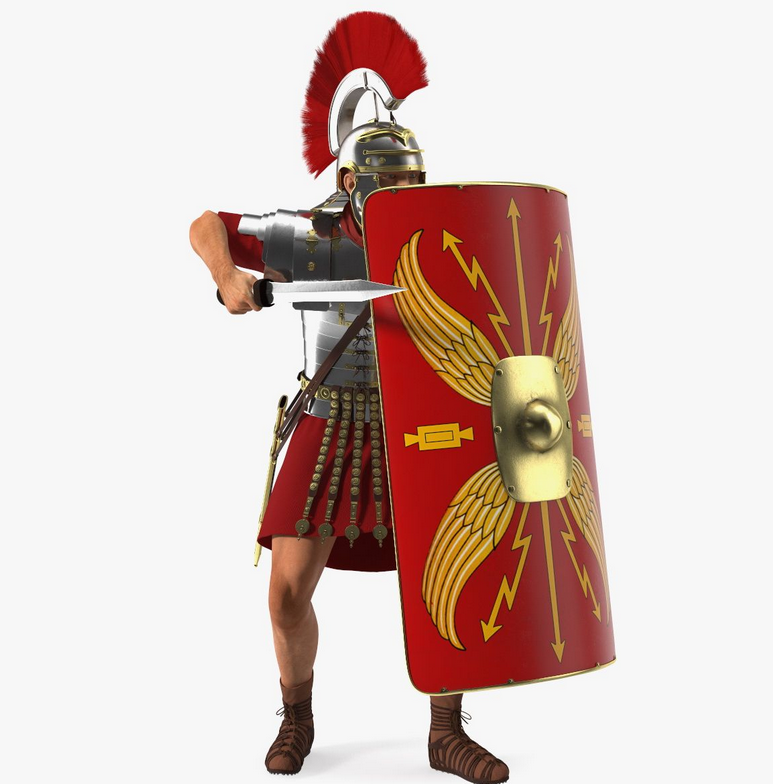
Throughout most of history, and especially in the ancient world, most sword designs prioritized reach and the ability to cut and slash. The Romans went a different route. They adopted the gladius, a short straight sword that was intended first and foremost for stabbing.
The Hispanic Origins of the Roman Gladius

In the third century BC’s Punic Wars, the Romans faced Celtiberians who were armed with a short sword that could both cut and thrust – but that was really good at the thrusting part – and were impressed. So they copied it, with slight modifications, to come up with the gladius. Specifically, the gladius hispaniensis, in reference to the Celtiberians’ homeland of Hispania. The short gladius became the primary weapon of the Roman legions for the next five hundred or so years. It was not until the third century AD, that the gladius finally gave way to another sword, the spatha, as the Romans’ standard weapon.
The gladius was thus the primary weapon with which the Romans conquered their empire, won their greatest victories, pushed their boundaries to their furthest extent, and brought ancient Rome to the zenith of its power. There were various versions of the gladius, but all gladii shared some common characteristics. Gladii were doubled edged straight steel swords. Their blades typically around two feet, and tapered into a ‘V’ shaped tip. Gladii were used primarily as close quarter combat thrusting weapons. They could be used to cut and slash as well, but stabbing was their thing. The handle was typically ridged for the user’s fingers or knobbed for a solid grip. A significant feature that distinguished the gladius, its successor the spatha, and their immediate descendants well into the Middle Ages, was the absence of a cross guard.
The Gladius in the Legionary’s Hand

The gladius was typically carried in a scabbard that was attached to a belt on the legionary’s right hip. In combat, the legionary, his torso armored and his head protected by a helmet, carried a long shield, the scutum. The Roman shield was initially oval, but later became rectangular and featured a pronounced curve. Held in the left hand, it covered most of the legionary’s body from his shins to his chin. In his right hand, the legionary held his gladius in an underhanded grip, its tip projecting from the right side of his shield at waist level. From that stance, the legionary strove to stab his gladius into his adversary’s abdomen or chest. He could also thrust above the shield’s upper rim into the enemy’s face or neck.
Both the gladius’ design and the Roman legionary’s training prioritized thrusting. However, if the opportunity presented itself, the legionary could also slash at the opponent’s knees or legs, or hamstring him with a drawing cut. The gladius’ relatively short blade was an advantage in close quarters combat, because it allowed the legionary to step inside his enemy’s guard and thrust at speed in any direction from which his foe was vulnerable. That would have been more awkward with a longer sword, which would have required more space between the parties for optimal thrusting.

_________________
Some Sources & Further Reading
Goldsworthy, Adrian – The Complete Roman Army (2003)
History Halls – The Ancient Greek Xiphos: The Spartans’ Favorite Sword
My Armory – The History and Development of the Roman Gladius

